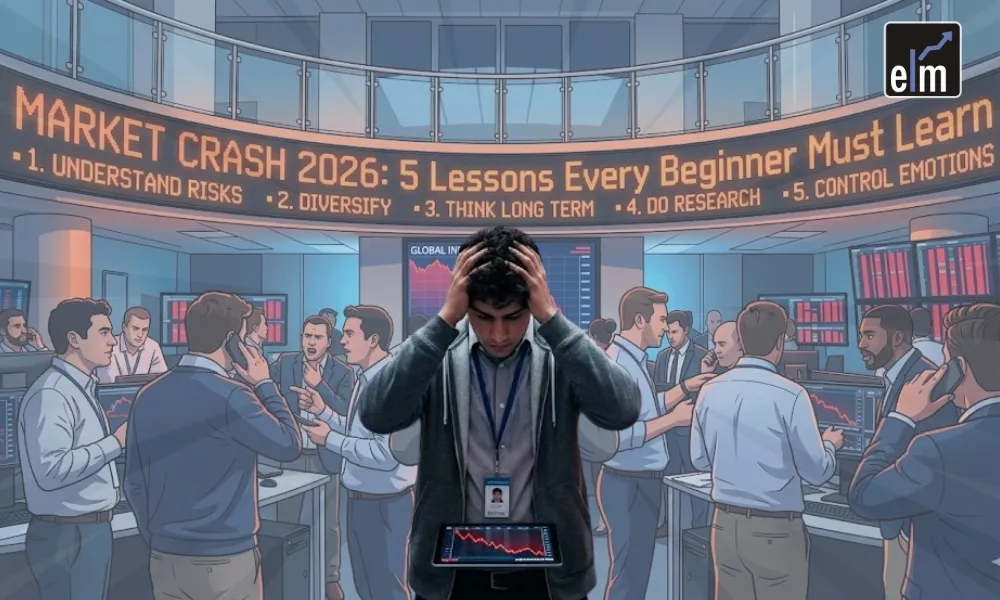

The stock market operates independently of your emotional state. The world experienced a market decline of over 11% within days of rising geopolitical tensions and an unexpected oil crisis in April 2026. All investors' investment accounts showed losses. Social media platforms display widespread anxiety among users. In a state of panic, the novice traders sold their investments.
The position where they made their greatest errors exists at this point.
The experienced investors possess the knowledge that proves that most beginners lose their money through unexpected market crashes. The market crash causes them to lose money through their responses to the situation. The market correction presents five essential lessons that new investors must learn at this moment.
Lesson 1: Market Corrections Are a Normal Part of Investing
Market corrections occur when prices decline by 10% or more, approximately every one to two years. The 2020 COVID crash wiped out more than 30% of market value within several weeks. The 2008 financial crisis cut markets in half. The market found a way to recover from all previous downturns and reached new highs.
Investors should not view market corrections as signals for broken investment systems. The process operates according to standard market procedures. The market reacts to fresh data, which includes oil price shocks, geopolitical conflicts, and changes in interest rates. Investors must first understand the investment cycle before developing their long-term investment approach.
Lesson 2: Risk Management Is Not Optional
The primary rule of investing states that you should only invest funds that you can afford to lose during the upcoming months. The 2026 correction saw many beginners who had invested all their savings into one stock or sector. The situation left them without any protection when prices dropped.
Investors must practice proper risk management methods that require them to distribute their funds into multiple asset categories through diversification and maintain an emergency fund that exists outside their investment portfolio, while they must avoid using any funds that they need to repay as investment capital. Investors should also consider the impact of position sizing on their investment decisions. The market will cause significant losses when your investment reaches 80% of your portfolio. The same drop becomes easy to handle because your investment only represents 10% of your portfolio.
Organisations need to manage their risks because they want to protect their assets from potential losses. The purpose of this system is to minimize losses without making complete loss avoidance a goal.
Lesson 3: Panic Selling Is the Most Expensive Mistake
Retail investors sold their positions at the market's lowest point during the April 2026 crash, which resulted in permanent loss of their investments. A few weeks later, markets began recovering. Investors who maintained their investments during that period experienced portfolio growth. The investors who sold their assets stayed outside the market for an indefinite period because they could not decide when to buy back into stocks.
The term "panic selling" describes this phenomenon. The behaviour exists because fear dominates people who experience this particular behavioural finance mistake, which researchers have extensively studied. The emotional drive to stop financial losses appears logical to people who experience it. Professional traders face extreme difficulty in achieving successful market timing because it represents an almost impossible task to accomplish.
The data shows a definite conclusion. Long-term returns will decrease by over 50% if investors miss the 10 best trading days that occur over 10 years.
Lesson 4: How Professional Investors Handle a Crash
The beginners who sold their assets in April 2026 made different trading decisions than institutional investors and experienced traders. The investors in this market purchased assets.
Market crashes serve as buying opportunities for professional investors. The investors maintain their investment approach while they adjust their investment holdings and search for high-quality assets that have experienced a price decline but maintain their long-term worth.
They avoid the 24-hour news cycle during economic downturns. Financial news, which airs continuously, seeks to create emotional reactions in its viewers. The professionals ignore market disturbances and concentrate on essential data, which includes company revenue, financial reserves, future development possibilities, and national economic patterns.
A beginner needs to establish a trading strategy before a market crash occurs, and he should execute this plan throughout the crash.
Lesson 5: A Market Crash Is a Learning Opportunity
The best investment education does not come from books. It comes from experience. Every crash teaches you something about yourself as an investor: how much risk you can truly tolerate, whether your portfolio is built for the long term, and whether your financial goals are realistic.
Use the April 2026 correction as a reference point. Ask yourself, did you panic? Did you have a plan? Was your portfolio too concentrated? The answers will help you build a stronger strategy going forward.
Beginners who treat crashes as tuition rather than disaster come out ahead in the long run.
Final Thought
The market crash that occurred in April 2026 represents both the first market crash that has taken place and the final market crash that will ever happen. Every generation of investors faces its defining correction. The ones who survive and grow are not the ones who predicted it. The successful individuals maintained their composure while executing their established procedures because they recognised that immediate discomfort would lead to future benefits.
Crashes do not destroy wealth. Panic does.
You should begin your financial education by learning these fundamental concepts, which include portfolio diversification and risk management, and maintaining a long-term investment strategy while making financial decisions without being influenced by fear. The guidance that you receive during a crisis actually serves as the essential principle that underpins effective investment strategies.




























Sign in to leave a comment.