

If you have ever tried to meditate and spent the whole time fighting your own thoughts, you are not alone. Most beginners hit the same wall — you sit down, close your eyes, and suddenly your brain decides it is the perfect time to remember every awkward thing you said in 2014.
That is exactly where tuning forks come in.
Tuning fork meditation gives your mind something real to hold onto — a sound you can hear and a vibration you can actually feel. It is one of the most underrated tools for people who struggle with traditional silent meditation, and once you understand how it works, it is surprisingly simple to get started.
What Is a Tuning Fork and Why Does It Work?
A tuning fork is a two-pronged metal instrument that produces a single, pure frequency when struck. Unlike music or ambient sounds, it creates what is called a sine wave — one clean, stable tone with very few overtones. That purity is exactly what makes it so effective for meditation.
When you bring a vibrating tuning fork near your body or place it on certain points, your nervous system responds to both the sound and the physical vibration. Some practitioners point to a concept called brainwave entrainment, where the brain's electrical activity tends to sync with a rhythmic external stimulus. In simple terms, the fork helps pull your mind away from the busy Beta state — the anxious, overthinking mode most of us live in — and nudge it toward Alpha and Theta states, which are associated with deep relaxation and calm focus.
Types of Tuning Forks for Meditation
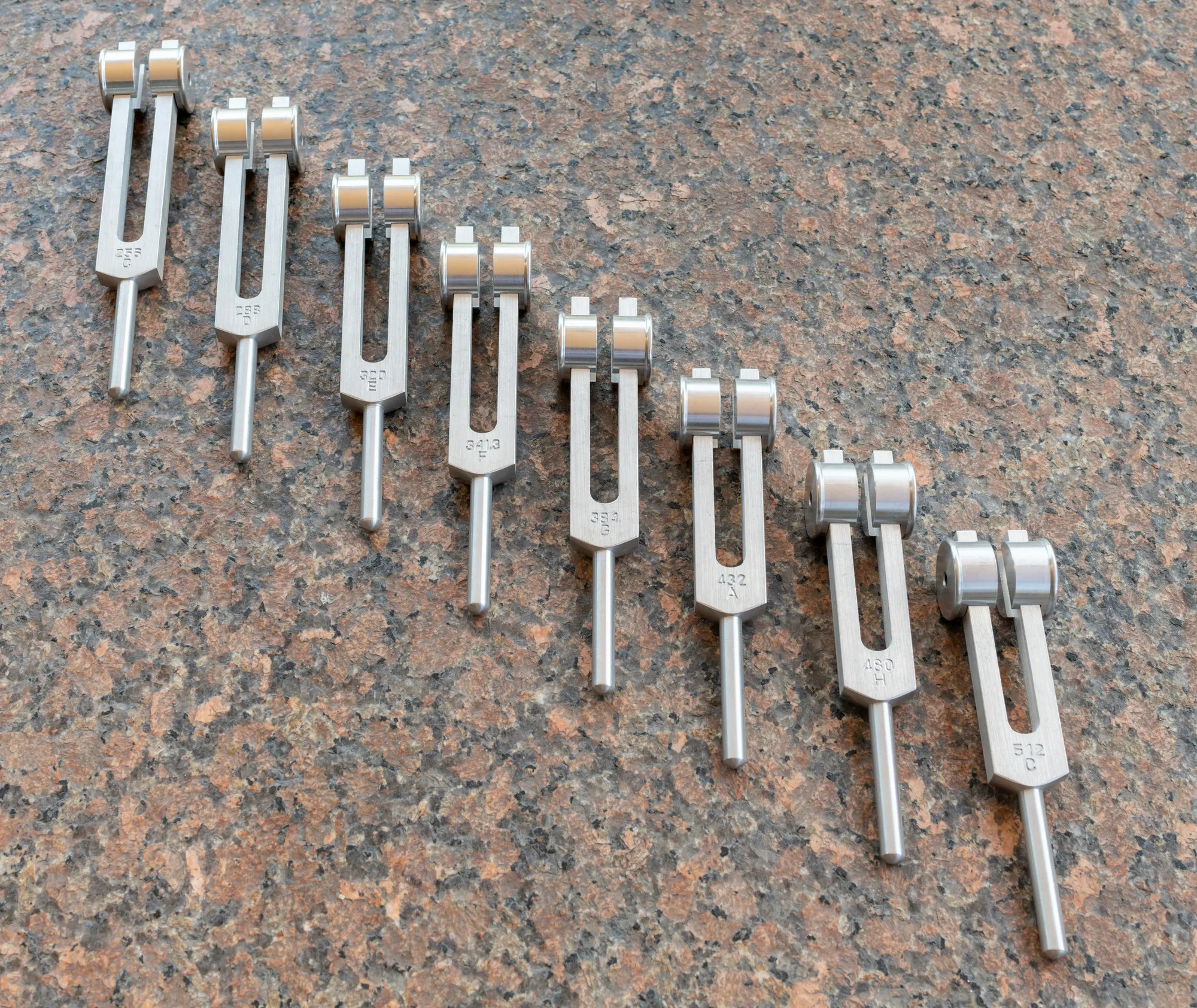
Not all tuning forks are the same. Here is a simple breakdown of what you will come across as a beginner:
Weighted tuning forks have a small weight at the end of each prong. They produce a stronger vibration and are designed to be placed directly on the body. Great for physical relaxation and grounding.
Unweighted tuning forks produce a lighter, more airy tone. They work best held near the ears or used to fill a room with sound, making them ideal for sound baths.
Chakra tuning forks come as a set of seven, each tuned to a frequency that corresponds to one of the body's main energy centers. A popular starting point for beginners who want a structured system.
Solfeggio tuning forks use a set of ancient frequencies believed to carry specific healing properties. The 528 Hz fork is often called the love frequency, while 396 Hz is associated with releasing fear and guilt.
Planetary tuning forks are tuned to frequencies mathematically linked to celestial bodies. The Earth frequency at 136.1 Hz is one of the most commonly used for grounded, peaceful meditation.
Which Frequency Should You Start With?
128 Hz is an excellent starting point. It is grounding, stable, and easy for the body to absorb. Many people feel an immediate sense of calm when using it.
136.1 Hz, also known as the OM frequency, is deeply connected to emotional balance and heart coherence. If you tend to carry stress in your chest or feel emotionally overwhelmed, this one is worth trying.
528 Hz is popular for mental clarity and is often recommended for people dealing with anxiety or mental fog.
If you are just starting out, a single 128 Hz or 136.1 Hz weighted fork is all you need. I actually came across a helpful breakdown of these frequencies on purefrequencies while researching this topic — worth bookmarking if you want to go deeper into the science behind each one.
How to Use a Tuning Fork for Meditation: Step by Step
Step 1: Set up your space
Find a quiet spot where you will not be interrupted for at least 15 to 20 minutes. Sit comfortably with your spine relatively upright.
Step 2: Clear your space with sound
Before sitting down, strike your tuning fork and slowly walk around the room, letting the tone ring into corners and along walls. This simple ritual helps signal to your mind that it is time to shift gears.
Step 3: Strike the fork gently
Use a rubber mallet or activator to tap the fork. Never strike it against a hard surface — this can damage the fork and creates a harsher tone.
Step 4: Listen first
Bring the tines about two inches from your ear and simply listen. Follow the sound as it fades. This is your anchor. When your mind wanders, the sound brings you back.
Step 5: Apply to the body
If you are using a weighted fork, gently place the stem on areas like the sternum, the top of your head, or along the spine. Many people find that placing it on the sternum creates an immediate sensation of settling and calm.
Step 6: Repeat and rest
Strike the fork again whenever the tone fades. After several rounds, sit in the silence that follows. That quiet after the sound is often where the deepest meditation happens.
Common Mistakes Beginners Make
Striking too hard. A gentle tap is all it takes. Striking hard just creates unwanted overtones.
Expecting instant results. Like any practice, this deepens with repetition. Give yourself at least a week before deciding whether it works for you.
Buying an expensive set right away. Start with one fork. One good quality fork at the right frequency will teach you more than seven forks used randomly.
Holding the fork wrong. Hold it by the stem, not the prongs. Touching the prongs immediately dampens the vibration.
Final Thoughts
Meditation does not have to be a battle between you and your own thoughts. Tuning forks offer a different entry point — one that works with your senses rather than against them. The sound gives you something to follow, the vibration gives you something to feel, and slowly, the mental noise has less room to dominate.
Start simple. One fork, one frequency, fifteen minutes. That is genuinely all it takes to begin.
































Sign in to leave a comment.