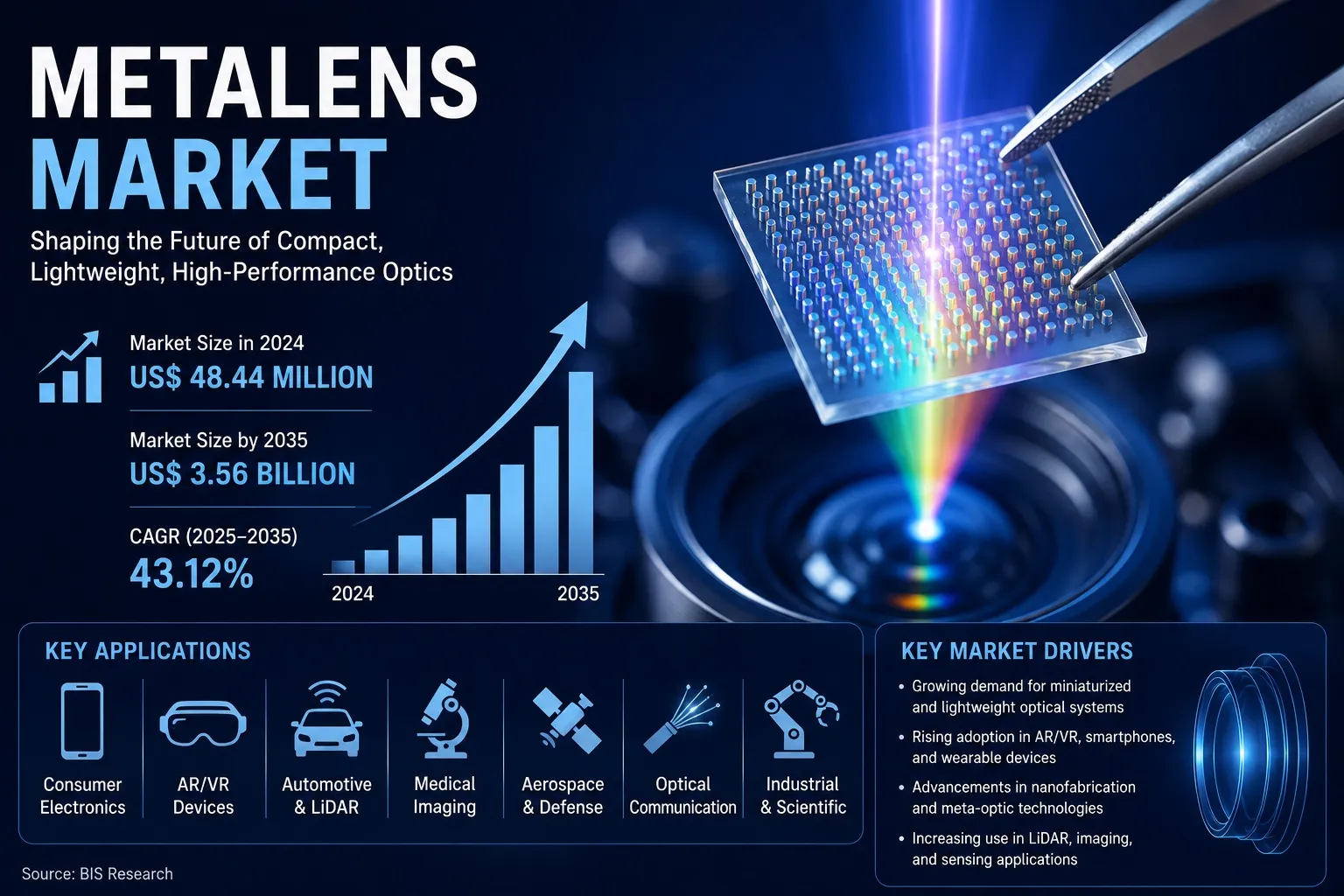

The global metalens market is witnessing rapid expansion due to the increasing demand for compact, lightweight, and high-performance optical components across industries such as consumer electronics, healthcare, automotive, and aerospace. Metalenses use nanostructured surfaces to manipulate light more efficiently than traditional curved lenses, enabling thinner and more advanced optical systems.
According to BIS Research, the Metalens market was valued at nearly $48.44 million in 2024 and is projected to reach approximately $3.56 billion by 2035, growing at a CAGR of 43.12%.
What Are the Key Drivers of the Metalens Market?
- Growing Demand for Compact Optical Devices: The increasing use of slim and lightweight devices such as smartphones, AR/VR headsets, and wearable electronics is driving the adoption of metalenses due to their ultra-thin structure and high optical efficiency.
- Expansion of AR/VR and Mixed Reality Technologies: Rising investments in augmented reality and virtual reality applications are boosting demand for advanced optics that can improve image quality while reducing device size and weight.
- Advancements in Nanofabrication Technologies: Improvements in nano-imprint lithography and semiconductor-compatible manufacturing processes are enabling scalable and cost-effective production of metalenses.
- Increasing Adoption in Automotive and Healthcare Sectors: Metalenses are gaining traction in LiDAR systems, medical imaging, and optical sensing applications because of their ability to deliver precise light control and compact integration.
Why Did Consumer Electronics Dominate the Metalens Market?
Consumer electronics emerged as the leading end-use segment in the metalens market in 2024, driven by rising adoption in smartphones, AR/VR devices, camera modules, and depth-sensing systems. Manufacturers are increasingly using metalenses to achieve slimmer designs, enhanced imaging performance, and advanced sensing capabilities. Strong production volumes, rapid innovation cycles, and the growing focus on miniaturization are expected to keep consumer electronics at the forefront of market growth.
Request A Sample for Metalens Market - Focus on Application, Product, and Regional Analysis and Forecast, 2025-2035
What are the Key Trends in the Metalens Market?
- Development of Broadband Achromatic Metalenses: Companies and research institutions are focusing on metalenses that can efficiently manipulate multiple wavelengths of light, reducing chromatic aberration and improving imaging quality.
- Integration with CMOS and Photonic Chips: Metalenses are increasingly being integrated into semiconductor-based optical systems to support advanced sensing, imaging, and communication technologies.
- Rising Use in Consumer Electronics: Smartphone manufacturers and wearable device companies are exploring metalens technology to replace traditional multi-lens camera systems with thinner alternatives.
- Growing Research in Meta-Optics and Nanophotonics: Increased R&D investments in metasurface technologies are accelerating innovation and expanding the commercial applications of metalenses across industries.
Why is Europe Leading the Metalens Market in 2024?
Europe holds the largest share of the metalens market in 2024, supported by its strong expertise in photonics research, precision optics, and early adoption of advanced optical technologies. Demand is growing across automotive LiDAR, aerospace, scientific imaging, and industrial instrumentation applications. Strong public funding, research partnerships, and a well-established ecosystem of optics manufacturers and photonics institutes continue to strengthen Europe’s leadership in high-value metalens applications.
What Challenges and Opportunities Exist in the Metalens Market?
Manufacturing metalenses requires nanoscale precision, making fabrication highly complex and expensive. Yield consistency, scalability, and integration into existing optical systems remain significant barriers for large-scale commercialization. Additionally, the absence of universal standards for meta-optic testing and qualification slows adoption in regulated industries such as healthcare and automotive.
However, these challenges also create opportunities for innovation. Companies investing in advanced lithography techniques, scalable fabrication methods, and AI-driven optical design are likely to gain a competitive advantage. The growing adoption of autonomous vehicles, smart sensors, medical diagnostics, and immersive display technologies is expected to create long-term demand for next-generation optical solutions.
Click Here to Download the ToC
Conclusion
The future of the metalens market appears highly promising as industries continue to prioritize miniaturization, energy efficiency, and enhanced optical performance. Rising investments in nanophotonics, metasurface technologies, and semiconductor-integrated optics are expected to accelerate commercialization over the next decade. As manufacturing processes mature and production costs decline, metalenses are likely to become a mainstream optical solution across consumer electronics, automotive sensing, healthcare imaging, and aerospace applications.


























Sign in to leave a comment.