
When do you actually need MongoDB consulting support?
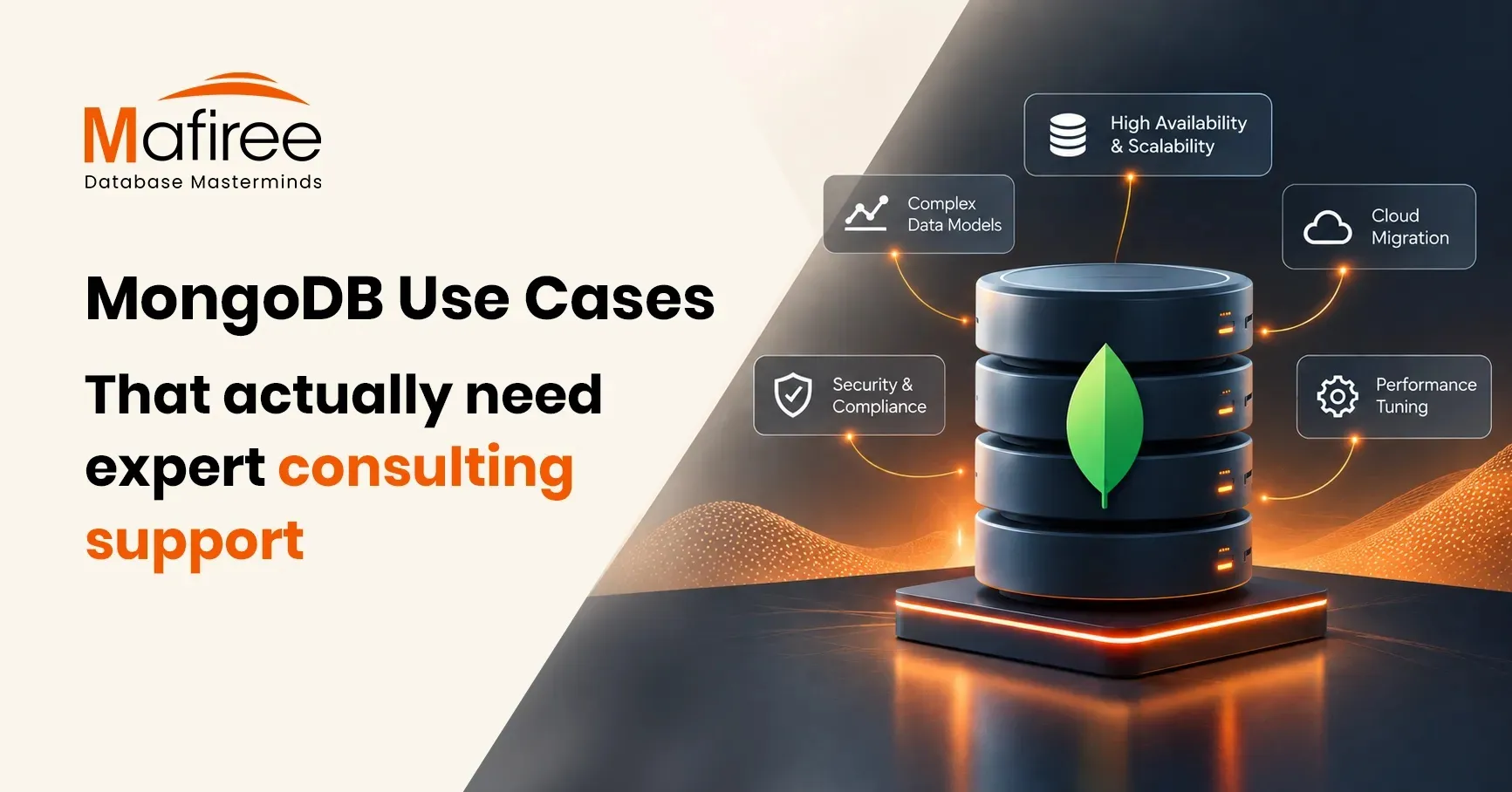
MongoDB doesn’t automatically need a consultant. Expert help pays off when decisions involve significant scale, production performance, migration risk, availability requirements, or security and compliance constraints. Five MongoDB use cases benefit most: schema design, large-scale migration, performance optimization, high availability and disaster recovery, and production security and compliance.
When do you actually need a consultant?
- Schema design: complex relationships, growing documents, inconsistent access patterns. Work: data modeling, embed-versus-reference decisions, schema review.
- Migration: large datasets, downtime limits, legacy dependencies. Work: migration architecture, testing, cutover planning.
- Performance: slow queries, resource pressure, indexing problems. Work: profiling, query tuning, index optimization.
- High availability/disaster recovery: strict uptime, RPO, or RTO needs. Work: replica-set architecture, failover, backup and restore planning.
- Security/compliance: sensitive data, regulations, production exposure. Work: access controls, encryption, auditing, compliance assessment.
Why expert support matters
MongoDB’s document model is flexible, but that brings pitfalls such as inefficient schemas, poor query performance, and inadequate backup strategies. A skilled Mafiree expert uses MongoDB’s strengths while reducing these risks across architecture, performance, migration, and production.
Key MongoDB use cases requiring expert consulting
1. Complex data modeling and schema design
Routine design is usually manageable internally, but expert input helps when a model must serve multiple teams, evolving access patterns, or large production datasets. Symptoms include queries slowing as collections grow, teams disagreeing on structure, and uncertainty about embedding versus referencing. Design should begin with application access patterns, not a copied relational schema, and embedded documents, arrays, and references need careful planning. Consultants review access patterns and growth projections, producing a model that avoids post-launch rework.
2. High-volume data migration strategies
Small migrations with flexible downtime are manageable in-house, while large datasets, tight downtime, and legacy dependencies raise risk. Symptoms include unknown duration, no rollback plan, and integrity worries. Downtime and integrity problems can derail a migration, so planning and testing matter. Help is valuable with near-zero downtime, cutover dependencies, rollback needs, or hard deadlines. Consultants tailor a strategy including testing and cutover planning, so data moves without unplanned downtime or loss.
3. Performance optimization at scale
Occasional slow queries often need only a quick index, but recurring or unpredictable problems at scale warrant diagnosis. Symptoms include slow queries, memory pressure, and inefficient indexing. Causes are rarely clear from dashboards and may involve query patterns, index design, sharding, or all three. Mafiree runs deep diagnostics and applies query tuning, index management, schema improvements, and sharding strategies, with a case study showing reduced latency. The outcome is faster, more predictable performance.
4. High availability and disaster recovery planning
Basic replica sets can be set up internally, but strict uptime, RPO, or RTO requirements make misconfiguration a real business risk. Symptoms include uncertainty about failover, untested backups, and SLAs not mapped to the architecture. Mistakes can cause data loss or outages. Help is valuable when restores are unproven, infrastructure spans regions, or a past incident exposed gaps. Mafiree designs resilient architectures that meet SLAs with low overhead, including ongoing administration, aiming for a system tested to fail gracefully.
5. Security and compliance in production environments
Basic access controls are usually manageable internally, but regulated data raises the stakes. Symptoms include unclear access-control ownership, inconsistent encryption, and audit logging that wouldn’t pass review. Securing MongoDB involves access controls, encryption at rest and in transit, audit logging, and standards like GDPR or HIPAA. Mafiree provides security assessments and best practices that protect data without hurting performance, plus ongoing security and maintenance. The result satisfies regulators and auditors without slowing the application.
DIY vs. expert review: a quick framework
Basic CRUD applications and simple schemas can be done in-house, with expert review optional. Complex multi-document relationships, large migrations, persistent production performance issues, regulated workloads, and major sharding decisions call for caution, with review recommended. Strict RPO/RTO requirements and minimal-downtime production migrations make expert review strongly recommended.
Mafiree’s approach to MongoDB consulting
Mafiree brings deep expertise in MongoDB architecture, deployment, and optimization. Its consultants work closely with your team to deliver tailored solutions aligned with business goals, including complex operations like transaction handling.
Conclusion
MongoDB use cases vary widely, and not all are simple. Whether building new or optimizing existing systems, expert guidance helps keep deployments efficient, scalable, and secure.


















Sign in to leave a comment.