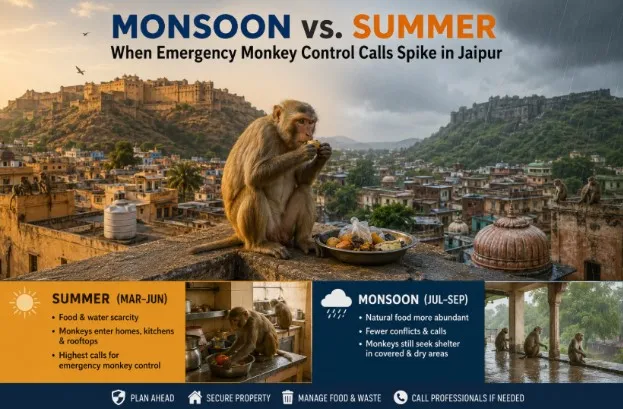

Anyone who has lived in Jaipur for a few years notices a pattern: monkey trouble doesn't stay constant through the year. Some months bring a steady trickle of complaints. Others bring a flood of calls for emergency monkey control, as troops move closer to homes, kitchens, and rooftops in search of food. Understanding why this happens — and when it happens — helps residents, housing societies, and businesses plan instead of reacting in a panic.
Why Monkey Conflict Isn't Constant Through the Year
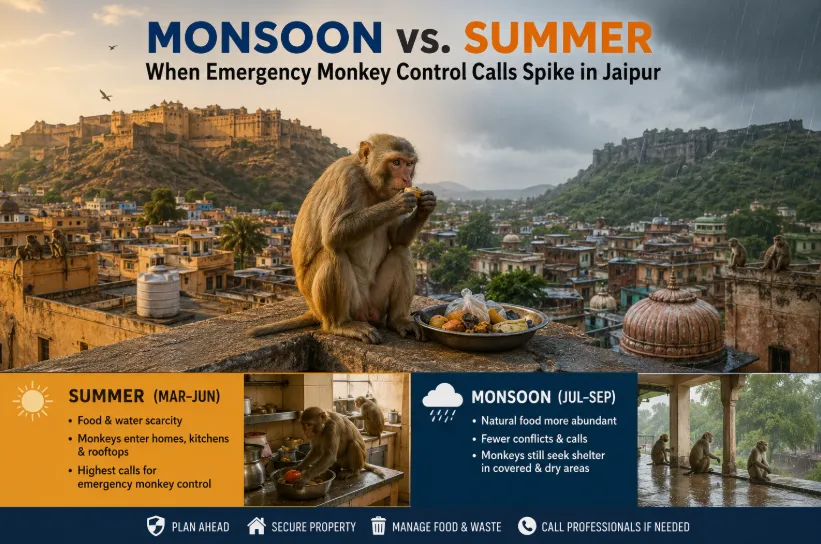
Rhesus macaques, the species responsible for most urban monkey conflict across North India, including Jaipur, are highly adaptable foragers. In their natural forest habitat, food availability shifts sharply with the seasons — fruiting trees, insects, and vegetation are abundant at some times of year and scarce at others. When the natural food supply drops, troops range farther into human settlements because gardens, kitchens, temple offerings, and garbage are a far more reliable food source than a forest under seasonal stress. This single behavioural driver — food scarcity pushing troops toward human areas — is the main reason monkey-related calls for residential and commercial monkey control rise and fall throughout the year rather than staying flat.
What the Research Shows
A peer-reviewed study on human-macaque conflict conducted around the Asola-Bhatti Wildlife Sanctuary in Delhi NCR — a comparable North Indian urban environment with the same macaque species and a similar climate pattern to Jaipur — recorded conflict incidents across all four seasons over a full year. The findings were striking: summer months (March–June) accounted for over a third of all conflict cases, followed by post-monsoon (September–November), while the monsoon period itself saw the lowest share of incidents.
The same research also found something worth noting for anyone managing risk on a property or campus: it wasn't the severity of individual attacks that stood out, but how consistently macaques had come to depend on human food sources overall. In other words, the conflict isn't driven by aggressive animals — it's driven by food availability and habituation.
Jaipur shares the same species, a comparable semi-arid climate, and the same underlying pattern of temples, markets, and residential colonies offering easy food access. While city-specific published data for Jaipur isn't publicly available in the way the Delhi NCR study is, the ecological drivers are the same, which is why the seasonal pattern is a useful planning reference for residents and businesses here too.
Jaipur's Hospital Data Overview
This isn't only a regional pattern — Jaipur has its own documented numbers, and they stand out nationally. A study conducted at Sawai Man Singh (SMS) Hospital, Jaipur's largest tertiary care and government referral hospital, examined 328 animal bite victims attending the anti-rabies clinic.
The results: dogs were responsible for the large majority of bites, while monkeys accounted for roughly one in five cases — a share far higher than the 2–7% typically reported in similar hospital studies from other Indian cities. The same study found that over 90% of these cases were classified as Category III exposures, the most severe WHO bite category, generally involving broken skin, bleeding, or multiple wounds, meaning most victims required full post-exposure treatment rather than just observation. Researchers linked Jaipur's unusually high monkey-bite share partly to its status as a major tourist destination, where visitors are more likely to approach or feed monkeys near forts, temples, and heritage sites.
The same data showed a demographic pattern worth knowing if you manage a property or public space: nearly three-quarters of victims were male, over a third fell in the 5–18 age group, and the majority were bitten on the lower limbs — consistent with people being caught off guard at ground level rather than deliberately provoking an animal.
Separately, a multi-year time-series analysis of SMS Hospital's anti-rabies clinic records spanning 2010–2019 (covering all animal bite types, of which dog bites make up the large majority) found that the monthly index of bite cases ran high from December through June and dropped from July through November — broadly consistent with the summer-peak, monsoon-relief pattern seen in wider macaque-conflict research from other North Indian cities, such as a Delhi NCR study on human-macaque conflict, which recorded the highest share of conflict incidents in summer (March–June) and the lowest during the monsoon (July–September).
Taken together, this gives Jaipur two things most cities in this space don't have written down anywhere: a documented, unusually high share of monkey bites relative to other Indian cities, and a broadly consistent seasonal curve pointing to the winter–summer stretch as the higher-risk window.
Why Summer Sees the Sharpest Spike
Summer in Jaipur combines two pressures at once:
- Natural food scarcity — the hottest, driest months reduce the availability of wild fruit, leaves, and insects that troops would otherwise rely on outside urban areas.
- Water scarcity — monkeys actively seek out open water sources (coolers, tanks, uncovered containers) on residential terraces and in commercial kitchens, which draws them directly into human spaces.
This is typically when calls for emergency monkey catchers in Jaipur rise fastest — homeowners finding troops raiding kitchens, hotels dealing with rooftop restaurant intrusions, and housing societies reporting repeated visits from the same troop.
Why Monsoon Brings Some Relief — But Not Complete Relief
Once the monsoon arrives, natural vegetation regrows quickly, and food becomes easier to find outside urban areas again. This is reflected in the research above, where monsoon months showed noticeably fewer conflict incidents than summer. However, monsoon isn't conflict-free — heavy rain can still push troops toward covered, dry areas like verandas, garages, and building overhangs, which is a different (and often underestimated) trigger for calls.
What This Means for Different Groups in Jaipur
Residential societies — The lead-up to summer (roughly February–March) is the right time to review terrace security, secure water tanks, and seal easy entry points, rather than waiting for the first incident.
Hotels and commercial kitchens — Properties near green belts, heritage areas, or hillside locations (common around Amer and Nahargarh) should treat summer as their highest-alert period for kitchen and rooftop restaurant intrusions, and plan staff protocols accordingly.
Farmers on the city's edges — Crop-adjacent properties may see a different pattern, since agricultural cycles and monkey foraging often overlap around harvest periods regardless of season.
Schools and institutions — Campuses with open food storage or gardens should factor summer into their safety briefings for staff and students.
Overall Conclusion
Monkey conflict in Jaipur isn't random — it follows food and water availability, and the available regional research points clearly to summer as the highest-risk period, with monsoon offering a natural (partial) reprieve. Planning residential or commercial monkey control measures a season ahead, rather than calling only after an incident, is the difference between prevention and emergency response.
If your property is already seeing early signs of monkey activity — noise on the terrace, food going missing, troops loitering nearby — it's worth arranging an assessment before the season's pressure peaks rather than after.



























Sign in to leave a comment.