A common dilemma exists for those who make technical decisions. A company will need to determine whether to create its own internal IT team or partner with a managed service provider (MSP). Although building an in-house IT team provides a sense of control over their technology, partnering with an MSP generally allows for lower costs. However, as a company grows, the difference in cost, risk and the actual performance of the two options becomes larger.
Recent data from various industry sources indicates that approximately 90% of small to medium-sized businesses currently utilize, or are considering utilizing, some form of MSP services.
If the partnership is formed correctly, then the company should be able to obtain a robust computer infrastructure, current security measures, 24-hour support and not pay the overhead costs associated with having a full-time employee.
However, depending on the type of company and where they are in their life cycle, the company may be better suited to create its own internal IT team versus partnering with an MSP. In the paragraphs below, we will outline how the characteristics of a company's growth trajectory, level of risk, and ultimate goals for technology will impact the type of relationship they choose with either their internal IT team or an MSP.
What "Internal IT Team" Really Means
The typical internal IT team is made up of full-time employees and is responsible for providing all of the IT support necessary to run a company. Internal teams provide: day-to-day support for desktop computers, network support, server support, security updates, data back-ups, and sometimes user training.
Pros
- Control over their IT environment (the team is only working for you).
- Knowledge of your internal systems and workflows.
- On-site support to address hardware-related issues or support for other in-office needs.
Cons (many times underestimated)
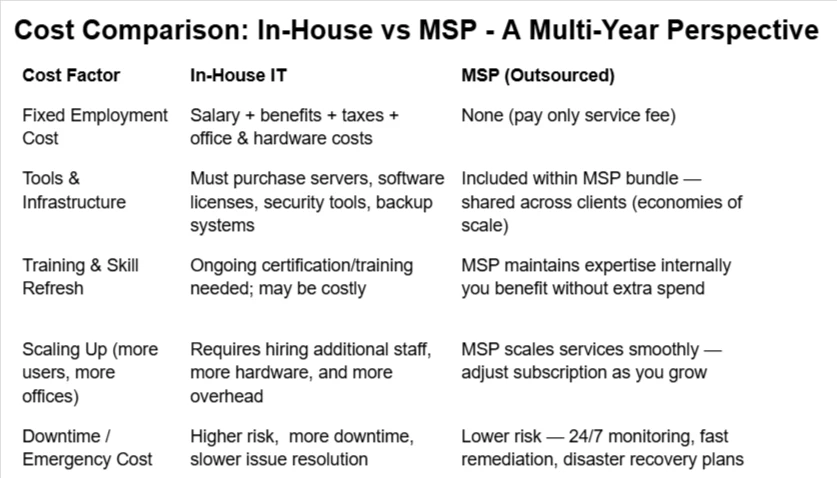
- The total cost of employing personnel is much more than just compensation: training, certification, software licensing, infrastructure upgrades, and recruiting are additional expenses.
- Limited skill set: a small internal team typically will lack depth - e.g., cloud infrastructure, advanced security, compliance, data protection & disaster recovery.
- Single Point Of Failure: If the internal IT employee leaves, becomes ill, or makes a critical error, the entire IT operation (and ultimately the business continuity) may be compromised.
Time and again, studies of SMB Cybersecurity have indicated that small firms are vulnerable to cyber threats due to limited resources, poor understanding of cybersecurity practices, and limited budgets - even when attempting to manage IT internally.
When done right, outsourcing can deliver robust infrastructure, up-to-date security, and 24/7 support without the overhead of full-time staff.
But is it always the better choice? The answer depends on a company’s size, growth trajectory, risk tolerance, and long-term goals. Below, we unpack what changes when a business leans on in-house IT vs. when it partners with an MSP like TechMasters - over a multi-year horizon.
What An MSP Does - And Why It Changes The Equation
An MSP is a third-party company that provides contracted IT services. Usually, this includes: managing the infrastructure, monitoring the infrastructure, backing up data, applying security updates, supporting end-users through a help desk, developing a disaster recovery plan, and, many times, continuous 24/7 monitoring of your IT operations.
To most small to medium-sized businesses, this translates into: a full IT department, but at a fraction of the cost of a full in-house IT department. Studies have shown that outsourcing your IT can save a company anywhere from 40-60% compared to keeping an in-house team, because of shared resources, predictable monthly retainer fees, and the spread of specialized skills across multiple clients.
Even more important, MSPs bring with them tools, experience, and processes that most internal IT departments do not possess: routine maintenance, threat identification, support for regulatory compliance, regularly scheduled back-up and restore procedures, and planning for disaster recovery.
Risk, Security & Business Continuity: The Hidden Variables
Cost is just one part of the equation. The bigger, often overlooked factor is risk.
Talent gap and security coverage
According to a 2023 systematic review, many SMEs (small and medium enterprises) are under-protected because they lack budget, cybersecurity literacy, or awareness of modern threats.
Meanwhile, MSPs specialize in security: continuous monitoring, managed backups, compliance protocols, patch management, and disaster recovery plans.
A managed provider can deliver enterprise-level security that would cost small firms a fortune to build internally.
Downtime, data loss, and compliance
When in-house IT is small or overstretched, reactive troubleshooting becomes the norm. Problems are fixed only after they surface, which means downtime, data corruption, lost productivity, and sometimes lost clients.
An MSP’s proactive approach, by contrast, aims to prevent issues before they happen. Backups are automated, patches are applied on schedule, and monitoring identifies anomalies, reducing the chance of a major outage or breach.
Additionally, for businesses subject to regulatory compliance, data privacy, audit logs, and security standards, MSPs often offer built-in compliance support, which a small internal IT team may struggle to deliver reliably.
Where In-House IT Still Makes Sense
Outsourcing isn’t a silver bullet. There are scenarios where maintaining internal IT is valid — even beneficial:
- Highly specialized infrastructure or workloads: If your business relies on custom hardware, legacy systems, or is sensitive to on-premise data that can’t be outsourced.
- Strict data residency or regulatory requirements: In some industries or geographies, you may need full control of data on-site.
- Large enterprises with scale: When you have 200+ employees and constant, heavy IT demands, an in-house team + MSP support may hybridize better.
- In such cases, in-house IT offers direct control, tight alignment with business processes, and easier customization.
Hybrid Approach - Best of Both Worlds
For many growing businesses, a hybrid model, a small in-house lead plus an MSP partner, offers balance.
You retain:
- Direct control and internal knowledge
- On-site access when needed
While outsourcing:
- Security, monitoring, backups, compliance
- Scalability, predictable cost, and broad expertise
This hybrid model reduces risk without sacrificing flexibility.
When MSP Might Fall Short: What to Watch Out For
- Perceived loss of control or “vendor lock-in”: Some MSPs use proprietary tools or practices that make switching providers harder.
- Quality variance: Not all MSPs are equal. Lower-tier providers might offer limited support or patchy service. Vet carefully.
- Compliance limitations: If you operate in a highly regulated sector (healthcare, finance), ensure the MSP understands regulatory demands.
Final Verdict: For Most Growing Businesses, MSP Wins - with Caveats
For small to mid-sized businesses, particularly those scaling fast, operating remotely, or lacking dedicated IT budgets, MSPs offer a compelling mix of cost-efficiency, expertise, scalability, and risk reduction.
In-house IT still holds value for companies with specialized infrastructure, regulatory constraints, or large, stable headcounts. But even many of those benefit from a hybrid model: internal oversight + outsourced redundancy.
In today’s fast-moving threat landscape, where cyber-attacks, ransomware, and compliance risks grow constantly, underestimating the complexity and cost of a full IT stack can be dangerous.
Key Takeaways
- MSPs typically cost 40–60% less than building equivalent in-house IT teams over 3–5 years.
- MSPs deliver full-time monitoring, backup, security, and scalability, often difficult for small internal teams to maintain.
- The hidden costs of in-house IT training, tools, infrastructure, and downtime often exceed the surface-level salary numbers.
- A hybrid approach (small internal IT + MSP) offers flexibility, control and risk mitigation ideal for many growing firms.
- The right choice depends on business size, growth plans, compliance needs and risk appetite.

























Sign in to leave a comment.