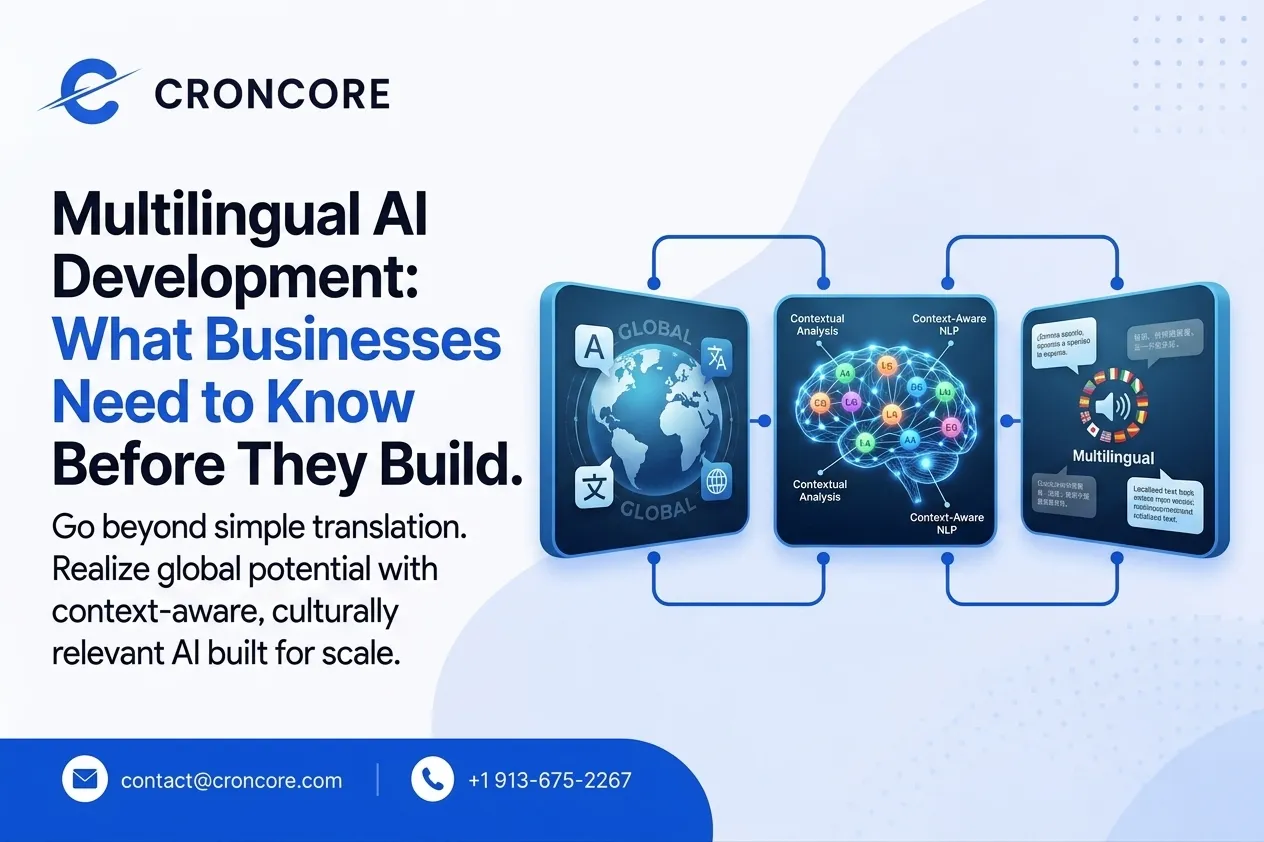

Most companies do not think seriously about multilingual support until it becomes a problem, a customer base that speaks a language the product does not handle well, an internal tool that only works in English, or a market expansion that exposes how narrow the original AI system actually was. At that point, the question shifts from "should we support more languages" to "how do we actually do this without starting over." That is where multilingual AI development comes in, and it is rarely as simple as plugging in a translation layer.
Why Translation Layers Are Not the Same Thing
A lot of teams assume that adding a translation API on top of an existing English model solves the problem. It does not, at least not well. Translation layers lose context, miss cultural nuance, and often fail completely on languages with different grammar structures or limited digital text available online. Real multilingual AI development means training or fine-tuning models that understand a language natively, not models that guess based on a translated version of the input.
The Low-Resource Language Problem
Most multilingual AI work assumes there is enough text data to train on, and for major world languages that is usually true. The harder problem shows up with languages that do not have that kind of data available, regional dialects, minority languages, or languages spoken widely but rarely represented in digital text. Building low-resource language AI models requires a different approach entirely, often combining smaller curated datasets, transfer learning from related languages, and techniques that squeeze usable performance out of far less data than a typical model would need.
Where Data Sovereignty Comes Into the Decision
For governments, financial institutions, and enterprises operating in regulated industries, multilingual AI development is not just a language problem, it is also a control problem. Where the data lives, who has access to it, and whether a third party outside the country can see it all matter. That is usually where sovereign AI systems enter the conversation, since organizations in this category need models that can be trained, hosted, and maintained within their own infrastructure or jurisdiction, without depending on external providers for core functionality.
What Businesses Often Get Wrong
The most common mistake is treating multilingual support as a feature to bolt on later instead of a decision that shapes the architecture from the start. A model built around one language and one dataset structure is often difficult to retrofit for additional languages down the line, especially low-resource ones. Planning for multilingual needs early, even if the rollout happens in phases, tends to save significant rework later.
The Bottom Line
Multilingual AI development is not a single technical task, it is a set of decisions about data, infrastructure, and which languages actually matter to the business, made early enough that the system can grow into them. A short conversation with a team that has actually built low-resource and sovereign AI systems is usually enough to figure out what the right approach looks like for a specific business, not just a generic one.


























Sign in to leave a comment.