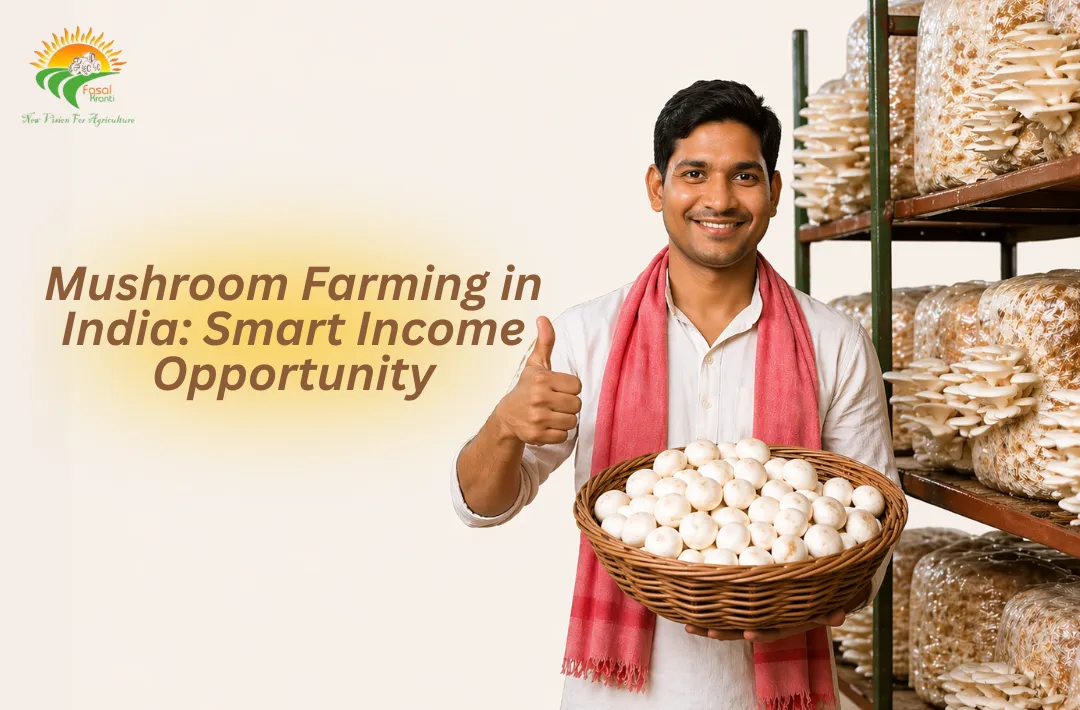

Mushroom Farming is steadily becoming a strong income source in India, especially for farmers who want to move beyond traditional crops. With limited land, rising input costs, and unpredictable weather, many farmers are now looking for alternatives that are less risky and more profitable. In this changing scenario, Mushroom Farming in India offers a practical solution that combines low investment with consistent returns.
Unlike field crops, mushrooms can be grown indoors in a controlled environment. This makes the business less dependent on rainfall and seasonal uncertainties. The growing demand for nutritious food and the increasing popularity of protein-rich diets have further boosted the importance of Mushroom Farming across both rural and urban markets.
Understanding Mushroom Farming in India
Mushroom Farming involves cultivating edible fungi using organic materials such as wheat straw, paddy straw, or compost. These materials act as a base where mushrooms grow under suitable temperature and humidity conditions. The process is scientific but not overly complicated, which makes it accessible even for beginners.
In India, Mushroom Farming is practiced in different climatic zones with varieties like button, oyster, and milky mushrooms. Each type has its own growing requirements, but all can generate good income when managed properly. The flexibility of growing mushrooms in small spaces like rooms, sheds, or even containers makes it suitable for small farmers and entrepreneurs.
Rising Demand and Market Growth
The demand for mushrooms in India has increased significantly over the past few years. Changing lifestyles, urbanization, and growing awareness about health and nutrition have made mushrooms a preferred food choice. They are rich in protein, vitamins, and minerals while being low in fat, which attracts health-conscious consumers.
Restaurants, hotels, supermarkets, and online grocery platforms are continuously looking for fresh mushroom supply. This consistent demand ensures that farmers engaged in Mushroom Farming do not struggle to find buyers. In many cities, mushrooms are now a regular part of daily meals, which further strengthens market stability.
Low Investment with High Potential
One of the biggest advantages of Mushroom Farming in India is that it requires comparatively low investment. Farmers do not need tractors, large irrigation systems, or expensive fertilizers. Basic inputs such as spawn, straw, and a simple structure are enough to start.
Despite the low cost, the income potential is quite promising. Mushrooms grow quickly and can be harvested within a few weeks. This fast production cycle allows farmers to earn multiple times in a year. When managed efficiently, even a small unit can generate steady monthly income, making it a reliable business option.
Suitable for Small and Landless Farmers
Mushroom Farming stands out because it does not depend on large land areas. Farmers can use vertical racks to grow mushrooms, which increases production in a limited space. This feature makes it especially useful for small and marginal farmers who cannot afford large-scale farming.
Even people without agricultural land can start Mushroom Farming at home or in rented spaces. This opens doors for youth, women, and small entrepreneurs to enter the agriculture sector without heavy investment. It also supports rural employment and helps families generate additional income.
Cultivation Process and Practical Approach
The process of Mushroom Farming begins with preparing the substrate, which is usually made from straw or organic waste. This material is cleaned and treated to create a suitable environment for mushroom growth. After that, spawn is mixed with the substrate, and the mixture is kept in a controlled space.
During the incubation stage, the fungus spreads through the substrate. Once this stage is complete, conditions like fresh air, light, and moisture are adjusted to encourage mushroom growth. Within a short period, mushrooms start appearing and are ready for harvest.
Harvesting is done carefully to maintain quality. Fresh mushrooms have better market value, so timing and handling play an important role in profitability.
Profitability and Income Opportunities
Mushroom Farming in India offers good profit margins because the cost of production is low and the selling price is relatively higher. Farmers who maintain quality and ensure regular supply often earn better returns compared to traditional crops.
The income can increase further if farmers focus on value addition such as drying, packaging, or processing mushrooms. Selling directly to consumers, restaurants, or local markets also helps in getting better prices. Over time, many farmers turn mushroom cultivation into a full-time business with stable earnings.
Government Support and Training
The government and agricultural institutions are actively promoting Mushroom Farming in India. Training programs are conducted through agricultural centers where farmers can learn scientific methods of cultivation. These programs help beginners understand the process and avoid common mistakes.
In some cases, financial support and subsidies are also available to encourage farmers to adopt mushroom cultivation. This support reduces the initial burden and motivates more people to start this business.
Challenges and How to Manage Them
Mushroom Farming requires attention to detail, especially in maintaining temperature, humidity, and cleanliness. Any imbalance can affect the growth and quality of mushrooms. Another challenge is the short shelf life, which makes quick marketing necessary.
However, these challenges can be managed with proper planning and basic training. Farmers who follow hygiene practices, monitor environmental conditions, and build strong market connections can overcome these issues easily.
Future Scope of Mushroom Farming in India
The future of Mushroom Farming in India looks promising as demand continues to grow. With increasing awareness about healthy eating and the expansion of retail markets, mushrooms are becoming more popular among consumers.
The rise of online food delivery platforms and processed food industries is also creating new opportunities for mushroom producers. In addition, export potential is gradually increasing, which can further boost farmer income.
Mushroom Farming is also aligned with modern agricultural trends such as indoor farming and sustainable practices. It uses less water, recycles agricultural waste, and produces high-value output, making it a future-ready farming model.
Conclusion
Mushroom Farming is not just an alternative crop but a smart income opportunity that fits well into today’s agricultural needs. It offers flexibility, quick returns, and the ability to start small while scaling gradually. For farmers, youth, and entrepreneurs looking for a reliable and profitable venture, Mushroom Farming in India provides a strong pathway.
With the right knowledge, careful management, and market understanding, this business can deliver consistent income and long-term growth. In a time when agriculture is evolving, Mushroom Farming stands as a practical and forward-looking choice for building a sustainable future.































Sign in to leave a comment.