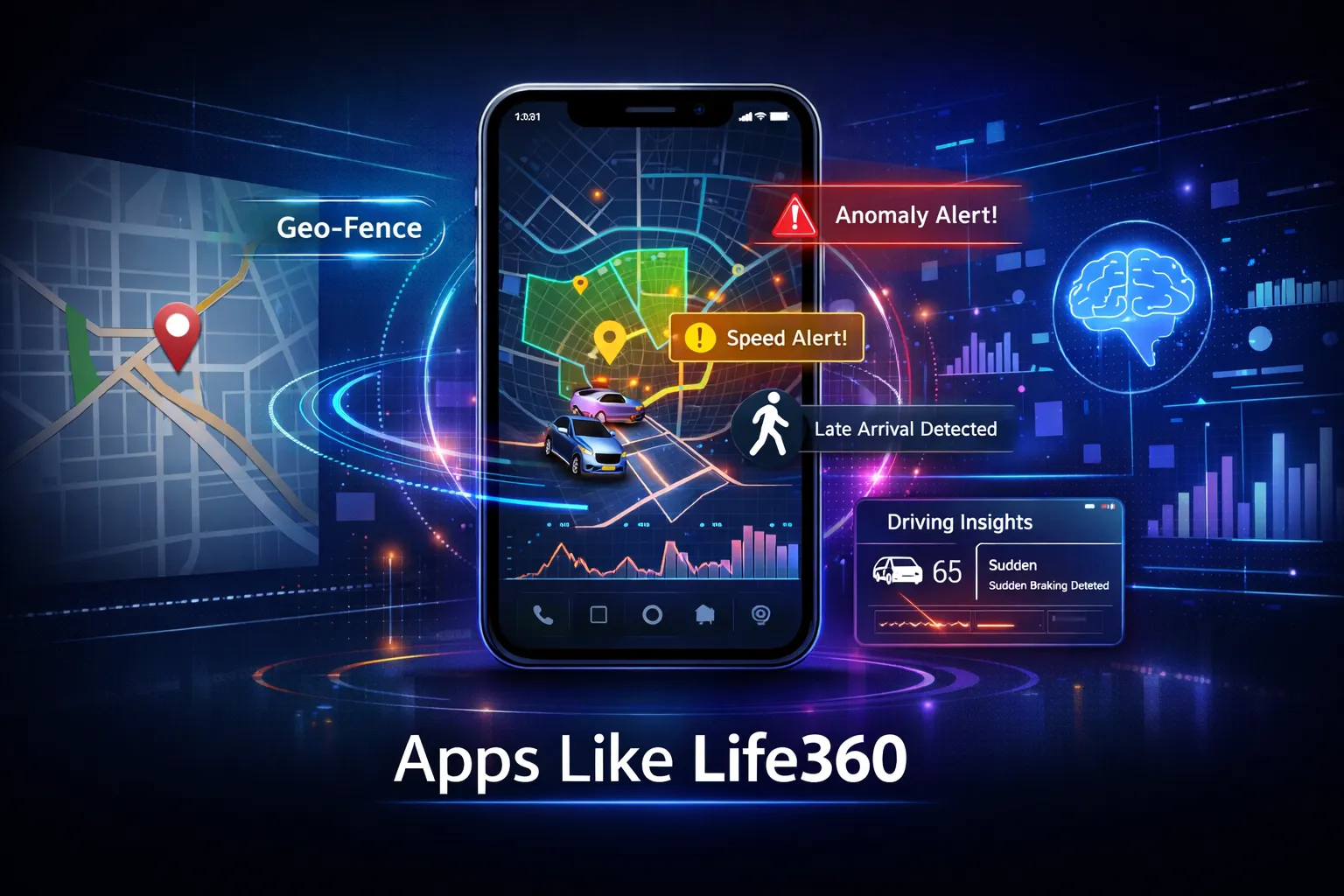

The trajectory of Apps Like Life360 is no longer tied to GPS alone. That layer—once revolutionary—has flattened into a commodity. What’s replacing it is far more complex: data interpretation engines, behavioral modeling, and context-aware safety systems that operate with minimal user intervention.
Most users entering this space still search for apps similar to life360, expecting better maps or faster updates. That’s a misread of where the industry is heading. The shift isn’t visual. It’s architectural.
The Collapse of GPS as a Differentiator
GPS accuracy has plateaued across consumer devices. Marginal gains exist, but they don’t redefine the experience.
What does? Multi-source data fusion. Modern apps combine GPS with Wi-Fi triangulation, Bluetooth proximity sensing, and even inertial measurement units (IMUs) to stabilize tracking in complex environments. Urban density, underground travel, signal loss—these are no longer blind spots but variables to be managed.
The result is continuity. Not perfection, but fewer gaps where visibility drops to zero.
Behavioral Intelligence Takes Center Stage
Location answers “where.” Safety demands “why.”
Advanced platforms now deploy behavioral analytics frameworks that map routines over time. These systems flag anomalies—unexpected stops, unusual routes, prolonged inactivity—without requiring predefined rules for every scenario.
Technically, this leans on unsupervised learning models that cluster normal behavior and isolate deviations. It’s not flawless. Edge cases still confuse the system. But the direction is clear: automation over manual configuration.
Smart Alerts Are Becoming Context Engines
Alerts used to be binary. Enter or exit a geofence. Trigger a notification. Done.
Now, alerts are layered. A late-night movement combined with device inactivity and route deviation escalates differently than a midday errand. This is context stacking—multiple data points feeding a single decision engine.
The challenge? Calibration. Over-sensitive systems create noise. Under-sensitive ones miss critical events. The best apps continuously recalibrate using real-time feedback loops.
Hardware Integration Is Reshaping Capabilities
Pure software solutions are hitting limits. Hardware integration is filling the gap.
Vehicles, wearables, even home IoT systems now feed data into tracking ecosystems. A smartwatch can detect sudden impact or abnormal heart rate, triggering alerts that GPS alone would never catch.
This convergence creates multi-dimensional safety nets—location, motion, and physiological data working in sync. It’s powerful. Also more invasive, which raises legitimate concerns.
Persistent Weaknesses the Industry Hasn’t Solved
Battery consumption remains unresolved. Continuous tracking, sensor fusion, and real-time analytics demand energy. Optimization helps, but trade-offs persist.
Privacy is even more complex. As apps collect behavioral and biometric data, transparency becomes critical. Yet many platforms still obscure how data is processed or shared.
Then there’s reliability under failure conditions. Network outages, device shutdowns, sensor errors—most apps still degrade poorly when systems break.
Final Outlook on Apps Like Life360
The future of Apps Like Life360 is not about refining GPS—it’s about building intelligent systems that interpret human movement in context. The shift is subtle on the surface but profound underneath.
Families aren’t just tracking each other anymore. They’re relying on systems to detect risk, filter noise, and respond faster than human awareness allows.
That evolution changes expectations permanently. And it raises the bar for every app competing in the space of Apps Like Life360—where performance is measured not in features, but in outcomes when conditions turn unpredictable.






















Sign in to leave a comment.