

The reef you've explored dozens of times transforms completely after sunset. Parrotfish sleep in mucus cocoons, octopuses emerge to hunt, and bioluminescent plankton sparkle in your wake. Night scuba diving opens an entirely different underwater world that a significant majority of certified divers never experience, often due to misconceptions about difficulty and danger.
If you're a certified diver curious about diving after dark, you're not alone in your hesitation. Real questions come up: What equipment do you need? How do you navigate without visual references? Is it more dangerous than daytime diving? If clear underwater vision is already a concern for you, a vision corrective scuba mask ensures you won't miss a single detail in the focused beam of your dive light.
Here's the truth: night diving is far more accessible than most divers assume. The challenges are real but manageable, and the rewards are unlike anything you'll experience during daylight hours.
Why Night Diving Offers a Completely Different Experience
The Nocturnal Underwater Ecosystem
The most compelling reason to try night scuba diving is simple: the reef at night is a completely different place.
During the day, octopuses are nearly impossible to spot. After dark, they actively hunt across open sand and coral rubble, their arms probing every gap for crabs and small fish. Lobsters that hide in overhangs by day emerge in groups, foraging across the bottom. Mantis shrimp patrol rubble zones rarely visible on day dives.
Meanwhile, familiar daytime creatures are doing something you've never seen: sleeping. Parrotfish produce mucus cocoons as a predator defense. Surgeonfish hover motionless. Wrasses bury themselves in sand. Their colors often shift noticeably, making familiar species look surprisingly different.
Bioluminescence adds another layer. In plankton-rich waters, disturbing the water produces flashes of blue-green light. To observe it properly, turn off your light, wait for your eyes to adjust, then wave your hand slowly through the water.
The Sensory Experience of Diving in Darkness
There's a paradox experienced divers frequently describe: reduced visibility makes you see more. Your dive light illuminates a focused cone of reef, and within that cone, colors are vivid in a way midwater daylight rarely produces. Reds and oranges that wash out at depth are saturated and sharp under a direct beam.
First-time night divers often report that anxiety transforms into focus within the first few minutes. That shift is part of what makes so many divers say their first night dive was transformative.
Essential Night Dive Equipment
Dive Lights: Primary, Backup, and Specialty Options
Your primary dive light should produce a minimum of 500 to 1,000 lumens, with many experienced divers preferring 1,000 to 2,500 lumens for reef diving. Look for a burn time of at least 90 minutes at full output and a clearly indicated battery level system.
Your backup light is non-negotiable. If your primary fails at depth, you need to execute a safe, controlled ascent. A backup light rated at 100 to 200 lumens minimum is adequate. Mount it somewhere accessible with one hand, clipped to your BCD shoulder strap or on a wrist mount.
Tank markers solve an easy-to-underestimate problem: identifying your buddy from a distance. A small LED marker clipped to your tank valve makes you immediately identifiable. Many quality rechargeable dive lights now include a red mode, which preserves night vision and is less disruptive to marine life behavior.
Additional Equipment Modifications
Illuminated gauges and dive computers matter far more at night. Choose a computer with an auto-backlight function.
Reflective tape on your BCD and tank adds passive visibility that costs almost nothing.
Exposure protection may need reassessing. Water temperature at depth often drops two to five degrees Fahrenheit after dark. If you're comfortable in a 3mm wetsuit, consider a hood or switching to a 5mm.
Pre-Dive Equipment Checks
- Test every light on the surface before entering the water
- Confirm battery levels are adequate for dive time plus a 50% buffer
- Review light signals with your buddy before descending
- Verify backup light accessibility with your non-dominant hand
- Confirm your computer or gauges are readable in darkness
Night Diving Techniques and Skills
Navigation in Low Visibility
The most important rule: dive a site during the day before diving it at night. Familiarity with the bottom topography and entry and exit points eliminates most navigation uncertainty.
Natural navigation remains your first tool. Follow the reef contour at a consistent depth, use prominent coral heads as waypoints, and pay attention to the slope of the bottom. Compass navigation requires more deliberate execution at night because you'll be holding a light in one hand. Practice reciprocal headings in daylight before relying on them in darkness.
Time and air management should be more conservative at night. Plan your turnaround point at roughly one-third of your starting air, not one-half.
Light Communication
Light signals replace many hand signals used during day dives:
- OK: Move your light in a slow, steady circle
- Get attention or signal a problem: Move your light rapidly back and forth
- Emergency: Move your light rapidly and erratically
Never shine your light directly into your buddy's face. Aim the beam at your signal and keep it below eye level. In groups, light discipline is critical. Multiple lights sweeping in different directions create visual chaos and can disorient divers who lose their reference points.
Buoyancy Without Visual References
At night, the visual cues your brain uses to maintain depth, including the reef angle and ambient light direction, are gone. Check your depth gauge or computer every 60 to 90 seconds until you develop confidence in instrument-based depth management.
If you experience vertigo or disorientation, stop moving immediately. Find the bottom with your light and establish a visual reference. If you can't see the bottom, watch your bubbles. They always rise and give you a reliable vertical reference.
Choosing the Right Night Dive Sites
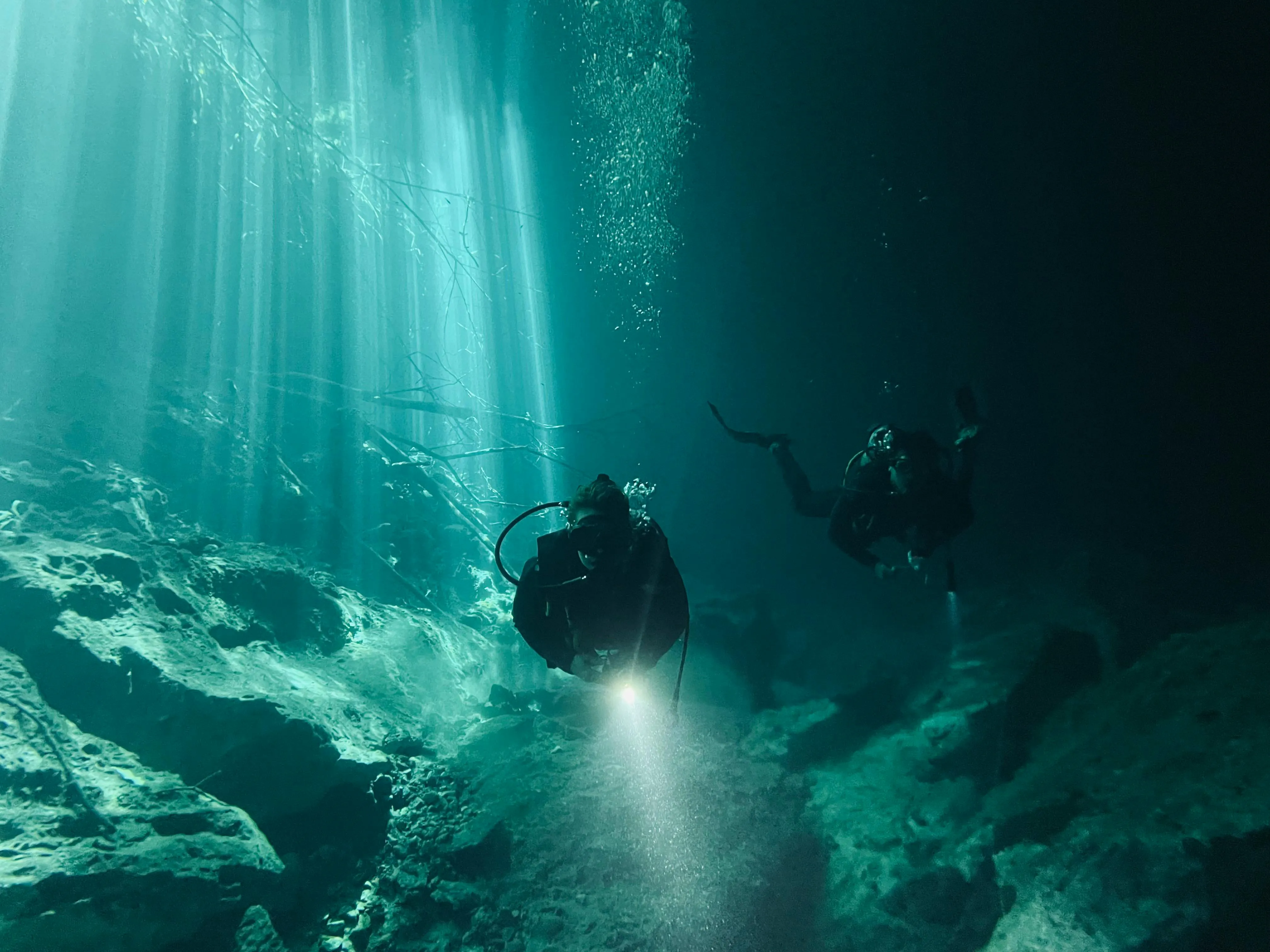
Ideal Site Characteristics
- Depth: For initial night dives, target sites with maximum depths between 30 and 60 feet. Shallower dives reduce the consequences of navigation errors.
- Bottom topography should offer clear natural navigation features. A reef with a defined edge and recognisable coral formations is far preferable to a featureless rubble slope.
- Currents are more problematic at night because you have fewer visual cues for detecting them. Sites with minimal or predictable current are significantly safer.
- Entry and exit points need to be clearly identifiable in darkness. Avoid sites where entry and exit require precise positioning to avoid hazards that are invisible at night.
Timing Your Dive
Dusk dives that begin just before sunset are an excellent entry point for first-time night divers. You start with ambient light, orientate yourself on the site, and experience the transition into darkness progressively. Full darkness dives, beginning 45 to 60 minutes after sunset, offer the most complete nocturnal marine life experience.
For beginners looking to understand dive planning and safety in tropical waters, this guide on Scuba Diving in Andaman Islands: Complete Beginner’s Guide is included
Safety Protocols
Buddy System and Emergency Procedures
Night scuba diving amplifies the importance of the buddy system. The standard protocol for buddy separation: turn on your light, pause for one minute while slowly rotating 360 degrees, and if no contact is made, ascend to the surface. Don't search horizontally for longer than one minute.
Primary light failure mid-dive should trigger an immediate transition to your backup light, a signal to your buddy, and a controlled ascent. Don't attempt to continue the dive on backup light alone.
Surface signalling at night requires specific equipment. A high-intensity surface signalling light with a strobe mode is essential for boat dives. Inflatable SMBs with reflective strips serve double duty as depth separation markers and visual location tools.
When to abort:
- Your primary light fails and you have no backup
- Any buddy pair loses orientation and cannot quickly reorient
- Current is stronger than anticipated and navigation back to the exit is uncertain
Marine Life Encounters at Night
Octopuses are the most universally celebrated night diving encounter, active from dusk until a few hours after midnight. Moray eels move off the reef at night in a way they rarely do during daytime dives. Sleeping parrotfish in their mucus cocoons can be approached closely (without touching) for extraordinary close-up views.
The most important rule for night marine life observation: your light is your interaction tool. Approach nocturnal subjects slowly and from the side. Aim your beam beside a target rather than directly at it. Do not touch sleeping fish, parrotfish cocoons, or any marine life regardless of how still it appears.
Night Diver Certification: Is It Necessary?
Major training agencies including PADI, SSI, and NAUI offer Night Diver specialty certifications. A typical course includes a knowledge development session followed by three to five supervised night dives with a qualified instructor, covering light communication, emergency procedures, and navigation techniques.
Formal certification makes sense if you want to night dive independently, dive regularly and anticipate multiple night dives per year, or have specific anxiety that structured training would address effectively.
Guided night dives are sufficient if you dive infrequently, have an experienced buddy, or are testing whether you enjoy night diving before committing to a specialty course.
A single guided night dive typically runs $60 to $120. A Night Diver specialty course typically costs $200 to $400. If you'll do three or more guided dives anyway, certification often makes economic sense alongside the skill benefits.
Your First Night Dives: A Progressive Approach
Start with a dusk dive, not a full darkness dive. Beginning your descent with 30 to 45 minutes of remaining daylight lets you orient yourself in ambient light and experience the transition gradually.
A simple five-dive progression:
- Dives 1 and 2: Dusk dive on a familiar, shallow site (under 40 feet) with an experienced buddy or guide
- Dive 3: Full darkness dive on the same site, focusing on navigation and light communication
- Dives 4 and 5: Introduce a new site at night, still shallow, after a daytime reconnaissance dive
Common mistakes to avoid:
- Attempting night diving too early in your diving career (fewer than 20 logged dives)
- Skipping pre-dive light tests or using partially depleted batteries
- Choosing sites beyond your skill level based on other divers' recommendations
- Losing buddy awareness when something interesting captures your attention
Pairing quality dive lights and accessories with thorough preparation eliminates most equipment-related problems before they happen.
Frequently Asked Questions About Night Scuba Diving
How many dives should I have before attempting a night dive?
Most agencies recommend 20–25 logged dives. Guided night dives may allow fewer, but you should already be comfortable with buoyancy, navigation, and air management.
What is the biggest difference between day and night diving beyond the obvious darkness?
It’s the mental load. At night you rely on your light and instruments instead of natural visibility, making the dive more focused and mentally demanding.
Can I night dive in cold water?
Yes. You just need proper thermal protection (wetsuit or drysuit, plus gloves and hood). Cold can increase air use and reduce dexterity, so good gear matters.
What should I do if I surface away from the boat or entry point?
Use a strobe and audible signal device, stay calm, inflate your BCD, and wait for pickup. Never swim long distances in the dark.
Does bioluminescence occur on every night dive?
No. It depends on location, season, and conditions. It’s not guaranteed, but many night dives still offer rich marine life regardless.
Building a Night Diving Kit: What to Prioritise
If you're outfitting yourself specifically for night diving rather than relying on rental equipment, the order in which you invest matters. Here's a practical prioritisation framework.
First purchase: primary dive light. Rent everything else, but own your primary light. Rental primary lights vary significantly in quality, charge state, and reliability. Owning and maintaining your own primary light eliminates one of the most preventable sources of night dive problems. A quality primary light in the 1,000 to 2,000 lumen range with a reliable burn time and a clear battery indicator is the single most important night diving investment you'll make.
Second purchase: backup light. This is non-negotiable for independent diving and strongly recommended even on guided dives. A compact, clip-mounted backup rated at 150 lumens or more costs relatively little and is worth every dollar.
Third: tank marker light. Small, inexpensive, and genuinely useful for group identification. Once you've experienced diving in a group without tank markers, you'll understand immediately why they're worth having.
Later additions: Reflective tape for your BCD, a surface strobe for boat diving, and an upgraded dive computer with a reliable backlight system can all be added progressively as you build your night diving experience and establish what matters most in your specific diving context.
Conclusion
Night scuba diving opens an entirely different dimension of the underwater world, revealing marine behaviours and creatures that remain hidden during daylight hours. While it requires additional equipment and more deliberate planning, the experience is far more accessible than most divers assume.
Start with dusk dives on familiar, shallow sites. Invest in quality primary and backup lights and test them before every dive. Build your navigation comfort gradually, adding complexity only when the fundamentals feel solid.
Whether you're drawn by watching an octopus hunt in your dive light beam, experiencing bioluminescence, or accessing a part of the reef most certified divers have never seen, the rewards are genuine and lasting.
Your next steps: Review your current equipment and identify what lights and accessories you'll need. Browse rechargeable dive lights that deliver reliable output across a full dive. Then find a guided night dive through your local dive shop, choose a calm and familiar site, and discover for yourself why so many divers consider night diving the most transformative experience the underwater world has to offer.
























Sign in to leave a comment.