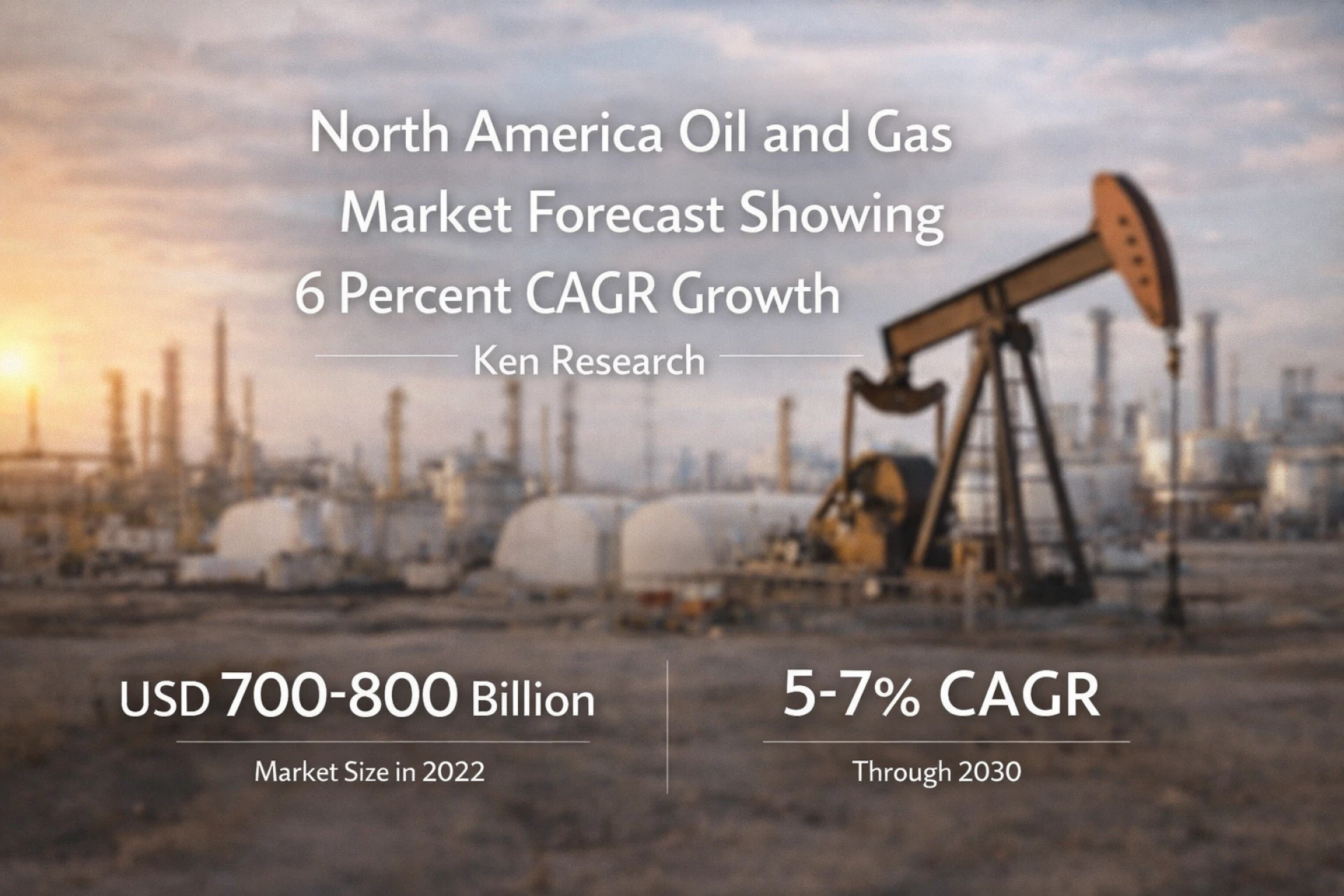

North America's oil and gas market is maintaining a structural growth trajectory that defies the simplistic narrative of fossil fuel decline. Based on market research insights from Ken Research, the North America oil and gas market was valued at approximately USD 700-800 billion in 2022 and is projected to advance at a CAGR of approximately 5-7% through 2030, driven by sustained global hydrocarbon demand, the region's position as the world's largest oil and gas producer, accelerating LNG export infrastructure investment, and the Permian Basin and Marcellus Shale's continued above-expectation production delivery. The forecast reflects a market that is not simply maintaining its position but is actively expanding its global market share in both oil production (the United States surpassed 13 million barrels per day in 2023) and LNG exports (the US became the world's largest LNG exporter in 2022 by volume).
The North America oil and gas market forecast to 2030 is underpinned by several quantifiable projections: US oil production is expected to maintain above 13 million barrels per day through 2027; US LNG export capacity is scheduled to increase from approximately 14 billion cubic feet per day (bcfd) in 2023 to approximately 22-24 bcfd by 2027 as under-construction liquefaction capacity completes; and Canadian oil sands production is projected to grow toward 3.8-4.0 million barrels per day by 2030 as Trans Mountain Pipeline expansion improves Pacific market access.
Key Data Insights
- Market size: approximately USD 700-800 billion in 2022, advancing at 5-7% CAGR through 2030
- US oil production: exceeded 13 million barrels per day in 2023, the world's highest ever single-country annual production level
- US LNG export capacity: approximately 14 bcfd in 2023, scheduled to reach 22-24 bcfd by 2027 as Plaquemines, Corpus Christi Stage 3, and other projects complete
- Permian Basin: approximately 5.8 million barrels per day crude production in 2023, projected toward 6.5-7.0 million barrels by 2027
- Canada's oil sands: projected to grow toward 3.8-4.0 million barrels per day by 2030 with Trans Mountain Pipeline expansion improving Pacific access
- US natural gas production: exceeded 100 bcfd in 2023, the world's first national gas production system to achieve this milestone
- Source: Ken Research - North America Oil and Gas Market Industry Forecast
The Permian Basin: The Engine of US Production Growth Through 2030
The Permian Basin in West Texas and New Mexico remains the most prolific oil and gas producing region in the world and the primary driver of North America's production growth forecast. The basin's unique combination of multiple stacked oil-bearing formations, existing infrastructure density, and the industry's accumulated shale drilling and completion efficiency improvements have produced a productivity trajectory that consistently outperforms EIA and IEA production forecasts.
Permian crude production grew from approximately 4.0 million barrels per day in 2019 to approximately 5.8 million barrels per day in 2023 - a 45% increase during a period that included the pandemic demand collapse and significant capital expenditure reduction. The basin is projected to reach 6.5-7.0 million barrels per day by 2027, maintaining its position as the single most important oil production region globally for the US's production trajectory.
- Well productivity improvements: Average Permian Basin well productivity has improved by approximately 30-40% since 2018 through longer lateral drilling (7,000-12,000 feet), more proppant per stage, and precision completion optimisation, allowing operators to sustain production growth with flat or declining rig counts.
- Major consolidation: ExxonMobil's USD 59.5 billion acquisition of Pioneer Natural Resources (announced 2023) and Chevron's USD 53 billion acquisition of Hess Corporation reflect the industry's consolidation thesis that larger operators with deeper capital resources can sustain basin development at lower break-even costs, supporting production growth through lower-price-cycle periods.
LNG Export Growth: North America Becomes the World's Supplier
The North America oil and gas market trends include the most consequential structural development in global gas markets in decades: the United States' emergence as the world's largest LNG exporter has fundamentally altered the global natural gas market's geopolitical structure. US LNG export capacity grew from near-zero in 2016 to approximately 14 bcfd by 2023, with Sabine Pass, Freeport, Cameron, Corpus Christi, Cove Point, and Elba Island facilities collectively making the US the world's largest LNG exporter by volume.
The second wave of US LNG capacity currently under construction includes Plaquemines LNG (Venture Global, 20 mtpa), Corpus Christi Stage 3 (Cheniere Energy, 10+ mtpa), and several other projects that will add approximately 8-10 bcfd of additional export capacity by 2027. The Department of Energy's January 2024 pause on new LNG export licences creates near-term uncertainty, but the existing permitted and under-construction capacity pipeline is sufficient to deliver the 22-24 bcfd export capacity projection regardless of new licence decisions through 2027.
- European demand pull: Europe's structural shift away from Russian pipeline gas following the 2022 Ukraine invasion has created long-term LNG demand that North American exporters are well-positioned to serve. European LNG import terminal capacity has grown from approximately 230 bcm/year to 380+ bcm/year through new FSRU (floating storage and regasification unit) deployments, creating infrastructure to absorb US and Canadian LNG exports at scale.
- Asian demand growth: Japan, South Korea, Taiwan, and China collectively represent the world's largest LNG import market. North America's Pacific Coast LNG ambitions - particularly Canada's LNG Canada (18 mtpa Phase 1, targeting first cargo 2025) and potential US West Coast projects - could redirect significant North American LNG export capacity toward Asian buyers at competitive delivered costs.
Canadian Oil Sands and Trans Mountain Pipeline Expansion
The North America oil and gas market size includes Canada's oil sands as a structurally important production source that is often underweighted in forecasts focused on US shale dynamics. Canada's oil sands produced approximately 3.3 million barrels per day in 2023 and are projected to grow toward 3.8-4.0 million barrels per day by 2030 as Trans Mountain Pipeline Expansion (TMX) - which entered service in May 2024 with 590,000 barrels per day of added capacity to the Pacific Coast - opens Asian market access for Canadian heavy crude that was previously entirely reliant on US refinery markets.
TMX's completion is strategically significant beyond its volume contribution: it gives Canadian crude producers price optionality by connecting them to Asian buyers who will pay WTI-equivalent or better pricing for Canadian heavy crude, eliminating the structural discount (historically USD 10-20 per barrel) that Canadian producers accepted for US market captivity. This pricing improvement significantly improves oil sands project economics and is expected to catalyse continued development investment at existing projects through 2030.
Ken Research's North America oil and gas market intelligence covers production forecasting, LNG export capacity analysis, pipeline infrastructure assessment, and competitive player benchmarking across all major basins and segments. Explore Ken Research for the comprehensive sector intelligence framework.
North America Oil and Gas Market Challenges
North America oil and gas market challenges through 2030 include: regulatory and permitting complexity that has extended infrastructure development timelines significantly (the average major pipeline project now takes 8-12 years from conception to operation versus 3-5 years two decades ago); energy transition pressure creating investor capital allocation competition between hydrocarbon and clean energy investments at major integrated energy companies; labour market tightness in oilfield services creating cost pressure and project execution delays; and the long-term demand trajectory uncertainty as EV adoption and energy efficiency improvements potentially moderate global oil demand growth below prior projections.
Competitive Landscape: US, Canada, and Mexico's Distinct Roles
The North America oil and gas market competitors landscape is structured around the three distinct national market architectures. The United States is the global production and export leader, with ExxonMobil, Chevron, ConocoPhillips, Pioneer (now Exxon), Devon Energy, EOG Resources, and Diamondback Energy as the leading independent and integrated producers. Canada's oil sands market is dominated by Suncor Energy, Canadian Natural Resources (CNRL), Cenovus Energy (which acquired Husky and some ConocoPhillips assets), Imperial Oil, and MEG Energy. Mexico's PEMEX, despite structural challenges, remains a significant Gulf of Mexico operator with significant production volumes that form the southern anchor of the continental market.
Conclusion: North America's Oil and Gas Market Forecast Through 2030
North America's oil and gas market through 2030 is a compelling combination of production volume growth, LNG export expansion, infrastructure investment, and corporate consolidation that collectively support a 5-7% CAGR trajectory toward a market approaching USD 1 trillion by 2028-2030. The Permian Basin's production trajectory, the US LNG export programme's completion, Canada's TMX pipeline access to Asian markets, and the region's energy security role for European and Asian LNG importers collectively make North America the most strategically important hydrocarbon supply region in the global energy system through at least 2030.
Investors, energy companies, and policy analysts evaluating the North America oil and gas market outlook should monitor Permian Basin productivity trajectories, US LNG export licence policy evolution under the Biden administration, Canadian TMX pricing realisation data, and the pace of IRA clean energy investment in determining how the market's growth rate tracks against the 5-7% CAGR base case through 2030.
Ken Research provides the authoritative North America oil and gas market report covering production forecasting, LNG export capacity analysis, pipeline infrastructure assessment, major basin analysis (Permian, Marcellus, Haynesville, Eagle Ford), and competitive benchmarking through 2030.
Frequently Asked Questions (FAQ)
Q1. What is the North America oil and gas market size?
Based on independent industry evaluation, the North America oil and gas market was valued at approximately USD 700-800 billion in 2022, advancing at approximately 5-7% CAGR through 2030. The US accounts for the largest share, as the world's largest oil and gas producer with crude production exceeding 13 million barrels per day and natural gas production exceeding 100 bcfd in 2023. Canada's oil sands producing approximately 3.3 million barrels per day contributes the second-largest component, while Mexico's PEMEX operations provide the third major market contribution. By 2028-2030, the combined market is projected to approach USD 1 trillion as LNG export capacity expansion, oil production growth, and natural gas price normalisation contribute to market value growth.
Q2. What is driving the North America oil and gas market forecast at 6% CAGR?
The North America oil and gas market's approximately 5-7% CAGR forecast through 2030 is driven by: US oil production growth from the Permian Basin (projected toward 6.5-7.0 million barrels per day by 2027) driven by completion technology improvement and major operator consolidation (ExxonMobil-Pioneer, Chevron-Hess); US LNG export capacity expansion from 14 bcfd to 22-24 bcfd by 2027 as Plaquemines, Corpus Christi Stage 3, and other projects complete; Canada's oil sands growth to 3.8-4.0 million barrels per day by 2030 supported by Trans Mountain Pipeline Expansion market access improvement; and European structural LNG demand shift away from Russian gas creating long-term US and Canadian LNG export market pull.
Q3. What role does the Permian Basin play in North America's oil and gas market?
The Permian Basin in West Texas and New Mexico is the most important single driver of North America's oil and gas production growth forecast. Producing approximately 5.8 million barrels per day in 2023 and projected toward 6.5-7.0 million barrels per day by 2027, the Permian represents approximately 44% of total US crude production from a single geological basin. The basin's unique characteristics - multiple stacked producing formations, exceptional existing infrastructure density, and accumulated efficiency improvements from years of shale development - produce a per-well productivity and break-even cost structure (approximately USD 35-45/barrel WTI breakeven for new wells) that makes it competitive with any oil production region globally at current prices. ExxonMobil's acquisition of Pioneer Natural Resources for USD 59.5 billion in 2023 reflects institutional confidence in the Permian's sustained long-term production potential.
Q4. How is US LNG export growth affecting the North America oil and gas market?
US LNG export growth has been transformational for the North America oil and gas market structure. The US became the world's largest LNG exporter by volume in 2022, with export capacity growing from near-zero in 2016 to approximately 14 bcfd in 2023. The scheduled completion of Plaquemines LNG (20 mtpa), Corpus Christi Stage 3, and other under-construction projects will bring US LNG export capacity to approximately 22-24 bcfd by 2027. LNG exports have fundamentally changed US natural gas market economics by connecting US domestic gas prices more directly to global LNG prices, created sustained demand for natural gas transportation infrastructure (pipelines, compression, processing), and established the US as the critical swing supplier for both European post-Russian-gas deficit demand and Asian LNG import growth. Canada's LNG Canada (18 mtpa Phase 1, first cargo 2025) adds a Pacific Basin dimension to North American LNG export growth.
Q5. What are the North America oil and gas market challenges through 2030?
The primary challenges facing North America's oil and gas market through 2030 include: regulatory and permitting complexity extending infrastructure development timelines (8-12 years for major pipeline projects), energy transition investor preference creating capital allocation competition between hydrocarbon and clean energy investment; oilfield services labour market tightness generating cost inflation and project execution delays; the Department of Energy's January 2024 pause on new LNG export licences creating uncertainty for projects beyond the current permitted pipeline; methane emission regulation increasing operating costs and compliance complexity; and long-term oil demand uncertainty as EV adoption accelerates in key consuming markets. Despite these challenges, the market's strong production growth trajectory and structural LNG export demand from Europe and Asia provide a solid demand foundation through the decade.
Q6. Where can I access North America oil and gas market research?
Ken Research publishes the comprehensive North America oil and gas market report covering production forecasting by basin, LNG export capacity analysis, pipeline and midstream infrastructure assessment, major operator competitive benchmarking, energy transition intersection analysis, and market size forecasting through 2030.
























Sign in to leave a comment.