
Being told that no sperm was found in a semen sample can be frightening, especially for a man hoping to become a biological father. The medical term for this finding is azoospermia. But azoospermia is not one single condition, and understanding its cause is one of the most important steps in deciding what happens next.
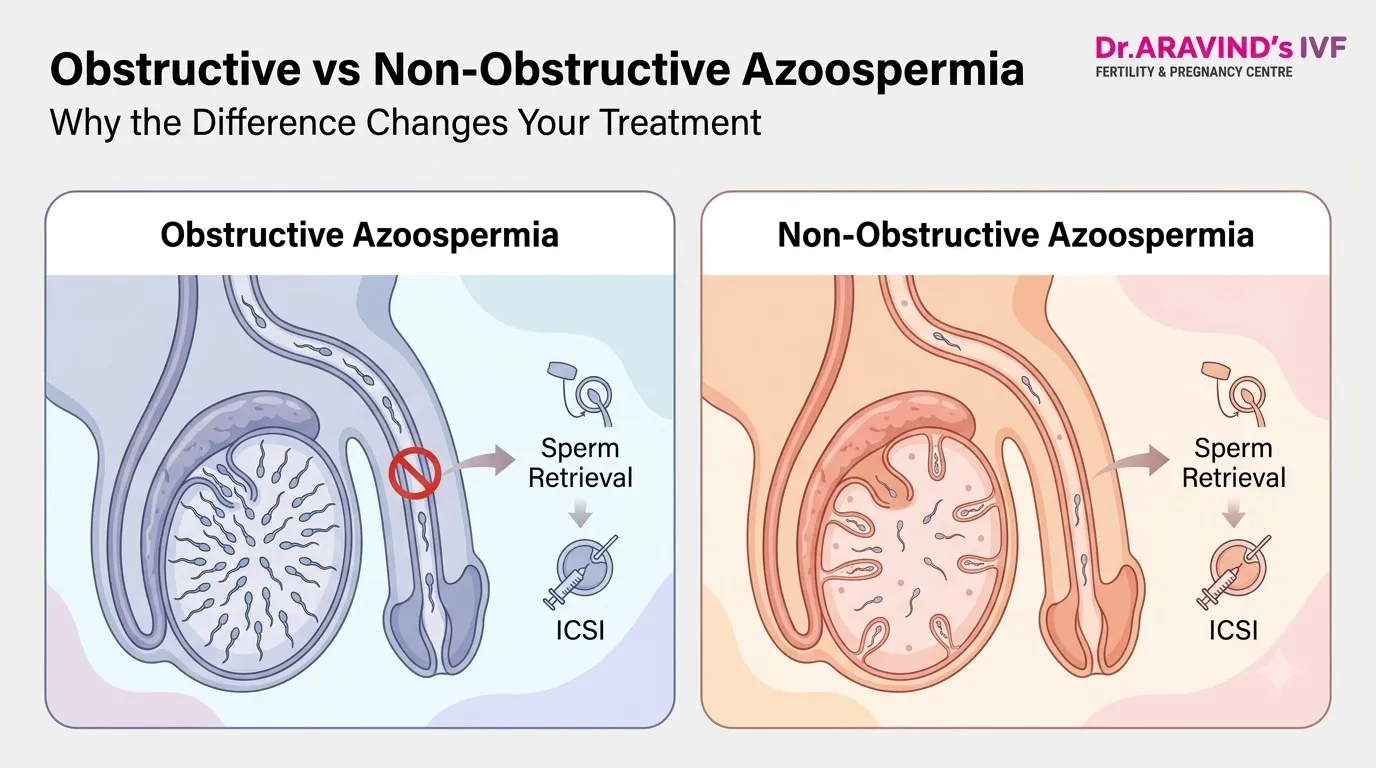
Broadly, doctors classify azoospermia into two major types: obstructive azoospermia and non-obstructive azoospermia. The difference is simple to describe but clinically very important. In one type, sperm may be produced normally but blocked from reaching the semen. In the other, the main problem is impaired sperm production inside the testicles.
For couples seeking help at a fertility centre in Trichy, identifying this difference can help doctors choose a more appropriate treatment pathway rather than treating every case of absent sperm in the same way.
What Is Azoospermia?
Azoospermia means that sperm are not detected in the ejaculated semen. It is different from having a low sperm count, where sperm are present but their concentration is below the expected range.
The finding is usually confirmed through semen testing. Depending on the circumstances, doctors may recommend repeat testing and detailed laboratory examination before confirming the diagnosis.
Once azoospermia is established, the next question is: Why are sperm missing from the semen?
That question leads to the distinction between obstruction and impaired sperm production.
What Is Obstructive Azoospermia?
In obstructive azoospermia, the testicles may continue producing sperm, but the sperm cannot travel normally into the ejaculate because of a blockage somewhere along the reproductive tract.
Think of it as a transport problem rather than necessarily a production problem.
The blockage may involve structures such as the epididymis, vas deferens, or ejaculatory ducts. Previous surgery, infections, injury, congenital conditions, or certain anatomical problems can contribute to obstruction.
Because sperm production may remain intact, some men with obstructive azoospermia can have sperm retrieved directly from the reproductive tract or testicle.
What Is Non-Obstructive Azoospermia?
Non-obstructive azoospermia is different. Here, the main concern is reduced or severely impaired sperm production within the testicles.
The causes can vary considerably. Hormonal disorders, genetic conditions, previous testicular injury, certain medical treatments, and problems affecting testicular function may contribute.
Importantly, sperm production may not be completely absent throughout the testicles. Some men may have small areas where sperm are still being produced even when no sperm appears in the semen.
This is one reason why a diagnosis of non-obstructive azoospermia does not automatically mean that sperm retrieval will be impossible.
Why Does the Difference Matter So Much?
The distinction affects what doctors consider next.
If an obstruction is responsible and sperm production is preserved, treatment may focus on correcting the blockage or retrieving sperm from above the obstruction.
If sperm production itself is impaired, the treatment plan may instead involve evaluating the underlying cause and determining whether sperm can be found within the testicular tissue.
In other words, the same semen-analysis finding can lead to very different treatment strategies.
That is why azoospermia treatment should begin with diagnosis rather than immediately moving to a procedure.
How Do Doctors Tell the Two Types Apart?
There is no single test that always distinguishes the two types.
Doctors usually combine information from the man's medical history, physical examination, semen analysis, hormone levels, and other investigations.
The semen volume and other characteristics may provide useful clues. Hormone results can also help doctors understand how the testicles are functioning.
In selected patients, ultrasound or genetic testing may provide additional information.
The goal is to build a complete clinical picture before deciding whether surgery, sperm retrieval, or assisted reproduction is appropriate.
Can Sperm Be Retrieved in Obstructive Azoospermia?
Often, sperm retrieval is a possibility when sperm production is preserved.
Depending on the location and cause of the obstruction, doctors may consider procedures such as epididymal sperm aspiration or testicular sperm retrieval.
Some men may also be candidates for reconstructive surgery to restore sperm transport. Whether reconstruction or assisted reproduction is preferable depends on factors such as the location of the blockage, duration of infertility, female partner's fertility, and previous treatment history.
The important point is that obstruction does not necessarily mean that the testicles have stopped producing sperm.
What Happens in Non-Obstructive Azoospermia?
Non-obstructive cases can be more challenging because the amount of sperm production may be very limited.
When there is a possibility of finding sperm within the testicles, a specialist may discuss micro-TESE, or microdissection testicular sperm extraction.
During micro-TESE, an operating microscope helps the surgeon identify areas of testicular tissue that may be more likely to contain sperm-producing structures. Tissue is then examined by an embryology team to look for usable sperm.
Sperm retrieval is not guaranteed, and the likelihood varies depending on the underlying cause.
What Role Does ICSI Play?
When only a small number of sperm are available, ICSI treatment can be particularly important.
ICSI, or intracytoplasmic sperm injection, involves selecting an individual sperm and injecting it directly into an egg. This means the laboratory does not need a large number of actively moving sperm to attempt fertilisation.
If sperm are successfully retrieved through a surgical procedure, they may therefore be used as part of an IVF-ICSI treatment plan.
However, retrieving sperm is only one stage of the process. Egg quality, embryo development, uterine factors, and other reproductive considerations also influence the final outcome.
Why Genetic Testing May Be Important
Some cases of severely impaired sperm production have a genetic basis.
Doctors may recommend genetic investigations for selected men with azoospermia, particularly when non-obstructive azoospermia is suspected.
Tests may include chromosomal analysis or Y-chromosome testing depending on the clinical findings.
Genetic information can help explain the cause of infertility and may also influence decisions about treatment and counselling before assisted reproduction.
This is another reason why a detailed assessment is important before proceeding with sperm retrieval.
Can Lifestyle Changes Fix Azoospermia?
Lifestyle changes can support overall reproductive health, but they cannot correct every cause of azoospermia.
Stopping smoking, limiting excessive alcohol, maintaining a healthy weight, exercising appropriately, getting adequate sleep, and managing medical conditions are sensible measures for sperm health.
However, if the underlying problem is a complete obstruction, genetic condition, or severe impairment of testicular sperm production, lifestyle changes alone may not restore sperm to the semen.
The right approach depends on the diagnosis.
Which Treatment Is Better?
There is no universal "best" treatment for azoospermia.
For some men with obstruction, surgery may be considered. For others, sperm retrieval followed by ICSI may be more appropriate.
In non-obstructive cases, the fertility team may first determine whether sperm retrieval is realistic and whether an underlying hormonal or genetic issue needs attention.
Couples researching the best IVF centre in India should therefore consider more than IVF technology. Experience in male infertility, diagnostic evaluation, surgical sperm retrieval, embryology, and reproductive medicine can all matter when managing complex cases.
What Should Patients Ask Their Doctor?
If you have been diagnosed with azoospermia, useful questions include:
- Is my azoospermia obstructive or non-obstructive?
- Is there evidence that my testicles are producing sperm?
- Do I need hormone or genetic testing?
- Could sperm retrieval be an option?
- Would micro-TESE be appropriate in my case?
- If sperm is retrieved, would I need ICSI?
- What are the realistic benefits and limitations of each option?
These questions can help turn an alarming diagnosis into a clearer treatment discussion.
The Diagnosis Determines the Direction
Obstructive azoospermia and non-obstructive azoospermia may look similar on a semen report, but they represent very different problems.
In obstructive cases, sperm may be produced normally but unable to reach the semen. In non-obstructive cases, the challenge is usually reduced sperm production, although small areas of sperm production may sometimes remain.
That difference influences whether doctors consider reconstructive surgery, sperm retrieval, micro-TESE, or assisted reproduction with ICSI.
At Dr. Aravind's IVF Fertility & Pregnancy Centre, a trusted fertility centre in Trichy, men with azoospermia can undergo a structured evaluation to understand the likely cause and discuss appropriate fertility options.
Frequently Asked Questions
1. What is the main difference between obstructive and non-obstructive azoospermia?
Obstructive azoospermia occurs when sperm are produced but cannot reach the semen because of a blockage. Non-obstructive azoospermia usually involves significantly reduced or impaired sperm production.
2. Can men with obstructive azoospermia have sperm retrieved?
Yes. When sperm production is preserved, doctors may be able to retrieve sperm from the epididymis or testicle, depending on the cause and location of the obstruction.
3. Can sperm be found in non-obstructive azoospermia?
Sometimes. Sperm production may be very limited or occur only in small areas of the testicles. In selected patients, micro-TESE may be considered to search for these areas.
4. Is ICSI needed after sperm retrieval?
Often, when only a small number of sperm are available, ICSI may be used to fertilize the eggs. The appropriate treatment depends on the couple's individual fertility assessment.
5. Should every man with azoospermia have genetic testing?
Not necessarily. Genetic testing is recommended for selected patients based on factors such as suspected sperm-production problems, semen findings, hormone results, and clinical history.
Azoospermia Is a Diagnosis, Not the End of the Journey
A semen report showing no sperm can feel like a final answer, but it is actually the starting point for a more detailed investigation.
Determining whether the problem is obstructive or non-obstructive azoospermia helps doctors understand where the problem may be occurring and which treatment options could be realistic.
For some men, sperm retrieval may provide an opportunity to use their own sperm in assisted reproduction. For others, addressing an underlying medical or anatomical problem may be the priority.
Take the Next Step
If you have been diagnosed with azoospermia or have received repeated semen reports showing no sperm, speak with a fertility specialist before making assumptions about your fertility options.
For comprehensive male infertility evaluation, sperm retrieval, IVF, and ICSI guidance, consult Dr. Aravind's IVF Fertility & Pregnancy Centre, a trusted fertility centre in Trichy.























Sign in to leave a comment.