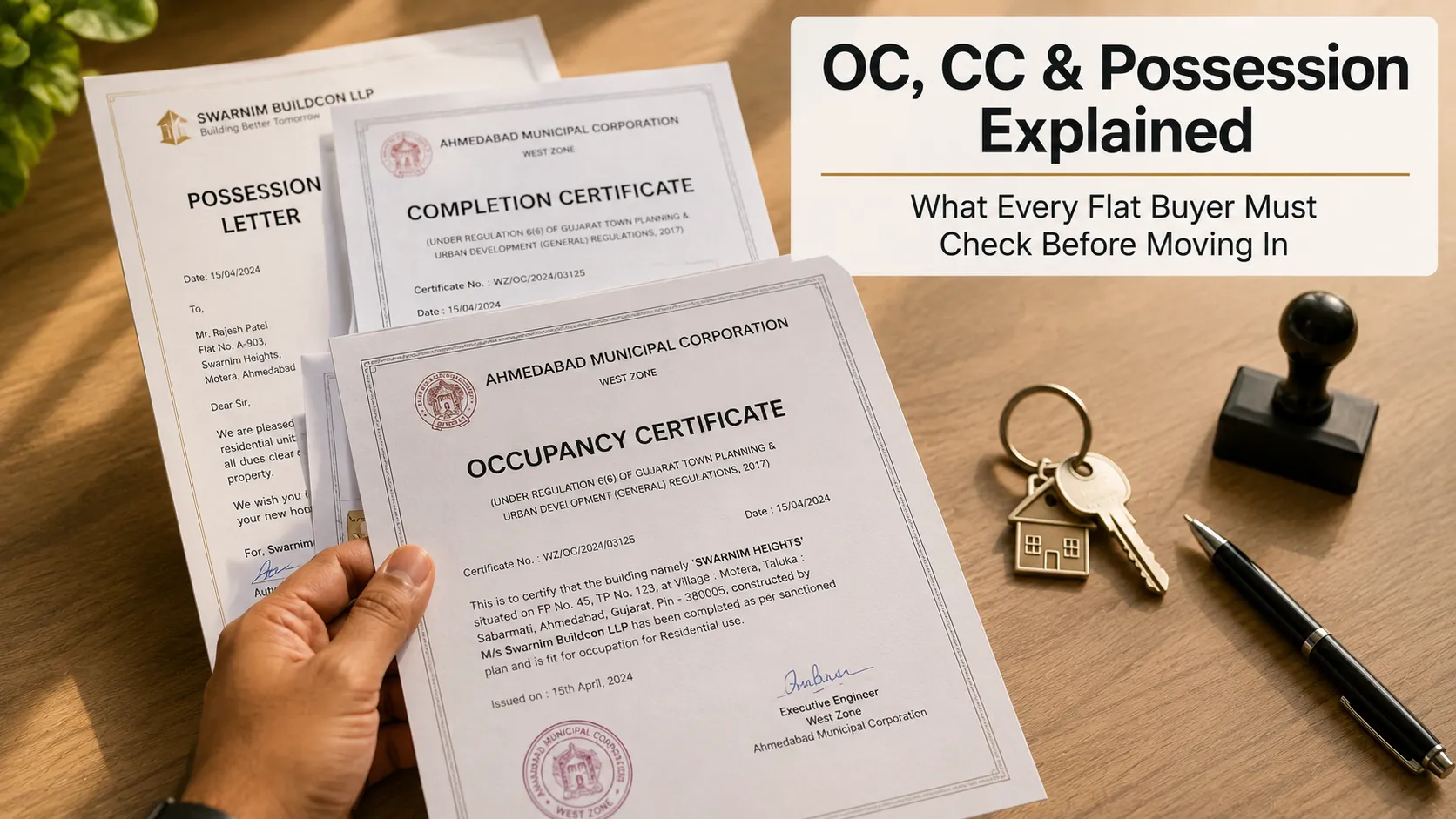

Three abbreviations that confuse almost every first-time buyer in India: OC (Occupancy Certificate), CC (Completion Certificate), and possession. Here's the quick version. CC confirms the building was constructed as per the approved plan. OC confirms the building is safe and legal to live in. Possession is when the builder hands you the keys. The correct sequence is CC first, then OC, then possession. If a builder offers you possession without OC, you're moving into a flat that's technically illegal to occupy, and you'll face problems with water connections, electricity meters, home loans, and resale for years.
This guide explains what each document means, why they matter, and how to verify them before buying a flat in Ahmedabad.
What is a Completion Certificate (CC)?
A Completion Certificate is issued by the local planning authority (in Ahmedabad, this is the Ahmedabad Urban Development Authority (AUDA) or the Ahmedabad Municipal Corporation (AMC) depending on the zone) after the building passes a final inspection.
The CC confirms three things:
Construction matches the approved plan. The number of floors, the floor area, setbacks from boundaries, parking layout, and common area dimensions all match what the builder submitted for approval. If the builder added an extra floor or converted a parking area into shops without approval, the CC won't be issued.
Structural safety standards are met. The building complies with the National Building Code requirements for structural stability, fire safety exits, lift specifications, and earthquake resistance (important in Gujarat, which falls in Seismic Zone III).
Utility provisions are in place. Water supply connections, sewage lines, electrical infrastructure, and fire safety systems are installed and functional.
Without CC, the building is officially "incomplete" in the eyes of the municipal authority, even if it looks finished from the outside and people are living in it.
What is an Occupancy Certificate (OC)?
The OC is issued after the CC, by the same municipal authority (AMC for Ahmedabad city limits, AUDA for extended areas). It specifically certifies that the building is safe and legally fit for people to live in or use.
The difference between CC and OC is subtle but matters:
CC says: "The building was built correctly." OC says: "The building is safe to occupy."
The OC check includes everything in the CC plus additional verification: fire department clearance, environmental compliance (for larger projects), rainwater harvesting systems (mandatory in Gujarat since 2019), and confirmation that the builder hasn't deviated from RERA-registered specifications.
In practice, the OC is the document that unlocks everything for the buyer. Without it, you can't get:
- A permanent water connection from AMC
- An individual electricity meter from Torrent Power or UGVCL
- Home loan disbursement (banks halt final payment without OC)
- Legal resale of the flat (no buyer's lawyer will approve a purchase without OC)
- Property tax assessment (which you actually want, because it proves legal occupancy)
What does "possession" actually mean?
Possession is the formal handover of the flat from the builder to the buyer. It includes:
Physical possession. You get the keys, access cards, parking allotment, and the flat is yours to enter, furnish, and live in.
Legal possession. The builder executes a possession letter, updates the society records (or initiates society formation), and hands over the flat's share certificate or allotment letter.
Financial closure. The final payment tranche is released (if you have a home loan, the bank releases the last disbursement after verifying OC).
The correct and legal sequence is: CC → OC → Possession. Any builder offering possession before OC is asking you to move into an uncertified building. Some buyers accept this out of eagerness or because they're already paying EMI and want to stop paying rent. But the risks are real and long-lasting.
What happens if you move in without OC?
This is where many Ahmedabad buyers make a costly mistake. Here's what goes wrong:
| Problem | Impact | How long it lasts |
|---|---|---|
| No permanent water connection | Tanker water or temporary connection, higher cost | Until OC is obtained |
| No individual electricity meter | Shared builder connection, inflated per-unit charges | Until OC is obtained |
| Home loan final disbursement blocked | Bank holds 10-15% of loan amount | Until OC is obtained |
| Can't legally resell the flat | No buyer's lawyer will clear the title | Until OC is obtained |
| No property tax card | Can't prove legal occupancy for address proof, voter ID | Until OC is obtained |
| Society formation delayed | Can't form a registered cooperative society | Until OC is obtained |
| Municipal action risk | AMC can issue notice, impose penalties, or seal the building | Ongoing |
I've seen buyers in Chandkheda and Bopal who moved into flats in 2023 and still don't have OC in 2026. They're paying ₹12-14 per unit for electricity (versus ₹5-7 per unit with a Torrent Power meter) and can't sell the flat because no bank will approve a loan for a buyer purchasing a flat without OC. The annual financial impact is ₹50,000-1,00,000 in excess electricity charges alone.
Under the Gujarat Municipal Corporations Act, occupying a building without OC is technically illegal. While AMC rarely demolishes residential buildings, they can impose fines of ₹10,000-50,000 and issue stop-work notices that prevent the builder from starting new projects until the OC issue is resolved.
How do you verify OC and CC before buying?
Five steps that take less than a day:
Step 1: Ask the builder directly. Request a copy of the OC and CC. A confident builder will hand them over immediately. If the response is "it's in process" or "we'll get it after possession," that's a red flag.
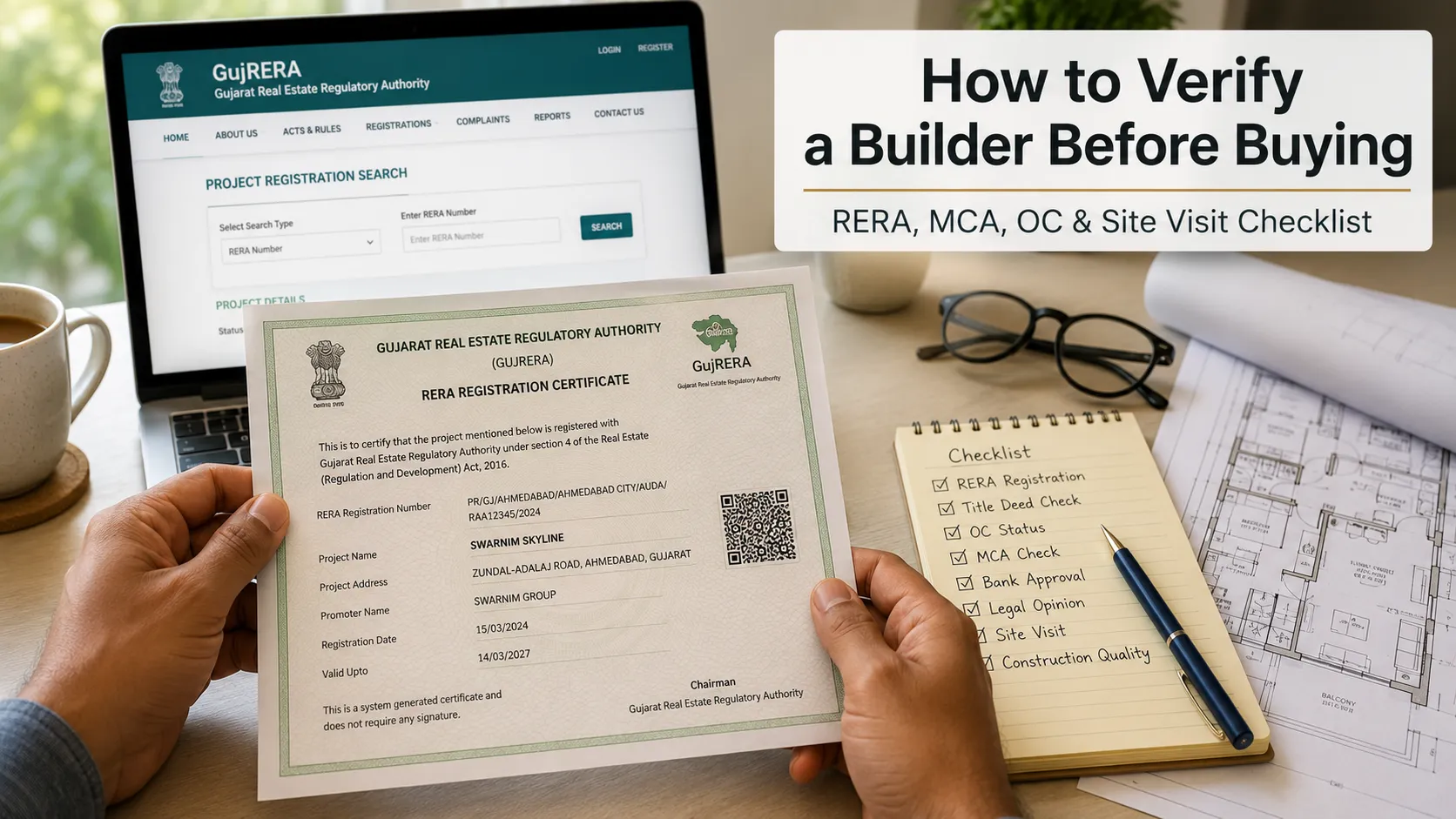
Step 2: Check on Gujarat RERA. Visit gujrera.gujarat.gov.in and search the project. RERA filings include the expected completion date and OC status. If the project shows "completed" on RERA but the builder can't produce an OC, something is wrong.
Step 3: Verify with AMC/AUDA. You can file an RTI (Right to Information) application with AMC or AUDA asking for the OC status of a specific building. The fee is ₹20 and the response comes within 30 days. This is the most reliable verification method.
Step 4: Check with existing residents. If the project has partially occupied buildings, ask current residents whether they have individual electricity meters and permanent water connections. If they don't, the building likely doesn't have OC.
Step 5: Ask your bank. If you're taking a home loan, your bank's legal team independently verifies OC status before final disbursement. If the bank won't release the last tranche, the OC is missing.
Builders with clean delivery records in Ahmedabad who've completed 10+ projects typically have OC documentation ready before or at the time of possession. This is one of the clearest indicators of a credible developer: they don't hand you keys without handing you the OC first.
What's the difference between OC and CC at a glance?
| Parameter | Completion Certificate (CC) | Occupancy Certificate (OC) |
|---|---|---|
| Issued by | AMC / AUDA (planning dept.) | AMC / AUDA (building dept.) |
| What it confirms | Building matches approved plan | Building is safe to occupy |
| When issued | After construction completion | After CC + safety clearances |
| Includes fire clearance | No | Yes |
| Required for water/electricity | No | Yes |
| Required for home loan disbursement | Partially | Yes (final tranche) |
| Required for legal resale | No (but helps) | Yes |
| RERA connection | Project completion status | Mandatory disclosure |
Frequently asked questions
Can I buy a flat that doesn't have OC?
You can, but you shouldn't. Without OC, you'll face problems with water, electricity, resale, and home loans. The flat is technically illegal to occupy. If you're considering it because of a lower price, calculate the excess electricity cost (₹50,000-1,00,000/year) and the resale restriction before deciding.
How long does it take to get OC after construction is complete?
If the building complies with all approved plans, OC typically takes 30-90 days after the builder applies. Delays happen when the builder has made unauthorised changes (extra floors, converted parking) that need rectification first.
Is OC mandatory under RERA?
Yes. RERA requires builders to disclose OC status in project filings. Buyers can file complaints on the Gujarat RERA portal if a builder offers possession without OC. RERA can impose penalties and restrict the builder from launching new projects.
What is partial OC?
Some large projects with multiple towers get OC tower-by-tower as each building is completed. This is called partial OC or phase-wise OC. It's legitimate as long as your specific tower has OC. Check the OC document to confirm your building number is listed.
Can a builder give possession without OC in Gujarat?
Legally, no. But in practice, some builders offer "early possession" or "pre-OC possession" to buyers who've paid in full. Accept this only if you get a written commitment with a date for OC delivery. And understand that you'll face utility and resale limitations until the OC arrives.





























Sign in to leave a comment.