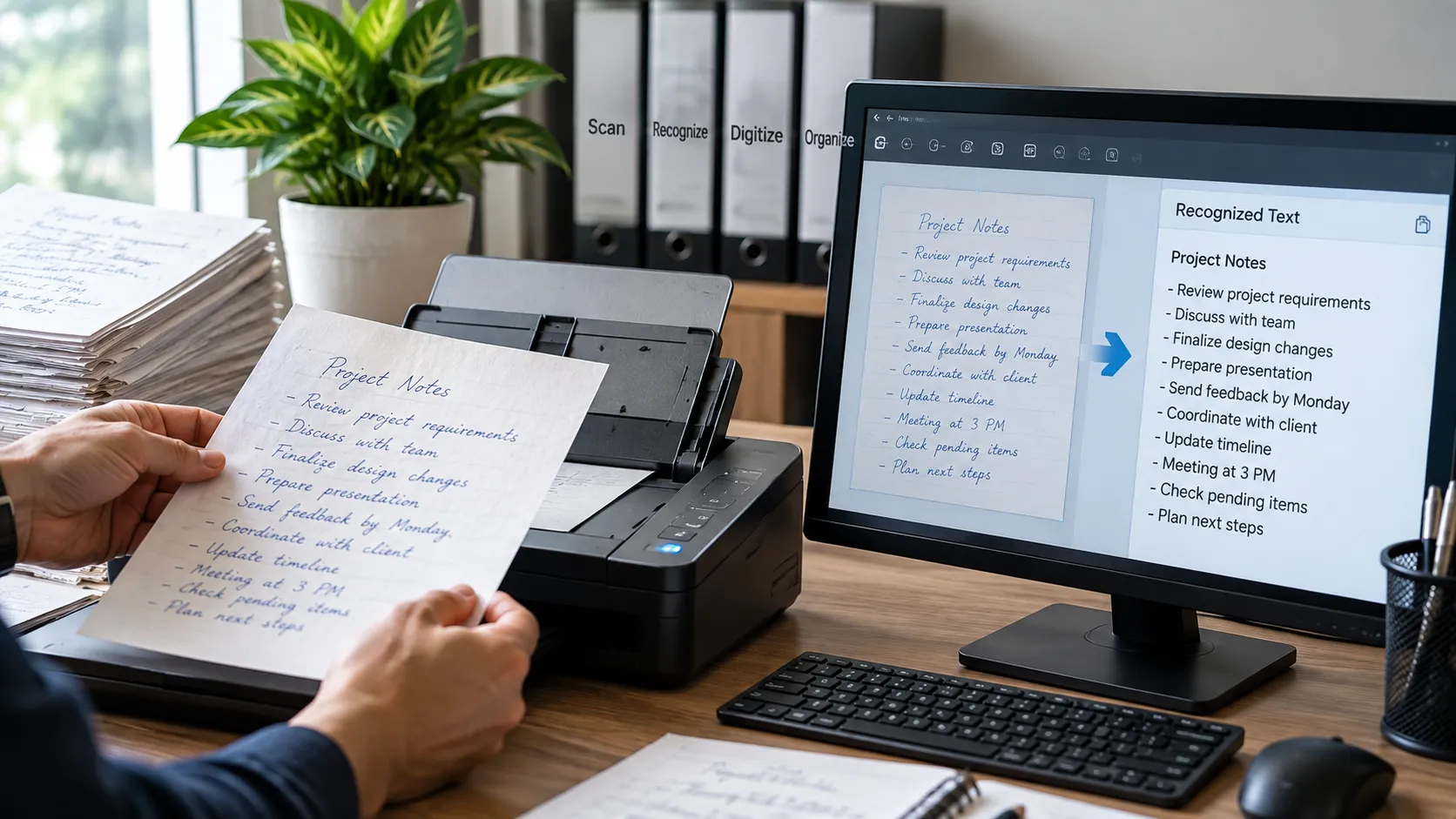

Even as more industries adopt digital workflows, many still use handwritten documents in their daily practices. Every day, documents such as notes, invoices, medical charts, and registers are still often created on paper. This becomes problematic when these handwritten documents need to be searched, stored, or reused.
Typing handwritten documents takes a long time, and if the handwriting isn’t neat and the volume is high, it becomes almost impossible to do without human mistakes. This is the point where Optical Character Recognition (OCR) is useful. Scanned handwritten documents can be turned into machine-readable digital text. The text can then be processed, indexed, and stored efficiently.
Many organizations already use document OCR scanning services when they need to digitize older files or large batches of handwritten records without rebuilding data manually.
What Makes Handwritten OCR Different from Standard OCR
Printed text is usually easier for OCR systems to process because letters maintain consistent shapes and spacing. Handwriting is less predictable as various writing styles, slanted characters, overlapping lines, and inconsistent spacing all make recognition more challenging.
1. Difference in Writing Style
Different people can write the same word very differently, so handwriting recognition software tends to give up on character recognition and looks at word and character structures.
2. Scan Quality
If a scan is low-quality, no matter how good the handwriting is, how even it is, or how much shadow is cast by the hands, it will significantly reduce recognition accuracy.
3. Document Layout
Some handwritten documents can have stamps, signatures, imprinted elements, and even tables. The OCR has to differentiate and separate these components before it can accurately interpret the text.
How an OCR Solution Processes Handwritten Content
Before text recognition begins, some initial processing is performed on the document image.
1. Image Preparation
First, the document is cleaned, aligned, and adjusted to improve character clarity before recognition begins.
2. Finding Characters
The OCR engine most likely finds lines, word boundaries, and character shapes. In handwriting recognition, this stage often uses machine learning models trained on a wide range of writing styles.
3. Change of Format
After matching patterns, the system converts handwriting into editable text that can be searched, copied, and stored in an organised manner.
Where Handwritten OCR Is Most Useful
Documents requiring OCR for handwriting are most valuable in places where paper documents are still used as part of normal day-to-day work processes. OCR for handwriting is useful in the following areas:
1. Paperwork in healthcare
Healthcare documents often include handwritten prescriptions, patient forms, and clinical notes that require digital access.
2. Banking and other financial services
The signed copies of banking and other financial documents, as well as the handwritten transactional documents, need to be kept for future reference and additional review.
3. Education
Some documents, such as admission registers, examination scripts, and handwritten archival documents, need to be digitized to improve storage and access.
Practical Benefits in Daily Business Use
Part of the value of OCR is that it reduces the work across departments.
1. Faster Access to Information
With the digitisation and searchability of handwritten notes, members of your team can easily locate required information instead of picking through a stack of paper.
2. Decreased Manual Work
A great deal of handwritten forms involve tedious typing. OCR significantly reduces that effort and increases uniformity.
3. Better Process Continuity
Many organisations exploring the benefits of OCR find that handwritten OCR enables smoother document handling across finance, operations, compliance, and customer support.
OCR and Data Handling Beyond Recognition
Recognition is only the first step. What happens after extraction often matters more.
1. Structured Information Capture
OCR can help extract handwritten content into structured fields such as names, dates, IDs, and values.
2. The Validation Process Gets Easier
Since the text is already in a digital format, the teams can review the extracted data quickly.
3. Support for OCR Data Entry
In most workflows, OCR data entry captures handwritten text, reducing redundant keyboard entry and enabling text verification and integration into the company's internal systems with minimal user intervention.
Why Accuracy Improves with Modern OCR Models
OCR for handwritten text has undergone substantial improvement as new systems learn from samples rather than from fixed templates.
1. Recognition of Patterns: AI systems are trained on large datasets of handwriting so they can easily identify various styles of each character.
2. Understanding Context: To enhance accuracy, some OCR systems read the text not as individual letters, but as words.
3. Continuous Improvement: OCR models enhance accuracy over time as they are trained on the same documents and recognize the same handwriting.
Choosing a Practical OCR Solution
Not all OCR setups need to be complex. The correct choice tends to vary depending on document type and the expected output.
1. Testing OCR accuracy: Testing claims against real samples of handwritten documents provides better insight than product claims alone.
2. Integration Needs Are Covered: If the extracted text needs to go to databases or internal systems, compatibility will be a concern.
3. Consider Volume and Format: A few scanned pages and thousands of archived records usually require different OCR approaches.
The Future of Handwritten Document Recognition
As recognition model technology improves, handwritten OCR is becoming more reliable. Understanding tough handwriting, documents with mixed languages, and dated scanned documents is improving. A dependable OCR solution minimizes manual processing, enhances the ease of information retrieval, and streamlines information flow, all without altering the source documents.
As companies continue modernizing records, handwritten recognition is becoming part of broader OCR services that support long-term digital accessibility and structured document management.
Future advancements will likely entail more than basic reading, but will include reading comprehension and contextual understanding.

















Sign in to leave a comment.