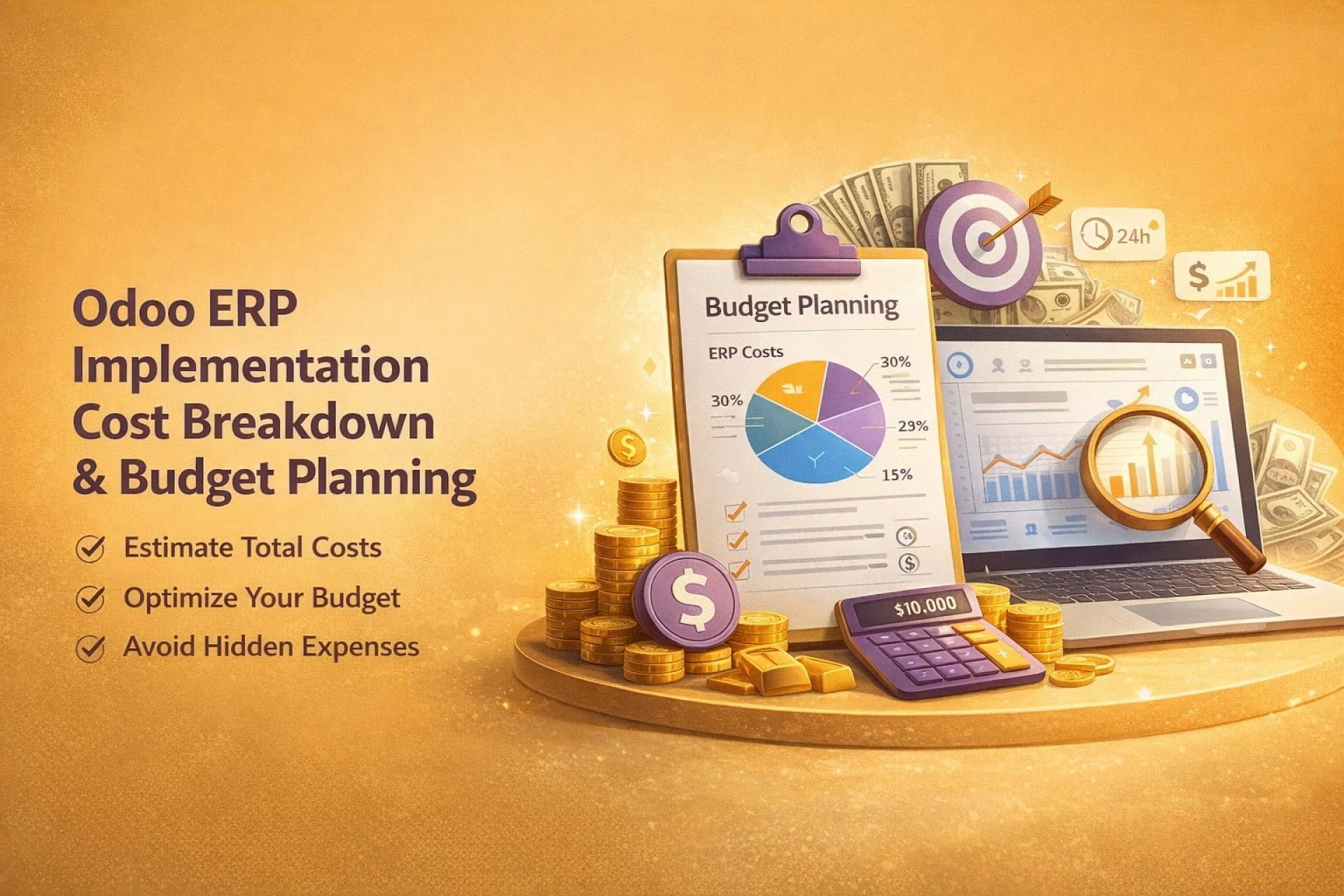

Planning an Odoo ERP implementation often starts with one question: How much will it actually cost?
The challenge is that Odoo pricing isn’t fixed or one-size-fits-all. Two companies using the same ERP can end up with very different budgets depending on scope, customization, and long-term goals.
This guide provides a clear Odoo implementation cost breakdown, explaining where your budget goes, what drives costs up or down, and how to plan realistically. Whether you’re a growing business or an enterprise replacing a legacy system, understanding the cost structure early can save months of rework and overspending.
Why Odoo Implementation Costs Vary So Much
Odoo is highly modular and flexible. That flexibility is its biggest advantage-and the main reason implementation costs vary widely.
Some organizations deploy Odoo with minimal changes, while others heavily customize workflows, integrate third-party systems, and support hundreds of users across regions. The cost is not just about software; it’s about how deeply Odoo is woven into your operations.
This is why focusing only on license pricing gives an incomplete picture of the cost of implementing Odoo ERP.
Key Components of Odoo ERP Implementation Cost
Software Licensing and Hosting
Odoo offers both Community and Enterprise editions. Community has no license fee, while Enterprise pricing depends on the number of users and selected modules. Hosting adds another layer—on-premise, Odoo.sh, or third-party cloud hosting all come with different cost implications.
For small teams, hosting costs remain modest. For enterprises, performance, redundancy, and compliance requirements can significantly influence infrastructure expenses.
Implementation Scope and Complexity
Implementation scope is the strongest cost driver. A basic CRM and accounting setup costs far less than a full ERP rollout covering manufacturing, inventory, HR, sales, and custom workflows.
Organizations often underestimate this phase. Adding just one custom approval flow or multi-company structure can change timelines and pricing. This is why Odoo ERP implementation pricing is typically estimated after detailed discovery rather than upfront.
Customization and Development
Odoo’s out-of-the-box features cover many standard use cases, but most businesses require some level of customization. This may include custom modules, workflow automation, reports, or UI adjustments.
Customization is where costs can rise quickly if requirements are unclear. Teams that define “must-have” versus “nice-to-have” features early tend to control budgets more effectively.
This is also where experienced Odoo Development Services add value by building scalable customizations instead of quick fixes that later require rework.
Data Migration and Integrations
Migrating data from legacy systems is more than a technical task-it’s a data quality exercise. Cleaning, mapping, validating, and testing data takes time, especially when historical records are involved.
Integrations with external systems such as payment gateways, CRMs, logistics platforms, or BI tools also add to the Odoo ERP implementation cost breakdown. Each integration increases testing and maintenance effort, which should be reflected in the budget.
Training, Testing, and Go-Live Support
User training and testing are often under-budgeted, yet they directly affect adoption and ROI. A system that users don’t understand will never deliver value, no matter how well it’s built.
Organizations that invest in role-based training and structured user acceptance testing typically experience smoother go-lives and fewer post-launch issues.
Odoo ERP Implementation Timeline and Cost Relationship
Time and cost are closely linked. A rushed implementation may appear cheaper initially but often leads to rework, support issues, and productivity loss.
For example, a mid-sized distribution company that skipped proper testing reduced initial costs but faced operational disruptions post-launch. Fixing those issues later cost more than the testing phase they originally avoided.
Understanding the Odoo ERP implementation timeline and cost together helps decision-makers balance speed with quality.
Budget Planning: How to Estimate Realistic Odoo Costs
Effective Odoo implementation budget planning starts with clarity, not assumptions. Instead of asking for a single number, organizations should break costs into phases-discovery, implementation, migration, training, and post-go-live support.
It’s also wise to set aside a contingency budget. Even well-planned projects encounter unexpected requirements, especially when business processes evolve during implementation.
Companies that treat ERP as a long-term platform rather than a one-time project tend to make better budgeting decisions.
Small Business vs Enterprise Cost Considerations
A small business may implement Odoo with minimal customization and limited integrations, keeping costs relatively low. Enterprises, on the other hand, often require advanced reporting, multi-company setups, role-based security, and performance optimization.
This doesn’t mean Odoo is unsuitable for large organizations-it means the cost of implementing Odoo ERP scales with ambition and complexity. The key is aligning investment with measurable business outcomes.
Common Cost Mistakes to Avoid
Many organizations underestimate costs by focusing only on initial setup. Ongoing support, upgrades, and optimization are often overlooked but essential for long-term success.
Another common mistake is over-customization early in the project. Building everything upfront increases cost and risk. A phased approach allows teams to validate assumptions before investing further.
Conclusion: Turning Cost Planning into Strategic Advantage
Understanding the Odoo ERP implementation cost breakdown is not about finding the cheapest option-it’s about making informed decisions. When budget planning is aligned with business goals, Odoo becomes a scalable platform rather than an expensive experiment.
A well-planned implementation considers licensing, customization, migration, training, and long-term support as part of a single strategy. Organizations that invest wisely in Odoo ERP implementation services gain flexibility, visibility, and operational efficiency without unexpected financial surprises.
With the right planning, experienced partners, and thoughtful use of Odoo Development Services, businesses can control costs while building an ERP system that grows with them.




























Sign in to leave a comment.