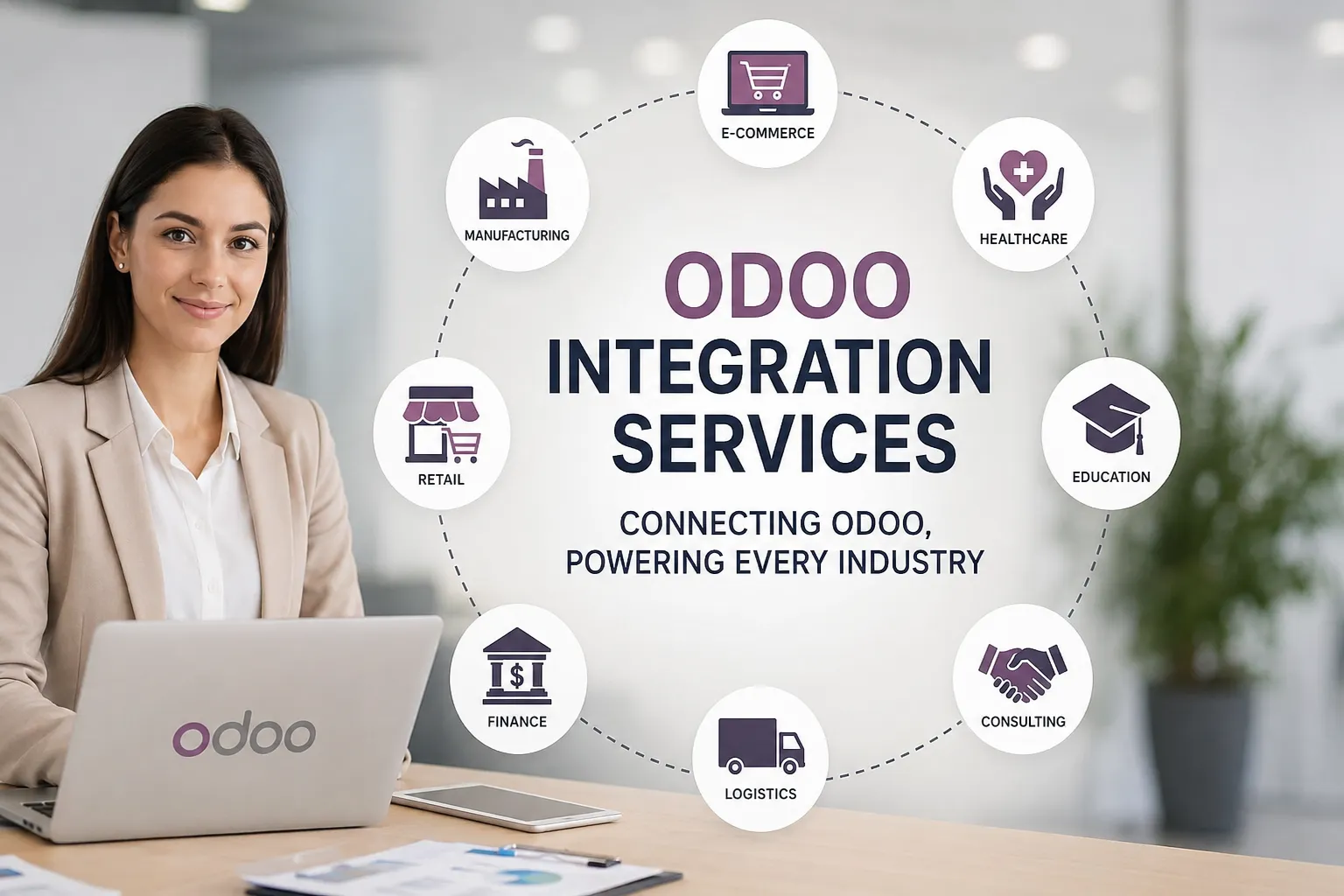

Modern businesses often rely on several applications to manage sales, finance, inventory, customer support, eCommerce, logistics, and other daily operations. When these systems do not communicate with one another, employees spend more time transferring data manually, correcting errors, and working with incomplete information. Odoo Integration services help businesses connect Odoo with essential platforms so that data moves smoothly across departments, processes become more efficient, and decision-makers gain a more accurate view of business performance.
Why Odoo Integration services Matter for Growing Businesses
Odoo is known for its modular structure, which allows companies to use applications for CRM, accounting, manufacturing, inventory, project management, human resources, and more. However, most businesses already use third-party platforms that support important processes. Replacing every existing system may not be practical or cost-effective. Integration allows organizations to retain useful tools while making Odoo the central source of operational information.
A reliable connection between Odoo and external applications can reduce duplicate data entry, improve reporting accuracy, and shorten process completion times. For example, connecting an eCommerce platform with Odoo can automatically synchronize customers, orders, products, stock levels, taxes, and shipment details. Similarly, integrating a payment gateway can help finance teams reconcile transactions faster and maintain more accurate records.
Choosing the best odoo integration company is important because ERP connectivity affects multiple departments and business-critical workflows. A capable integration partner should understand Odoo’s architecture, the external system, data security requirements, and the organization’s long-term operational goals.
Start With Clear Business Requirements
A successful integration project begins with a clear understanding of the problem that needs to be solved. Businesses should identify which systems must be connected, what data needs to move between them, how frequently it should be synchronized, and which platform should be treated as the primary source for each type of information.
For instance, a company may decide that Odoo will be the master system for product and inventory data, while its eCommerce platform will manage online customer activity. Defining these responsibilities early prevents conflicts, duplicate records, and inconsistent updates.
It is also important to map the complete workflow instead of focusing only on individual data fields. An order integration may involve customer creation, product validation, tax calculation, payment confirmation, inventory reservation, invoice generation, shipping updates, and return processing. Missing even one stage can create operational gaps after deployment.
Select the Right Integration Approach
Odoo can connect with external systems through APIs, middleware platforms, custom connectors, webhooks, file-based exchanges, and prebuilt applications. The best approach depends on the complexity of the workflow, the volume of data, the required synchronization speed, and the technical capabilities of the connected platform.
Prebuilt connectors may work well for standard requirements and can reduce development time. However, they should be carefully evaluated for compatibility, scalability, support, and customization limitations. Custom API integrations are usually more suitable when the business has unique workflows, complex data rules, or strict performance requirements.
Middleware can also be valuable when several systems need to exchange information. It creates a centralized integration layer that can simplify monitoring, transformation, and error handling. However, businesses should consider licensing costs, vendor dependency, and the technical skills needed to maintain the middleware environment.
Follow Data Mapping and Validation Best Practices
Accurate data mapping is one of the most important parts of Odoo Integration services. Every field in one system must be matched correctly with the corresponding field in the other system. Differences in naming conventions, formats, units, currencies, tax structures, and record identifiers must be resolved before data synchronization begins.
Data validation rules should also be established to prevent incomplete or incorrect information from entering Odoo. Required fields, accepted values, duplicate checks, date formats, and relationship rules should be tested thoroughly. Historical data may need cleaning before migration, especially when multiple legacy systems contain inconsistent records.
Working with the best odoo integration company can help businesses create structured mapping documents, identify hidden data dependencies, and establish validation rules that reduce integration failures.
Build Strong Security and Access Controls
ERP integrations often handle sensitive information such as customer details, financial records, employee data, pricing, and payment information. Security must be considered throughout the integration lifecycle.
Businesses should use secure authentication methods, encrypted connections, controlled API access, and role-based permissions. Integration credentials should never be shared unnecessarily or stored in unsecured locations. Access should be limited to the specific data and actions required by the integration.
Audit logs are equally important. They help technical teams track data exchanges, investigate unexpected changes, and identify unauthorized activity. Organizations should also review data protection requirements based on the regions and industries in which they operate.
Plan for Errors, Downtime, and Recovery
Even a well-designed integration can experience temporary failures caused by network issues, API limits, server downtime, invalid data, or changes in third-party systems. A successful implementation must include clear error-handling and recovery processes.
Failed transactions should be logged with useful details, and responsible team members should receive alerts when critical issues occur. The integration should support retries where appropriate without creating duplicate records. For high-volume workflows, a queue-based process can help manage delays and process transactions safely after services are restored.
Businesses should also define what happens when one system is unavailable. In some cases, transactions can wait in a queue. In others, users may need a temporary manual process. Documenting these scenarios reduces confusion during unexpected disruptions.
Test Real Business Scenarios
Technical testing alone is not enough. Odoo Integration services should be tested using realistic business scenarios, including standard transactions, unusual conditions, incomplete records, duplicate submissions, cancellations, refunds, returns, and high-volume periods.
Testing should cover individual components as well as the complete end-to-end workflow. Users from finance, sales, inventory, operations, and customer service should participate because they understand how processes work in practice. Their feedback can reveal issues that technical teams may overlook.
A staging environment should be used whenever possible so that testing does not affect live business data. Before launch, the team should confirm data accuracy, performance, permissions, notifications, reporting, and recovery procedures.
How the best odoo integration company Supports Long-Term Success
Integration work does not end when the connection goes live. APIs change, business processes evolve, data volumes grow, and new applications may be introduced. Continuous monitoring helps businesses identify failures early and maintain reliable connectivity.
Key metrics may include successful transactions, failed records, processing time, synchronization delays, API usage, and retry frequency. Regular reviews can reveal bottlenecks and opportunities for improvement.
A dependable integration partner should provide clear documentation, maintenance support, and knowledge transfer. Internal teams should understand how the integration works, where logs are stored, how common errors are resolved, and when specialist support is required.
Create a Scalable ERP Connectivity Strategy
Odoo Integration services deliver the most value when they are designed as part of a long-term ERP strategy rather than as isolated technical fixes. Businesses should use consistent integration standards, reusable components, clear naming conventions, and documented ownership responsibilities.
A scalable strategy makes it easier to connect new applications, expand into additional markets, and adapt workflows as the company grows. It also reduces maintenance complexity and prevents the organization from becoming dependent on fragile, undocumented connections.
Successful ERP connectivity requires more than moving data between two systems. It requires thoughtful planning, accurate mapping, secure architecture, realistic testing, reliable monitoring, and continuous improvement. When these practices are followed, Odoo becomes a more connected and effective business platform that supports faster operations, better collaboration, and more confident decision-making.




























Sign in to leave a comment.