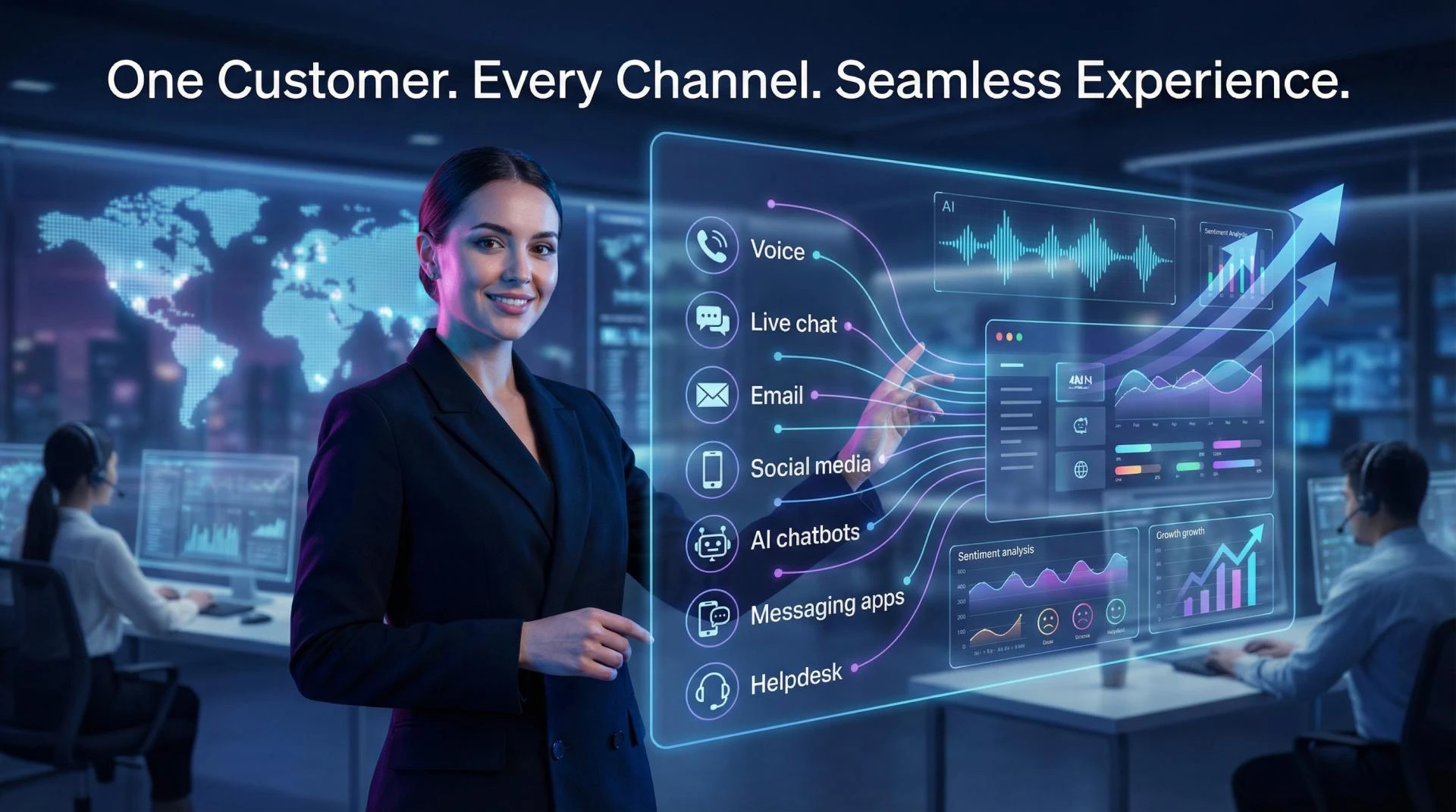

Omnichannel BPO support is a customer experience strategy that integrates multiple communication channels—voice, chat, email, and social media—into a unified, AI-enabled outsourcing model. It enables enterprises to deliver consistent, real-time, and scalable support while reducing costs, improving efficiency, and enhancing customer satisfaction.
What Is Omnichannel BPO Support?
Omnichannel BPO support refers to the delivery of customer experience services across multiple communication channels through a centralized outsourcing model powered by AI, automation, and integrated platforms.
Unlike traditional customer service outsourcing or siloed contact center outsourcing, omnichannel BPO connects every touchpoint—voice, chat, email, social media, messaging apps—into a single ecosystem. This ensures continuity, context, and consistency in every customer interaction.
It represents the evolution of business process outsourcing services, combining bpo call center operations with AI-driven workflows and real-time analytics.
AI Overview: Chatbots vs Human Agents in CX
AI is central to omnichannel BPO transformation.
AI Chatbots
- Handle repetitive, high-volume queries
- Provide instant responses 24/7
- Reduce operational costs significantly
- Improve response times and availability
Human Agents
- Manage complex, high-value interactions
- Deliver empathy and contextual understanding
- Resolve escalations and sensitive cases
Hybrid CX Model (Most Effective)
- AI manages Tier-1 queries
- Humans handle Tier-2 and Tier-3 issues
- Seamless handoff between AI and agents
- Optimized cost-to-service ratio
This hybrid model is now the foundation of modern Cxm strategies across global enterprises.
Key Insights at a Glance
- 30–60% cost reduction through omnichannel BPO and automation
- Up to 70% of customer queries handled by AI
- 40–50% reduction in average handling time
- 20–30% improvement in customer satisfaction scores
- 24/7 global support improves retention and loyalty
- Vendor consolidation reduces operational risk
Why Enterprises Are Adopting Omnichannel BPO
1. Rising Customer Expectations
Customers expect instant, personalized, and consistent service across all channels.
2. Global Scalability Requirements
Enterprises need support systems that operate across time zones and geographies.
3. Cost Optimization Pressure
AI and outsourcing reduce labor costs while maintaining service quality.
4. Operational Complexity
Managing multiple channels internally increases inefficiency and fragmentation.
Core Components of Omnichannel BPO Architecture
1. Unified Communication Layer
Integrates all channels into a single interface.
2. AI & Automation Engine
- Chatbots
- NLP systems
- Automated workflows
3. Data & Analytics Layer
- Real-time customer insights
- Predictive analytics
- Performance dashboards
4. Workforce Management
- Global talent pools
- AI-assisted agents
- Productivity optimization
5. Governance & Compliance Framework
- Data protection
- Regulatory adherence
- Vendor risk management
Real-World Enterprise Use Cases
Global Retail Expansion
A multinational eCommerce company uses back office outsourcing services and omnichannel BPO to support customers in multiple regions with multilingual agents and AI translation tools.
BFSI Transformation
A financial institution adopts financial services outsourcing and insurance bpo to streamline operations while ensuring regulatory compliance and secure data handling.
Healthcare Support Optimization
Hospitals leverage healthcare outsourcing services to manage patient inquiries, appointment scheduling, and billing support across channels.
Telecom Customer Support
Telecom providers deploy AI chatbots to handle high-volume queries, reducing call center load and improving response time.
Step-by-Step Implementation Framework
Step 1: Assess Current CX Maturity
- Identify channel gaps
- Evaluate customer journey pain points
- Benchmark performance metrics
Step 2: Define CX Operating Model
- Choose AI-only, human-only, or hybrid model
- Align with business objectives
Step 3: Select Technology Stack
- CRM/CXM platforms
- AI chatbot solutions
- Omnichannel communication tools
Step 4: Choose BPO Partner
Evaluate based on:
- Global delivery capability
- AI integration expertise
- Compliance and security standards
- Industry experience
Step 5: Integrate Systems
- Connect CRM, AI, and communication channels
- Ensure data synchronization
Step 6: Implement Governance
- SLA management
- Vendor performance tracking
- Compliance monitoring
Step 7: Optimize Continuously
- Use analytics for improvement
- Refine AI models
- Enhance customer journeys
Read More: https://mascallnet.ai/callmaster/
Business Benefits & ROI
Cost Efficiency
- Reduce operational costs by up to 60%
- Lower staffing requirements through automation
Productivity Gains
- Faster response and resolution times
- Improved agent efficiency
Customer Experience Improvement
- Consistent omnichannel interactions
- Higher satisfaction and retention rates
Data-Driven Decision Making
- Real-time insights enable proactive engagement
- Predictive analytics improve customer targeting
Quantified Enterprise Example
A global eCommerce enterprise implemented omnichannel BPO and achieved:
- 45% cost reduction
- 50% faster response times
- 25% increase in customer satisfaction
- 35% improvement in first contact resolution
Governance, Risk & Compliance
Data Governance
- Centralized data ensures consistency and security
- Compliance with global regulations (GDPR, HIPAA)
Vendor Risk Management
- Multi-vendor strategy reduces dependency
- SLA enforcement ensures accountability
AI Oversight
- Human-in-the-loop systems
- Bias monitoring and validation
- Transparent audit trails
Cross-Border Compliance
- Data localization strategies
- Region-specific regulatory adherence
Workforce Continuity Planning
- Distributed teams reduce disruption risks
- Backup systems ensure operational continuity
Omnichannel BPO vs Traditional Models
Traditional BPO
Strengths: Lower cost than in-house operations.
Limitations: Siloed channels and limited integration.
Best Use Case: Basic outsourcing needs with low complexity.
AI-Only CX
Strengths: Highly scalable and cost-efficient with 24/7 automation.
Limitations: Lacks human understanding for complex issues.
Best Use Case: High-volume, repetitive customer interactions.
Hybrid CX (AI + Human)
Strengths: Combines efficiency of AI with human expertise for better outcomes.
Limitations: Requires investment in integration and governance.
Best Use Case: Enterprise omnichannel environments with mixed complexity.
How to Choose the Right BPO Partner
Key Selection Criteria
- Proven experience in omnichannel CX
- Strong AI and automation capabilities
- Global delivery infrastructure
- Compliance certifications
- Transparent pricing and SLAs
Red Flags to Avoid
- Lack of AI integration
- Limited scalability
- Weak data security practices
- No clear governance framework
FAQ — Enterprise Level
How can enterprises reduce support costs using AI?
By automating repetitive queries, optimizing workforce allocation, and leveraging AI-driven routing, enterprises can reduce support costs by up to 60%.
Is outsourcing safer than in-house operations?
Outsourcing can be safer when supported by strong governance, compliance frameworks, and vendor risk management systems.
What industries benefit most from omnichannel BPO?
BFSI, healthcare, retail, telecom, logistics, and eCommerce benefit significantly due to high customer interaction volumes.
What risks must be managed?
Key risks include data security, compliance, vendor dependency, and AI bias, all of which require structured governance.
How long does implementation take?
Typical enterprise implementation ranges from 3 to 9 months depending on complexity and scale.
Conclusion
Omnichannel BPO support is a strategic enabler of modern customer experience, combining AI, automation, and global outsourcing to deliver scalable, efficient, and high-quality service.
Enterprises adopting hybrid CX models achieve measurable improvements in cost, performance, and customer satisfaction while strengthening governance and operational resilience.
Organizations evaluating their future CX operating model should assess whether their current structure can sustainably support this model at scale.



























Sign in to leave a comment.