
Introduction
You've probably heard that one dog year equals seven human years, but that old rule of thumb isn't nearly as accurate as most people assume. Dogs age differently depending on their size and breed, and the simple "multiply by seven" method can be off by a lot, especially early on.
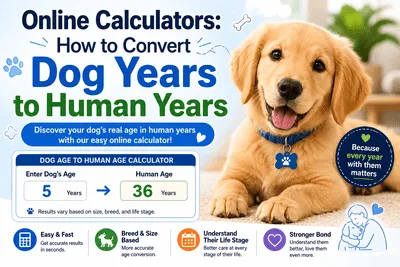
Understanding how dog aging actually works helps pet owners make better sense of their dog's life stage. A dog age to human years tool built for this kind of conversion uses more realistic aging patterns than the old multiplication trick, giving a closer estimate of a dog's age in human terms.
This guide explains why the "times seven" rule is outdated, how a more accurate approach works, and how to estimate your dog's age in human years using a dog age chart.
Why the "Times Seven" Rule Is a Myth
The idea that one dog year equals seven human years likely came from comparing average human and dog lifespans decades ago, without accounting for how aging unfolds. Dogs mature much faster than humans in their first couple of years, then age at a slower, steadier pace afterward.
A one-year-old dog isn't comparable to a seven-year-old child — it's closer to a teenager, already near physical maturity. This is where the simple multiplication method breaks down, and where a dog age conversion built on staged aging models does better.
How Dog Aging Actually Works
Dogs experience rapid physical changes in their first two years, then settle into a slower aging rate for the rest of their life — very different from the steady, linear aging humans experience.
Why a Flat Multiplier Doesn't Work
Since dog aging isn't linear, a single multiplier applied across a dog's entire life can't capture the fast early growth followed by slower later aging. This is exactly the non-linear pattern that a dedicated dog age chart is built to account for.
A More Accurate Age Conversion Approach
A commonly used, more realistic approach breaks a dog's aging into stages rather than applying one flat number:
First year: Roughly equivalent to 15 human years, covering rapid growth.
Second year: Adds roughly 9 more human years, bringing a 2-year-old dog to about 24 in human terms.
Each year after: Adds a smaller number, often estimated around 4 to 5 years per dog year, depending on size.
This staged approach reflects the fast early development followed by a slower aging curve later in life — the same logic behind a staged dog age to human years tool.
How Breed Size Affects Aging
Breed size plays a significant role in how a dog ages, particularly later in life:
Small breeds tend to live longer and often age more slowly after their early years.
Large and giant breeds typically mature faster as puppies but age more quickly in their senior years.
This is why two dogs of the same chronological age, but different sizes, can be at noticeably different life stages.
Real-World Examples
A 1-year-old dog ≈ 15-year-old human, near physical maturity.
A 2-year-old dog ≈ 24-year-old human.
A 5-year-old small breed dog ≈ late 30s in human years.
A 5-year-old large breed dog ages slightly faster, closer to the low-to-mid 40s.
A 10-year-old dog, depending on size, generally falls into the senior human age range.
Other Useful Online Calculators
Pet age conversion is just one example of how everyday calculations rely on the right formula for the situation, similar to unit conversions or percentage changes. Having a set of online calculators in one place makes it easy to check different conversions and calculations.
| Calculator Type | Common Use | Example |
|---|---|---|
| Age Calculator | Human age calculations | Birth date to today |
| Unit Converter | Converting measurements | km to miles |
| Percentage Calculator | Percentages and changes | 20% of 500 |
Sites offering a full range of calculation tools, such as CalcFormulas, make it convenient to check conversions like these alongside other everyday math.
Pros and Cons
Pros: A staged conversion is more accurate than the old flat multiplier, quick to reference, and helpful for understanding a dog's general life stage.
Cons: Results are still estimates, breed and individual health can affect actual aging, and no formula replaces guidance from a veterinarian for health decisions.
Expert Tips
Avoid relying on the outdated "times seven" rule.
Consider your dog's breed size when estimating their human-age equivalent.
Use a staged approach that accounts for faster early-life aging.
Treat any conversion as a general estimate, not an exact figure.
Consult a veterinarian for health decisions tied to your dog's actual age.
Use a dog age chart designed for pet age conversion, and general online calculators for other everyday math, as a quick reference point.
Common Mistakes to Avoid
Relying on the outdated "one year equals seven years" multiplier
Ignoring breed size when estimating a dog's human-age equivalent
Assuming aging is linear throughout a dog's life
Treating an estimated conversion as an exact medical figure
Comparing dogs of different sizes using the same aging assumptions
Key Takeaways
The "one dog year equals seven human years" rule is outdated and inaccurate.
Dogs age rapidly in their first two years, then more slowly afterward.
Breed size significantly affects aging speed, especially later in life.
A staged dog age conversion approach gives a more realistic human-age estimate.
Any conversion is a general estimate, not a substitute for veterinary guidance.
FAQs
What is a dog age to human years tool used for?
Converting a dog's age into an estimated human-age equivalent using a staged aging model.
Is the "one dog year equals seven human years" rule accurate?
No, it's outdated and doesn't reflect how dogs actually age, especially early on.
How fast do dogs age in their first year?
Very quickly a one-year-old dog is roughly comparable to a teenage or young adult human.
Does breed size affect a dog's aging rate?
Yes, larger breeds tend to age faster in their senior years, while smaller breeds age more slowly.
What's a more accurate way to estimate a dog's human age?
A staged approach accounting for rapid early growth followed by slower aging later on, often shown as a dog age chart.
Is a dog's converted human age medically meaningful?
It's a general estimate for life stage, not a precise medical measurement.
Do all dog breeds age at the same rate?
No, aging speed varies notably between small, medium, large, and giant breeds.
Should I use age conversion instead of veterinary advice?
No, conversions are for general reference only; a vet can assess your dog's actual health.
Conclusion
The classic "multiply by seven" rule doesn't reflect how dogs actually age, especially given how quickly they mature in their first couple of years. A staged dog age conversion approach that accounts for breed size and non-linear aging gives a far more realistic picture of your dog's life stage.
For readers who want a quick way to estimate conversions like these alongside other everyday calculations, a dog age to human years calculator like the one on CalcFormulas offers a convenient starting point.





























Sign in to leave a comment.