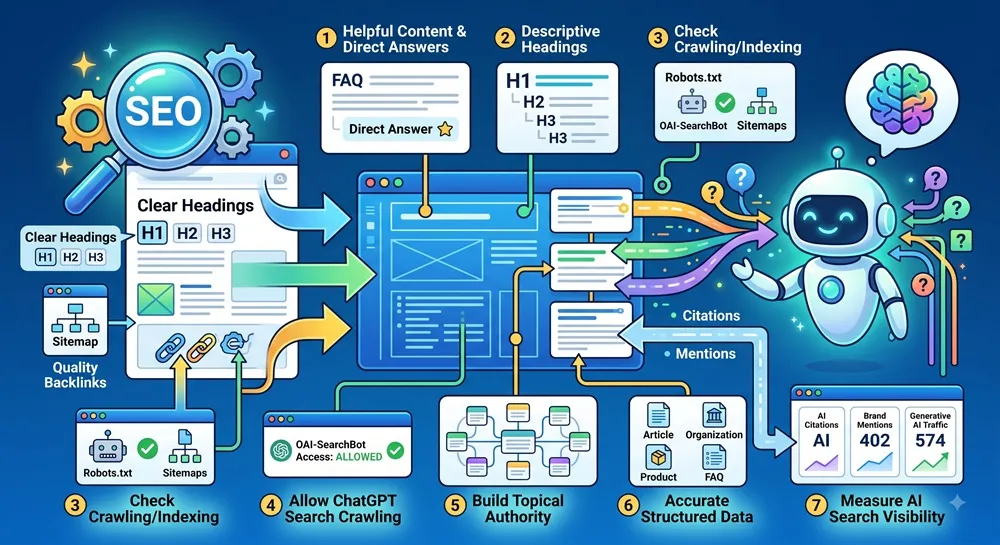

AI search is changing how people find businesses, products, and information online. Instead of typing short keywords into Google, users can ask detailed questions in ChatGPT and other AI search tools. To improve visibility, businesses need websites that are easy to crawl, understand, trust, and cite. This guide explains practical ways to optimize a website for ChatGPT and AI search while keeping traditional SEO strong.
What Is AI Search Optimization?
AI search optimization means improving your website so AI search systems can understand your content and use it when answering relevant questions. It builds on standard SEO rather than replacing it.
Google states that its generative AI search features rely on core Search systems, including retrieval of relevant web pages from its index.
OpenAI also says that there is no guaranteed way to receive top placement in ChatGPT Search. However, websites should allow OAI SearchBot to crawl their content and make sure their hosting setup does not block OpenAI search traffic.
7 Ways to Optimize Your Website for ChatGPT
1. Create Clear, Helpful Content
Start with the questions your customers actually ask. Give a direct answer near the start of each page, then provide useful details, examples, and supporting facts.
Google recommends helpful, reliable, people first content with original value rather than content created mainly to gain search traffic.
For a B2B marketing company, this could include pages answering questions about lead generation, content marketing, SEO, paid advertising, and customer acquisition.
2. Use Clear Headings and Page Structure
Organize content with descriptive H1, H2, and H3 headings. Keep paragraphs short and use lists or tables when they make information easier to understand.
A simple structure helps both visitors and search systems identify the main points of a page.
3. Check Crawling and Indexing
Your content must be accessible before it can appear in search or AI search results. Check robots.txt, XML sitemaps, canonical tags, internal links, and indexing status.
Google states that pages generally need to be indexed and eligible for normal Search results to qualify for its generative AI features.
4. Allow ChatGPT Search Crawling
Check whether your website allows OAI SearchBot to access important pages. OpenAI specifically recommends allowing this crawler when you want your site to be available in ChatGPT Search.
5. Build Topical Authority
Create useful content around related questions instead of publishing isolated articles. Link relevant pages together so users can move from basic information to detailed guides and service pages.
This creates a stronger topic structure and gives search systems more context about your expertise.
6. Add Accurate Structured Data
Use relevant schema markup when it accurately describes visible page content. Article, Organization, Product, and other suitable types can help search systems understand page information.
Google says structured data is not required for generative AI search, but it remains useful as part of a broader SEO strategy.
7. Measure AI Search Visibility
Do not measure success only through traditional rankings. Track brand mentions, citations, referral traffic, conversions, and visibility across relevant AI search experiences.
Google introduced Generative AI performance reporting in Search Console in 2026 and is rolling it out to a subset of websites.
Quick AI Search Optimization Checklist
- Content: Clear, useful, original answers
- Technical SEO: Crawling, indexing, sitemap, canonical tags
- Structure: H1, H2, H3 headings and short sections
- Authority: Authors, sources, expertise, relevant links
- AI access: OAI SearchBot access
- Schema: Accurate structured data
- Measurement: AI visibility, citations, traffic, conversions
FAQs
How do I get my website to appear in ChatGPT Search?
Make your important pages crawlable, publish reliable content, and allow OAI SearchBot to access your website. OpenAI does not guarantee top placement.
Is SEO still important for AI search?
Yes. Google says its generative AI search features are built on core Search and SEO systems. Strong technical SEO and useful content remain important.
Do I need special AI markup?
No. Google says there is no special schema or AI markup required for visibility in its generative AI search features.
Final Thoughts
Optimizing for ChatGPT and AI search starts with the same foundation as good SEO: useful content, technical access, clear structure, and genuine expertise. Businesses that want a more focused strategy can consider AI search optimization services to audit content, technical readiness, visibility, and citation opportunities. For a B2B marketing company, this approach can help build stronger digital authority while reaching customers who now use conversational search to research solutions. Arokia IT LLC can help businesses build a practical strategy that connects traditional SEO with modern AI search visibility.
Source:- https://tinyurl.com/3bd2t7uv















Sign in to leave a comment.