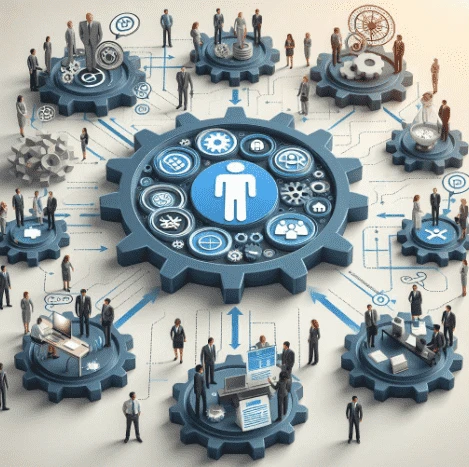

Operating a company is like conducting an orchestra. Finance, sales, and marketing are all instruments in a magnificent symphony that is created together. However, your HR division? stuck making noise with pots and pans when others are playing Mozart.
There are two common approaches to automate your HR tasks. You have two options: find an integrated suite that does everything or use separate software for each task. However, depending on the suite or vendor you're looking at, "everything" could mean something else.
According to a report, the market for human resource (HR) technology is expected to reach $81.84 billion by 2032, growing at a compound annual growth rate (CAGR) of 9.2% from $40.45 billion in 2024.
Recognizing Platforms for HR Technology and Their Integration
Platforms for HR technology are made to automate and streamline HR operations, such as hiring, payroll, and employee engagement. Connecting or combining several systems creates a seamless HR ecosystem that efficiently exchanges functionality and information.
Increasing productivity and efficiency is one of the key benefits of combining several HR technology systems. HR professionals' ability to obtain essential information without switching between systems is enhanced when the platforms interact and exchange data.
Compatibility problems, worries about data privacy, and the requirement for extra staff training are some difficulties that can arise when integrating various systems.
Advantages of One HR Integrated System
Working with a single system can greatly simplify things in your HR department, so carefully weigh the benefits and drawbacks before choosing your course of action. This entails how your choice will affect not just one area, no matter how particular or intricate, but the entire department and the larger organization.
1. Saves time
Using several platforms for various services might be complicated and challenging for your staff. As a result, HR may have to deal with a higher volume of inquiries from staff members regarding problems with these different systems, which could waste time and reduce output for everyone.
Having everything in one place, an integrated system saves time and hassle for all parties involved. Employees only need to log in once to view important information, such as current training status, payment information, and leave dates.
2. Enhanced reporting and analytics
The amount of work necessary to compile reports that appear straightforward is one of the most frequent issues that HR teams encounter. The data's quality is the primary cause. Data gathering, cleaning, and consolidation with various systems are usually done by hand. Compiling reports using cumbersome spreadsheets and intricate formulae might take days.
Most integrated systems come with a single set of reliable data to work with, with reporting, and analytics capabilities built right in. As a result, creating reports only requires a few clicks, freeing up HR teams' time to analyze data, spot trends, and take action rather than spending endless hours fiddling with spreadsheets.
3. Making compliance smoother
The most notable example of the growing regulatory obligations on HR professionals is the General Data Protection Regulation (GDPR). Numerous new tasks must be completed, adding to an already full plate.
HR staff may easily accomplish these additional responsibilities, which reduces work and mistake risk. They will offer an audit record of compliance actions and automate certain compliance process steps.
Features to guarantee permission is appropriately tracked, swiftly handle subject access requests, and deletion capabilities to abide by the right to erasure are a few examples of what this may contain.
4. A centralized solution
HR managers may access employee data centrally with integrated HRIS, automate manual operations, and make system-wide adjustments and modifications. Furthermore, integrations are pre-built into HRIS since they are intended to be a single solution.
It means that since all of the system's components are a part of the same ecosystem, HR managers won't have any trouble exchanging data across them, for example, when managing general HR chores and onboarding new hires.
5. Increases accuracy
The additional benefit of having data come into your system only once is that it will increase the accuracy of your data. Multiple systems increase the need for more personnel to enter more data, which raises the risk of human error and all the issues that result from it.
An integrated system greatly reduces the chance of human error through a streamlined and much lower data input requirement, providing you considerably better confidence in the correctness of your employee records even while it cannot eliminate the possibility of human error.
When Should You Consider Switching from Multiple HR Systems to One Integrated HR System?
Any software integration requires resources and time. Therefore, it is essential to know which circumstances call for HR integration and which do not. The best course of action is to evaluate your specific scenario to determine the most prudent, as every situation is unique.
1. Outdated version
The simplest HR system includes salary management, benefits administration, and recruiting. The business may use an HR system devoid of some of the characteristics your business needs. Your organization is a great candidate for integration to upgrade to software where all of your systems are connected to one.
Your company is a great candidate for integration to upgrade to a program where all of your systems are connected into one if you've made up for it by creating separate systems for other HR services and lack the resources to convert to an all-in-one suite.
2. Best of the Breed Option
Apps from several vendors that are distinct from one other may better fit your business's goals, methods, and legal requirements.
Vendors having expertise in one sector, like workforce management, are more likely to offer a solution with greater capability. They might concentrate their resources and expertise on a more limited specialization, which is the reason behind this.
Utilizing several best-of-breed systems together allows you to take advantage of specialization while still enjoying the benefits of centralization.
Wrapping Up
The use of an integrated HR system has numerous benefits and drawbacks. Some will center on the HR metrics you wish to use and evaluate for your HR data, while others will be centered on what your organization and employees require to achieve their goals.
It can be accomplished by using an HR system to automate processes. The cost and the time it takes to determine what your business needs to implement the finest HR methods to centralize all data and boost productivity across the board are some drawbacks.
























Sign in to leave a comment.