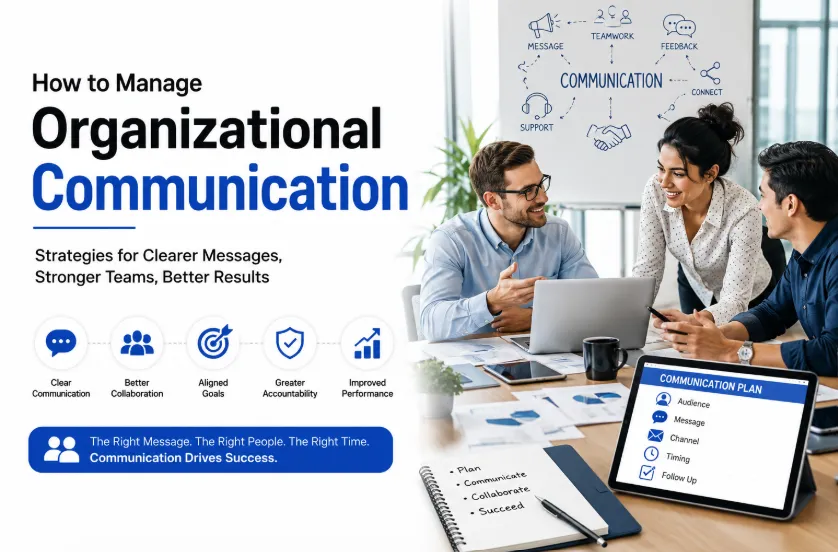

How to manage organizational communication effectively starts with a simple question: Can people get the information they need, understand it quickly, and know what to do next?
A business can have talented employees, strong products, and excellent technology. But if information gets lost between teams, decisions become unclear, or employees receive conflicting instructions, everyday work becomes harder than it needs to be.
Modern workplaces make this challenge even more interesting.
A single project may involve email, team chat, meetings, shared documents, phone calls, and project management tools. Each channel is useful. The problem begins when nobody knows which channel should be used for what.
That is why communication needs management, not just more activity.
What Does Organizational Communication Management Mean?
Organizational communication management is the process of planning, controlling, improving, and reviewing how information moves through a business.
It covers communication between:
- Managers and employees
- Employees and managers
- Different departments
- Internal and external stakeholders
- Business teams and customers
Good management makes communication easier to understand and easier to act on.
It also gives employees a shared understanding of where important information belongs and how it should move.
A useful way to think about it is:
Right information + right person + right channel + right time = better communication
Why Is Organizational Communication Important?
Organizational communication affects much more than daily conversations.
It influences decision-making, teamwork, employee engagement, customer service, productivity, and accountability.
For example, imagine a manager approves a project change during a meeting. One employee records the decision in a notebook. Another sends a message in chat. A third employee continues working from the previous instructions.
No one intended to create confusion.
The problem happened because the communication system did not provide a clear final version.
Effective communication reduces situations like this by making important information visible, understandable, and actionable.
What Are the Main Types of Organizational Communication?
Organizational communication usually moves in several directions.
Downward communication moves from leaders or managers to employees. It includes instructions, policies, priorities, goals, and announcements.
Upward communication moves from employees toward managers and leadership. It includes feedback, concerns, suggestions, reports, and operational updates.
Horizontal communication happens between employees, teams, or departments at similar levels. It supports coordination and problem-solving.
Organizations also use formal communication, such as official announcements and documented decisions, and informal communication, such as everyday discussions and quick conversations.
A healthy business needs all of these forms.
How Should Organizations Choose Communication Channels?
The right communication channel depends on the message.
Email is useful when people need detail, attachments, formal confirmation, or information they may need to revisit. Chat is usually better for quick questions and short coordination.
Meetings are useful when a topic requires discussion, negotiation, or several viewpoints. Shared documents work well when information needs to evolve over time.
The mistake is assuming that one channel can handle everything.
| Communication need | Suitable channel |
| Quick clarification | Chat |
| Detailed instruction | |
| Complex discussion | Meeting |
| Ongoing reference | Shared document |
| Urgent issue | Call or live communication |
| Formal confirmation | Email or documented record |
The question should always be:
What does this message need to accomplish?
How Can Businesses Manage Organizational Communication Better?
A practical communication system does not need dozens of rules.
It needs clear expectations.
Start by defining which channels are used for different situations. Then make responsibilities clear, encourage feedback, and document decisions that matter.
A simple communication workflow can be:
Plan → Communicate → Confirm → Document → Improve
This gives communication a purpose instead of letting information move randomly between tools.
How Can Managers Write Clearer Workplace Messages?
The easiest way to improve a message is to remove guesswork.
Compare:
"Please handle this as soon as possible."
with:
"Please review the customer proposal and send your comments by 4 PM Thursday."
The second message makes the action and deadline obvious.
Clear communication is not about sounding complicated. It is about making understanding easy.
Managers can improve important messages by identifying:
- The purpose
- The expected action
- The owner
- The deadline
- Any important context
A message that answers these questions is much easier to act on.
How Can Teams Reduce Communication Gaps?
Communication gaps often appear when information is scattered or responsibility is unclear.
A manager may send an email, a project team may discuss it in chat, and the final decision may only be mentioned during a meeting.
After a few days, people may remember different versions.
The solution is not necessarily more communication.
Instead, teams should create a clear final record for important decisions and make ownership visible.
A simple follow-up message can say:
Decision: Customer rollout moved to June 20
Owner: Operations
Next step: Update customer schedule
That takes less than a minute and can prevent much larger confusion later.
How Can Organizations Control Communication Overload?
Digital communication has made businesses faster, but it has also made attention harder to manage.
Employees may receive emails, chat notifications, meeting invitations, document comments, and project alerts throughout the day.
When everything looks urgent, nothing feels important.
Organizations can reduce overload by setting response expectations, removing unnecessary meetings, reducing duplicate updates, and moving recurring information into shared resources.
The goal should not be to communicate less simply for the sake of reducing volume.
The goal is to make important information easier to notice.
How Can Employees Be Encouraged to Give Feedback?
Organizational communication should work in both directions.
Employees often see problems before management does. They know when a process is confusing, when a customer is frustrated, or when an instruction does not match reality.
Leaders can improve communication by making feedback easier.
Simple questions can open the door:
- What is unclear?
- What is slowing the team down?
- What information is missing?
- What should we change?
When employees can respond honestly, communication becomes a learning system rather than a one-way announcement system.
How Has Digital Communication Changed Organizations?
Digital tools have changed how organizations communicate across locations and time zones.
Teams can now collaborate through email, messaging, video meetings, project platforms, and shared files without being in the same physical office.
That flexibility is valuable.
But it also creates fragmentation.
A single business decision can exist partly in email, partly in chat, partly in a meeting, and partly in a project document.
This is why modern communication management needs both speed and structure.
Why Is Email Still Important to Organizational Communication?
Email remains an important business communication channel because it handles detailed information well.
Organizations use email for formal instructions, approvals, customer communication, attachments, project updates, and other messages that may need to be referenced later.
That makes email more than a communication tool.
It can also become part of an organization's communication record.
And when a business needs to understand an incident later, those records may matter.
When Can Organizational Communication Become Relevant to an Investigation?
Communication may become relevant during an investigation involving suspected misconduct, fraud, data leakage, policy violations, workplace disputes, insider threats, or other serious incidents.
Email can help provide context about what was communicated, when it was communicated, who was involved, and what information was shared.
However, one message rarely tells the complete story.
Investigators may need to examine related messages, attachments, dates, participants, and surrounding communication before understanding what happened.
That is why communication records can become important beyond their original purpose.
How Can Organizations Examine Email Evidence?
Large investigations can involve substantial amounts of email data.
Manually reviewing every message may make it difficult to identify relevant information quickly and maintain a clear view of the case.
A specialized email investigation solution can help investigators examine communication data more systematically.
MailXaminer is designed for analyzing email data when organizational communication becomes relevant to a workplace or digital investigation.
What Are the Best Practices for Organizational Communication?
Strong communication usually comes from consistent habits.
The most useful practices are straightforward:
- Match the channel to the message.
- Use simple language.
- Make responsibility clear.
- Give important messages enough context.
- Confirm important decisions.
- Encourage feedback.
- Reduce unnecessary communication.
- Keep important information organized.
- Understand which records may matter during an investigation.
The objective is not a perfect communication system.
It is a workplace where people can move from information to understanding to action without unnecessary friction. We hope from the information above you are clear on how to manage organizational communication.
What Should Organizations Remember About Communication?
The strongest communication systems are not the ones with the most meetings, emails, or messages.
They are the ones where people know:
- What matters.
- Where to find it.
- Who needs to act.
- What happens next.
That is the real purpose of organizational communication management.
When communication is clear, teams work with more confidence. When important communication is properly documented, organizations also have better context when questions arise later.
And when those questions become an investigation involving email, a dedicated solution such as MailXaminer can help analyze the relevant communication data.
Communicate clearly. Choose deliberately. Document what matters.
Frequently Asked Questions
What is organizational communication?
Organizational communication is the exchange of information between people and groups inside and outside a business. It includes email, meetings, chat, documents, instructions, feedback, and other workplace interactions.
How can an organization improve communication?
An organization can improve communication by choosing appropriate channels, using clear language, defining responsibilities, encouraging feedback, documenting important decisions, and reducing unnecessary information.
Why can email become important during an investigation?
Email may contain communication history, attachments, dates, instructions, and responses that help investigators understand an incident or dispute. Relevant email can therefore become part of the evidence reviewed during an investigation.


























Sign in to leave a comment.