
For system integrators and developers, selecting a Zigbee smart plug is often reduced to a checkmark for "remote control." However, in commercial IoT—where decisions are driven by ROI, compliance, and system longevity—this component must be evaluated as a precision instrument and a network infrastructure node. The true differentiator lies in quantifiable performance data that consumer-grade devices simply do not prioritize.
This technical brief outlines the critical benchmarks we apply at OWON when engineering smart plugs for scalable deployments, moving beyond feature lists to measurable outcomes.
1. Energy Monitoring: Precision as a Prerequisite, Not a Feature
In commercial settings, energy data feeds into financial reporting, sustainability audits, and equipment health diagnostics. Therefore, measurement accuracy is non-negotiable.
- Accuracy Class vs. Consumer Approximations: Professional energy submetering typically requires accuracy within ±1-2%. This is the standard for dedicated energy meters (like Owon Zigbee energy meter) and must be the target for any metered smart plug claiming to be "commercial-grade." Consumer plugs often have unstated tolerances that can exceed ±5-10%, rendering the data useless for cost allocation or efficiency verification.
- The Role of Metrology Chips: Achieving this precision depends on integrated circuits dedicated solely to measurement. Look for components based on chips from established manufacturers like Analog Devices or Texas Instruments, whose performance is characterized over temperature and load ranges. This ensures stability where it matters most.
- Sampling Rate and Data Integrity: For detecting brief power surges or monitoring motor startup currents, a high sampling rate is key. A professional plug should sample thousands of times per second to calculate True RMS values accurately, rather than providing averaged or estimated readings.
Technical Verification Question: When evaluating a smart plug, ask for its active energy accuracy certification (e.g., meets ANSI C12.1 or IEC 62053-21 standards) over its declared operating range (e.g., 0.5A to 16A).
2. Network Performance: Quantifying Reliability in the Mesh
A smart plug's primary function is to be a dependable always-on router. Its RF performance and software stability determine the health of your entire Zigbee fabric.
- Routing Table Capacity: This is a core limit. A basic device may support 10-20 child end-devices (sensors, locks), while a robust router should handle 50+ concurrent connections without degradation. Exceeding this limit causes new devices to fail to join or existing links to drop.
- Network Rejoin and Recovery Time: When power-cycled, how quickly does the plug rejoin the network and resume routing? In a professional system, this should be under 30 seconds. Slower recovery can cause cascading failures in dependent devices.
- Transmit Power and Receiver Sensitivity: These RF parameters, measured in dBm, directly impact range and penetration. A strong router might have a transmit power of +20 dBm and a receiver sensitivity better than -100 dBm, ensuring stable links even at the edge of its coverage.
Technical Verification Question: Request the maximum routing table size and observed packet forwarding success rate (should be >99.5%) under load in a multi-hop network test. These are telltale signs of robust firmware.
Conclusion: From Spec Sheets to Validated Performance
The shift in thinking is from "Does it work?" to "How well does it work, and how do we know?" For architects of commercial IoT systems, the choice of a component like a smart plug should be based on verifiable technical data that aligns with project requirements for data fidelity and network resilience.
At OWON, this data-driven approach informs our design, from component selection to final validation. We understand that in a system comprising hundreds of nodes, every element must be a predictable and reliable performer.
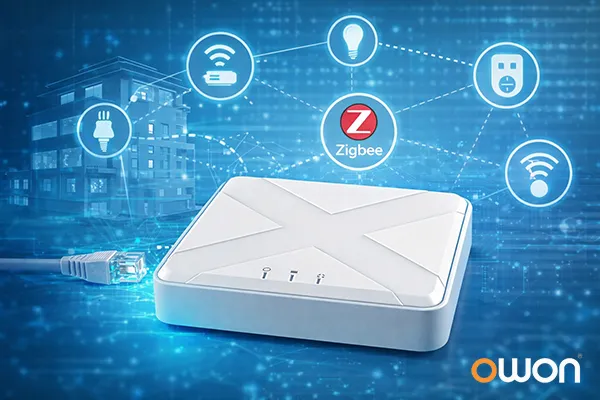
For a deeper dive into the architectural impact of device-level performance on overall system reliability—including how gateway selection interacts with endpoint capabilities—our technical team has published a detailed analysis on foundational IoT infrastructure choices.



























Sign in to leave a comment.