
For IoT developers and system integrators, Zigbee2MQTT has been a game-changer, unlocking a vast universe of devices from vendor silos. The excitement of getting a dozen sensors talking to Home Assistant on a Raspberry Pi, however, can quickly turn to frustration when scaling that prototype to cover a commercial building, a hotel, or a chain of retail stores. Intermittent dropouts, delayed sensor data, and mysterious “dead zones” emerge—symptoms of a critical gap between a DIY proof-of-concept and a production-ready, reliable deployment.
Crossing this chasm requires a shift in mindset: from simply making devices connect to architecting a resilient, maintainable wireless infrastructure. This guide explores the key considerations for scaling Zigbee2MQTT, focusing on network design, device selection, and the often-overlooked importance of hardware consistency.
Part 1: Laying the Foundation—Architecture for Stability
When device counts scale from tens to hundreds, your network‘s backbone must evolve from “it works” to “it’s robust.”
- The Hub Evolves: From Adapter to Gateway
- In a prototype, a USB coordinator plugged into a server is sufficient. For a production environment, consider a dedicated Zigbee2MQTT gateway. This is more than a rename; it implies hardware designed for 24/7 operation, with stable power, better thermal management, and superior RF performance to act as the unwavering core of your network.
- The Network‘s Lifeline: Routers and Repeaters
- Zigbee is a mesh protocol. Every mains-powered device should be a reliable Zigbee2MQTT router (or repeater). This means the smart plug zigbee2mqtt or the switch zigbee2mqtt you choose must do more than its primary job—it needs to efficiently relay data for battery-powered neighbors. A weak router creates a weak link. Strategically placing strong routers forms the resilient “backbone” that ensures commands reach a door sensor zigbee2mqtt at the far end of a warehouse reliably.
Part 2: Choosing the Right Nodes—Beyond the “Supported” List
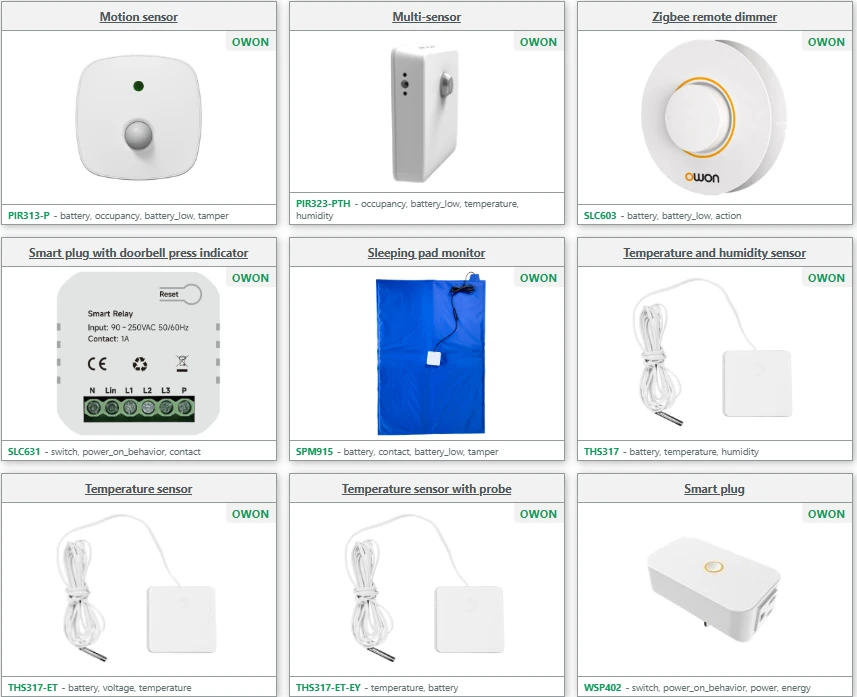
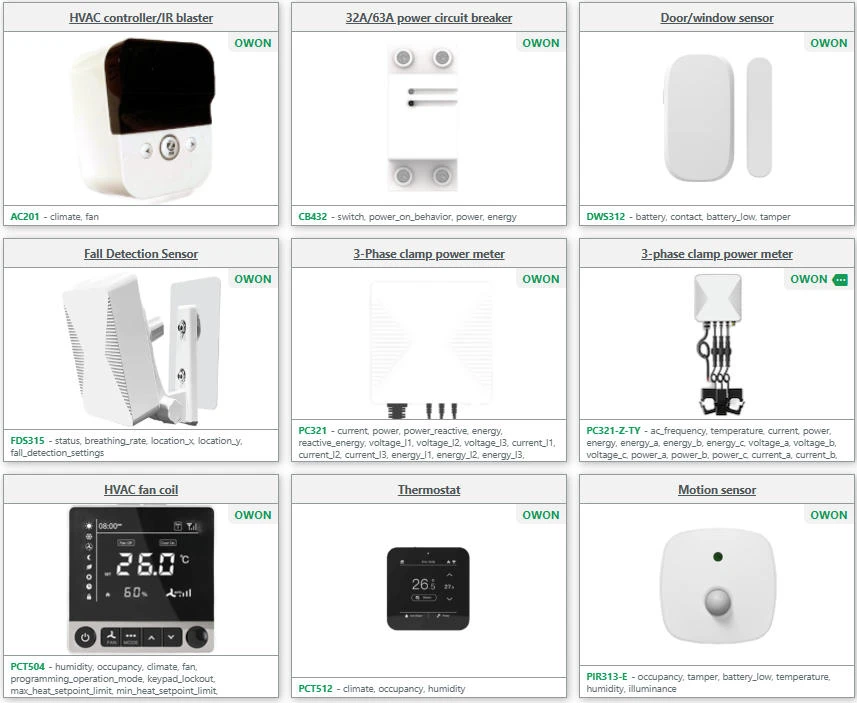
The Zigbee2MQTT supported devices list is a great starting point, but “supported” doesn’t automatically mean “optimized for scale.” Commercial deployment demands scrutiny of performance and consistency. For the purpose of illustration, we‘ll reference specific device models from a professional Zigbee2MQTT device supplier, OWON, as concrete examples of the features discussed.
- Accuracy and Consistency: A temperature humidity sensor zigbee2mqtt used for environmental monitoring must provide calibrated, consistent data. Variation of ±1°C between units can ruin analytics. Devices engineered for such measurement fidelity, like the THS317, are crucial.
- Intelligence and Filtering: A motion sensor zigbee2mqtt in a busy office must distinguish human movement from air currents. Advanced sensors use intelligent algorithms to minimize false triggers—a key feature of models like the PIR313 or the multi-sensor PIR323 (which can also serve as a vibration sensor zigbee2mqtt).
- Control with Precision: Specialty devices like a zigbee2mqtt thermostat (e.g., the PCT512 for boilers or PCT504 for fan coils) demand rock-solid connections. Similarly, a dimmer zigbee2mqtt (such as the SLC603) needs to handle various loads smoothly without causing network interference.
- Purpose-Built Reliability: The choice of every zigbee2mqtt device, from a door sensor (DWS312) to a water leak sensor or a smart plug (WSP403), impacts overall network health. Components designed for commercial use prioritize this long-term reliability.
Part 3: The Manufacturer‘s Lens—From Consistent Components to Scalable Solutions
This is where the perspective of a professional IoT device manufacturer becomes invaluable. The leap from a working prototype to hundreds of deployed units involves challenges of supply chain consistency, firmware homogeneity, and long-term hardware durability.
A manufacturer focused on the B2B and ODM/OEM space approaches these challenges systematically:
- RF Performance Consistency: Ensuring every unit of a given model has identical range and sensitivity, so network behavior is predictable at scale.
- Interoperability Assurance: Rigorously validating that an entire portfolio communicates flawlessly not just with Zigbee2MQTT, but under various network conditions and with different coordinators.
- Providing Integration Depth: Offering the detailed technical documentation on Zigbee clusters and attributes that advanced integrators need for deep customization.
For a system integrator, this manufacturer-level consistency is a strategic asset. It transforms device selection from a catalog exercise into a foundation for reliable design. Partnering with a manufacturer that understands this journey from prototype to production mitigates risk and ensures the underlying hardware can support the software‘s promise over the long term. This philosophy of predictable performance is what guides suppliers like OWON in developing their range of compatible devices, ensuring that the components can meet the demands of a scalable, open-source ecosystem.
Conclusion: Building on a Predictable Foundation
Successfully scaling Zigbee2MQTT is about recognizing that software flexibility must be built upon hardware reliability. By prioritizing a robust mesh architecture, selecting devices for their commercial-grade performance and consistency, and valuing the role of professional-grade manufacturing, integrators can build systems that are not only powerful and open but also truly dependable.
The most successful commercial IoT deployments are built on partnerships that bridge the innovative world of open-source software with the predictable, engineered world of industrial hardware—a synergy that turns scaling challenges into competitive advantage.
For integrators interested in the deepest level of technical detail for professional-grade Zigbee components, including full specifications and interoperability reports, comprehensive resources are often provided by leading device suppliers to support evaluation and design.
























Sign in to leave a comment.