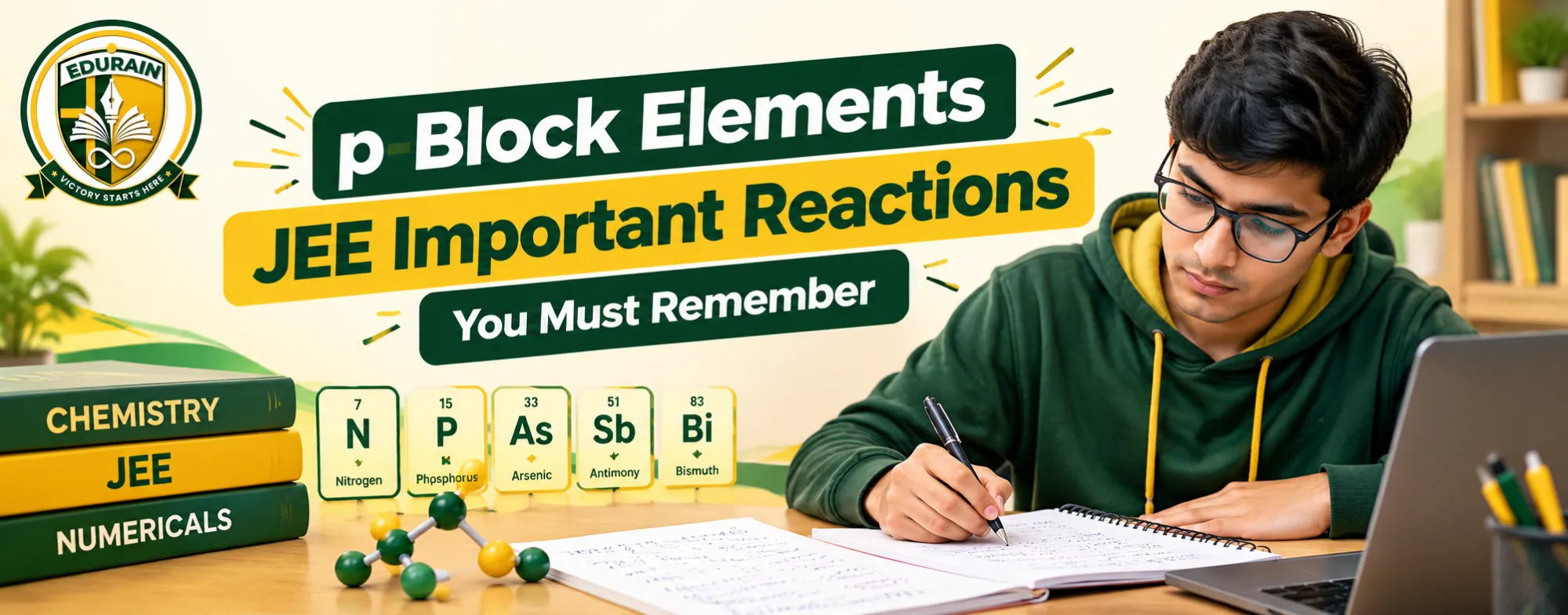


Chemistry can feel heavy when reaction lists keep growing every week. This guide is for JEE aspirants who want a clear, exam-focused view of p-Block Elements JEE Important Reactions. You will learn what this topic covers, why it matters for JEE Main and Advanced, the key reactions to remember, and how to prepare for it without confusion.
What Are p-Block Elements in JEE Chemistry?
p-Block elements are groups 13 to 18 of the periodic table, where the last electron enters the p orbital.
This section includes boron, carbon, nitrogen, oxygen, halogen, and noble gas families. JEE gives strong weightage to this part because it links directly with inorganic and physical chemistry concepts.
Key points students should know:
- p-Block covers six groups with wide variation in properties.
- Reactions of boron, carbon, nitrogen, and halogen families appear often in JEE papers.
- Concepts such as oxidation states, hybridisation, and bond type repeat across topics.
Why Is This Topic Important for JEE?
p-Block Elements JEE Important Reactions form a major part of inorganic chemistry, and inorganic chemistry decides many easy marks in the exam.
Most JEE inorganic questions are reaction-based, not just theory-based. Students who memorise reactions with proper reasoning score faster and with fewer mistakes.
Reasons this topic matters:
- High weightage in JEE Main and Advanced year after year.
- Direct, factual questions that need less calculation.
- Strong link with real-life applications such as fertilisers, glass, and industrial gases.
Which Reactions Should Students Focus On?
The most asked reactions cover borax, diborane, silicates, ammonia, nitric acid, sulphuric acid, and halogen compounds.
Here is a simple, well-organised list to guide daily revision:
Boron Family
- Reaction of borax with acids
- Preparation and hydrolysis of diborane
- Formation of boric acid and its acidic nature
Carbon Family
- Preparation of silicones and silicates
- Reaction of carbon with oxygen forming carbon monoxide and carbon dioxide
Nitrogen Family
- Preparation of ammonia by the Haber process
- Preparation of nitric acid by the Ostwald process
- Reactions of phosphine and phosphorus halides
Oxygen and Halogen Family
- Preparation of sulphuric acid by the contact process
- Reactions forming interhalogen compounds
- Preparation of oxoacids of halogens
Practical tip: group reactions by preparation method, properties, and use. This method saves revision time and improves recall during the exam. Common mistake to avoid: mixing up oxidation states of the same element in different compounds. Always double-check the state before writing the answer.
What Is the Best Way to Study This Syllabus?
A focused, chapter-wise approach works best for p-Block chemistry.
Break the syllabus into small, manageable parts:
- Read one family at a time, not the whole p-Block together.
- Note down reactions with conditions, not just products.
- Practice previous year JEE questions after every family.
- Revise oxidation states and bonding patterns weekly.
This structure keeps information organised and reduces last-minute stress.
What Skills Do Students Need for This Topic?
Strong basics in bonding, oxidation states, and periodic trends help students master p-Block reactions faster.
Skills that support this topic:
- Understanding of hybridisation and molecular geometry
- Clear grasp of oxidation and reduction concepts
- Ability to connect physical properties with chemical behaviour
- Regular practice of numerical and reasoning-based questions
Students preparing through a structured Edurain Online Education Platform course often find it easier to build these basics step by step, since concepts are broken down with guided practice.
How Should Students Approach Admission and Course Planning?
Good preparation planning starts well before the exam year, with the right course and batch selection.
Students usually look for:
- A well-structured Class 11 and 12 syllabus coverage
- Regular tests based on the JEE pattern
- Doubt-solving support for tricky inorganic reactions
For students planning ahead, the Edurain IIT-JEE chemistry course offers structured chapter-wise coverage of p-Block and other inorganic topics, along with regular practice tests. Those checking EduRain Target JEE batch details for Class 12 or looking at EduRain Target JEE batch fees 2027 can review the course structure before enrolling. Repeaters exploring EduRain Dropper JEE batch fees 2027 can also compare the syllabus coverage with their current preparation level.
Note: No course or platform can promise guaranteed admission or a fixed rank. Consistent practice and understanding of concepts remain the real deciding factor.
What Are the Career and Scope Benefits of Strong Chemistry Preparation?
Strong performance in chemistry, including p-Block reactions, directly improves overall JEE rank and future engineering options.
Career benefits linked to strong chemistry preparation:
- Better rank in JEE Main and Advanced
- Wider choice of branches in NITs, IITs, and other government colleges
- Strong base for future chemistry-related fields such as materials science and chemical engineering
- Confidence in competitive exams beyond JEE, such as state-level engineering tests
Salary and growth after engineering depend on branch, college, and skills gained during the course, so chemistry preparation is one part of a larger academic path.
Key Takeaways
- p-Block Elements JEE Important Reactions carry high weightage in JEE inorganic chemistry.
- Focus on boron, carbon, nitrogen, oxygen, and halogen family reactions.
- Group reactions by preparation, properties, and use for faster revision.
- Strong basics in bonding and oxidation states support better recall.
- Structured courses, including the Edurain Online Education Platform, can support step-by-step preparation.
- No coaching or platform can guarantee admission, rank, or placement.
Conclusion
p-Block chemistry may look large at first, but a family-wise, reaction-focused approach makes it manageable. Students who revise p-Block Elements JEE Important Reactions regularly, along with previous year questions, tend to build strong accuracy in inorganic chemistry. The next step is simple: pick one family, list its reactions, and start daily revision from today.
Frequently Asked Questions
1. Is p-Block chemistry difficult for JEE preparation?
It can feel detailed at first, but with a family-wise study method and daily revision, most students find it manageable within a few weeks.
2. How much time is needed to complete p-Block reactions?
On average, four to six weeks of regular study, with revision cycles, is enough to cover this topic well.
3. What are the fees for JEE chemistry courses?
Fees vary by platform, batch type, and course duration. Students should always check current fee details directly with the course provider, such as the Edurain Online Education Platform, before enrolling.
4. What is the eligibility for JEE preparation courses?
Students in Class 11, Class 12, or droppers preparing for JEE Main and Advanced are generally eligible, though specific admission steps may vary by institute.
5. Do p-Block reactions help in getting a good JEE rank?
Yes, since inorganic chemistry offers direct, factual questions, strong preparation in this area can improve accuracy and overall score.
6. What career options open up after strong JEE chemistry preparation?
Strong chemistry marks support better ranks, which widen options across engineering branches, including chemical engineering and materials science, in colleges such as IITs and NITs.


























Sign in to leave a comment.