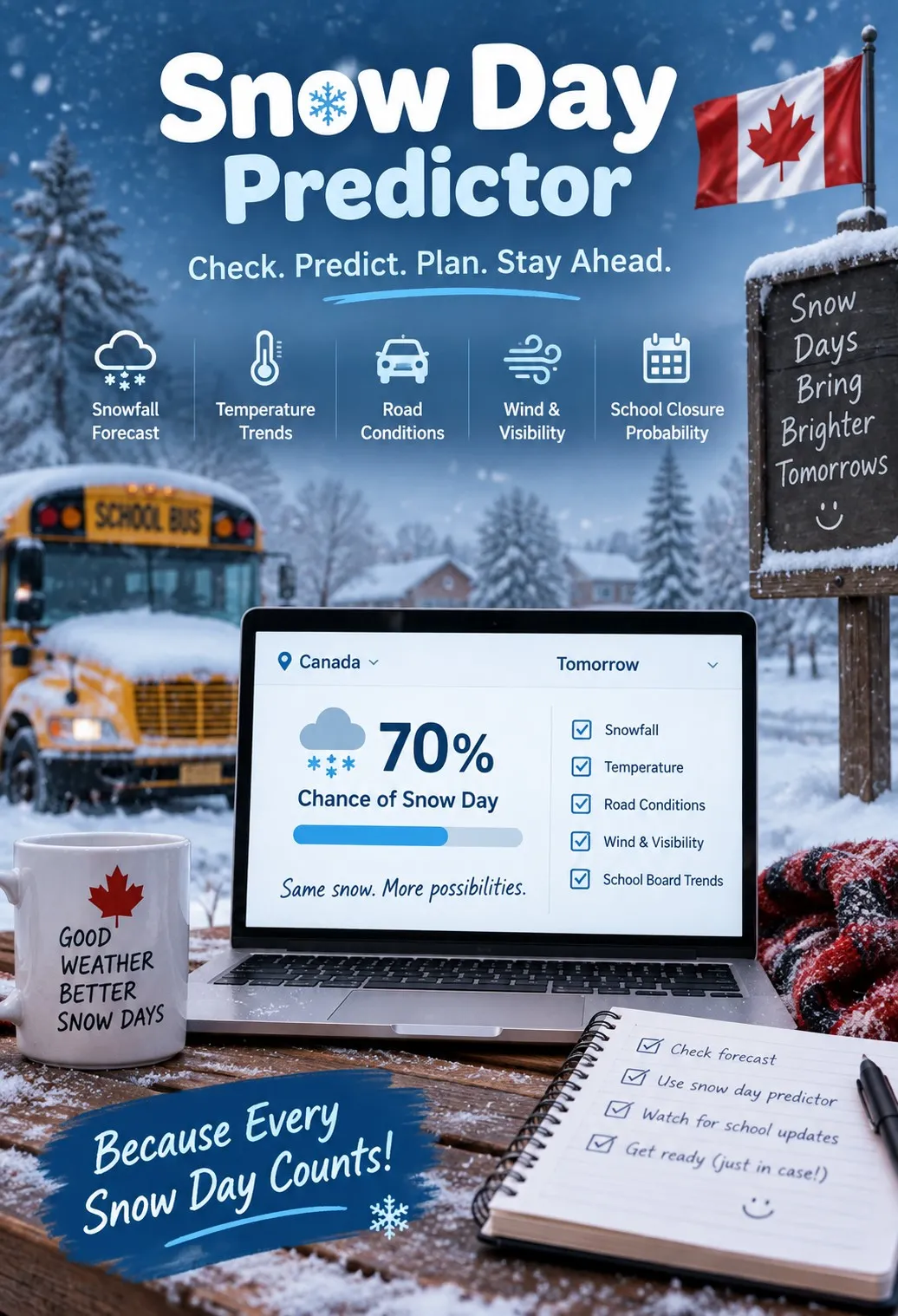

When a winter storm is approaching, one question quickly takes over: Will it be a snow day tomorrow?
The answer is rarely based on snowfall alone. A few inches of snow can cause major travel problems in one community while having little effect on another. Freezing rain, strong winds, poor visibility, overnight accumulation, road conditions, temperature, and the timing of the storm can all affect whether schools remain open.
That is why a useful snow day predictor should look at several weather conditions instead of treating snowfall as a simple yes-or-no trigger.
For students and parents, the goal is not to replace an official school announcement. It is to understand the probability of a closure early enough to plan for the next morning.
What Is a Snow Day Predictor?
A snow day predictor is a tool that estimates the likelihood that schools in a particular location will close because of winter weather.
Unlike a basic weather forecast, it focuses on a different question:
How could the expected weather affect school operations?
A weather service may tell you that your area could receive 15 centimetres of snow. A school closure estimate goes one step further by considering whether that snowfall is likely to create difficult travel conditions during school hours.
The result is usually expressed as a percentage, probability, or general likelihood such as low, moderate, or high.
It is important to understand that a prediction is not an official closure notice. The final decision belongs to the relevant school board, district, superintendent, or education authority.
How Does Snow Day Prediction Work?
A useful prediction starts with local weather information.
Environment and Climate Change Canada provides weather forecasts and alerts covering snowfall, freezing rain, winter storms, extreme cold, blizzards, blowing snow, and other hazards. These categories matter because winter conditions can create dangerous travel even when total snowfall is not especially high.
A prediction system can consider several variables.
Expected Snowfall
Snowfall accumulation is one of the most obvious factors.
However, the total amount is only part of the story. Ten centimetres falling gradually over many hours may create different travel conditions from the same amount falling within a short period.
The forecast should therefore consider both how much snow is expected and how quickly it may arrive.
Storm Timing
Timing can make a major difference.
A storm arriving during the overnight hours may leave roads covered when buses and families begin travelling in the morning.
A storm that arrives after school has already started can create a different situation. School officials may have to consider dismissal, transportation, and the safety of students already at school.
This is why a snow day forecast for tomorrow can change several times as the storm gets closer.
3. Freezing Rain and Ice
Snow is not the only winter hazard.
Environment and Climate Change Canada defines freezing rain as precipitation that freezes when it reaches surfaces below freezing, creating a layer of ice. Its winter alerts also include flash freezes, blowing snow, blizzards, and winter storms.
Ice can create dangerous roads and sidewalks even when snowfall totals are relatively small.
For that reason, an effective snow-day estimate should not focus only on centimetres of snow.
4. Wind and Visibility
Strong winds can blow loose snow across roads and create drifting or blowing snow.
Environment and Climate Change Canada uses specific alerts for blizzard and blowing-snow conditions because wind can reduce visibility significantly.
Poor visibility can affect school buses and other vehicles even when accumulated snow is moderate.
5. Road Conditions
School closure decisions are often connected to transportation safety.
For example, the Hamilton-Wentworth District School Board says its transportation carriers check weather forecasts, road conditions, and road clearing before making weather-related transportation decisions. At that board, transportation cancellation because of inclement weather triggers school closure, although procedures vary between boards. (Hamilton-Wentworth District School Board)
This shows why a weather-only forecast cannot perfectly predict a school closure.
Why Two Snow Day Calculators Can Give Different Answers
People sometimes check several websites and get completely different results.
That does not automatically mean one tool is broken. Different tools may use different weather sources, update schedules, locations, prediction methods, or assumptions about school closures.
A prediction can also change as new forecast information becomes available. For example, one forecast may expect heavy snow to finish before morning while another expects accumulation to continue during the morning commute.
The same storm can therefore produce different estimates several hours before the official decision.
Recent online discussions show that this is exactly what users are asking about. Students have compared different predictors when trying to determine whether school will close and have specifically questioned how accurate the predictions are.
Snow Day Calculator for Tomorrow: What Should You Check?
If you are checking a snow day calculator for tomorrow, do not look at the percentage alone.
Check the conditions behind the estimate.
| Factor | Why it matters |
|---|---|
| Snowfall | More accumulation can make travel harder |
| Snowfall rate | Heavy snow in a short period can disrupt travel |
| Storm timing | Morning storms can affect buses and commuters |
| Freezing rain | Ice can make roads and sidewalks hazardous |
| Temperature | Affects freezing, melting, and road conditions |
| Wind | Can create drifting and blowing snow |
| Visibility | Poor visibility can affect transportation |
| Road conditions | Directly affects school bus safety |
| Local geography | Conditions can vary between nearby communities |
| School board policy | Boards make the final closure decision |
This approach gives you more useful information than simply asking whether the forecast contains snow.
What Makes an Accurate Snow Day Calculator?
There is no calculator that can guarantee a school closure before the school board announces it. An accurate snow day calculator should instead provide a reasonable estimate using current local weather information and explain the factors behind the prediction.
The quality of the prediction depends on several things:
Fresh weather data: Older forecasts may miss changes in storm timing or intensity.
Local information: A forecast for an entire city may not perfectly represent every neighbourhood.
Multiple weather factors: Snowfall alone is not enough.
Frequent updates: Predictions should change when the underlying forecast changes.
Clear uncertainty: A probability should be treated as an estimate, not a promise.
The official decision remains more important than any third-party prediction.
Snow Day Tracker vs. Snow Day Prediction
A snow day tracker and a prediction tool serve different purposes.
A tracker is useful for following changing weather conditions and checking whether an official closure has been announced.
A prediction estimates what might happen before the announcement.
Think of the process this way:
Forecast → Prediction → Official Decision → Closure Alert
The forecast describes expected weather.
The prediction estimates the likelihood of a closure.
The school board makes the actual decision.
The official alert confirms what families need to know.
Keeping these stages separate prevents confusion.
Snow Day Checker: What Should Parents Verify?
If the weather looks serious, use a snow day checker as one source of information rather than the only source.
First, check the local weather forecast.
Next, look for active winter weather alerts.
Then check your school board or district's official website, app, email, social channels, or notification system.
This is especially important because school transportation and school closure decisions can be different.
The Toronto District School Board, for example, explains that transportation may be cancelled without schools necessarily closing. Its current severe-weather information also emphasizes that closure decisions depend on safety conditions. (Toronto District School Board)
Snow Day Chance Is Not the Same as Snowfall Chance
These two ideas are easy to confuse.
Snowfall chance describes the possibility of snow occurring.
Snow day chance describes the estimated possibility that school will close.
A forecast could show a high chance of snow but a relatively low chance of school closure if the expected accumulation is light, roads are treated quickly, or the snow arrives after the school commute.
The reverse can also happen.
A smaller amount of precipitation can create serious problems when it arrives as freezing rain or rapidly freezes on roads.
What About “Snowday Calculator” and Other Search Variations?
People do not always search using the exact spelling of a phrase.
You may see searches such as snowday calculator, snow calculator, snowdaycalculatir or even snow day calxulator.
These variations usually reflect typing errors, shortened searches, or users combining different terms.
The underlying question is generally the same:
Is school likely to close because of tomorrow's weather?
For Spanish-speaking users, pronostico de nieve means “snow forecast.” That search is more closely related to weather conditions than to an official school closure prediction, but the two can be connected when winter weather affects schools.
How To Think About Snow Day Probability
Suppose a prediction says there is a 70% snow day probability.
That does not mean there is a guaranteed 70% chance your particular school will close.
It means the prediction model considers the expected conditions relatively favourable for a closure based on the information available.
The number should be treated as a decision-support signal.
A 90% prediction can still be wrong.
A 30% prediction can still become a closure.
Forecast uncertainty, local road conditions, school policies, and changes in storm behaviour can all affect the final result.
When Is the Next Snow Day?
There is no universal answer to when is the next snow day because school closures depend on local weather and local school decisions.
Instead of looking for a fixed date, monitor the next significant winter-weather event affecting your area.
The same principle applies when searching for snow day predictor for Monday. The useful question is not simply whether Monday has snow in the forecast. It is whether the expected conditions during the Monday commute and school day are likely to create unsafe operating conditions.
Checking the forecast the evening before and again in the early morning can provide a clearer picture.
Will It Be a Snow Day Tomorrow?
The best answer comes from combining three types of information:
Weather data: What conditions are expected?
Prediction: How likely does the weather pattern appear to be to disrupt school?
Official information: Has the school board actually announced a closure or transportation cancellation?
A snow day tomorrow is ultimately confirmed only when the relevant authority announces it.
Environment and Climate Change Canada provides official Canadian weather alerts, while individual school boards communicate their own operational decisions.
Final Takeaway
A useful snow day predictor is not simply counting centimetres of snow. It is an estimate based on the combination of snowfall, storm timing, temperature, ice, wind, visibility, road conditions, transportation, and local school policies.
That is why a snow day forecast can change overnight and why two communities experiencing the same storm may receive different school decisions.
Use prediction tools to answer the early question “How likely is a closure?” but use your school board's official announcement to answer the final question “Is school actually closed?”
For families trying to plan around winter weather, that distinction is the most important part of using any snow day calculator or predictor.
Questions People Ask About Snow Day Predictors
How accurate is a snow day predictor?
A predictor can provide a useful estimate, but it cannot guarantee a school closure. Accuracy depends on forecast quality, local conditions, storm timing, and how the school board responds to those conditions.
Can freezing rain cause a snow day even when there is little snow?
Yes. Freezing rain can create a layer of ice on roads and sidewalks, making travel hazardous without a large snowfall total. Environment and Climate Change Canada treats freezing rain as a significant winter hazard.
Does a snow day predictor know if school buses will be cancelled?
Not necessarily. Bus cancellation rules vary by school board. Some boards may cancel transportation while keeping schools open, while others connect transportation cancellation directly with school closure.
How can I check whether tomorrow will be a snow day?
Use a local weather forecast and snow-day estimate to understand the conditions, then check your school board's official website, app, email, or alert system for the final decision. A prediction is not an official closure notice.



























Sign in to leave a comment.