

When a winter storm appears in the forecast, students and parents often start asking the same question: Will it be a snow day tomorrow?
The answer is harder to predict than it looks.
Snowfall matters, but it is only one part of the picture. Storm timing, temperature, freezing rain, wind, visibility, road conditions, existing snow and ice, and local school policies can all affect a closure decision.
That is why a snow day calculator alert is more useful when it explains the conditions behind a prediction instead of simply showing a percentage.
A prediction can help families prepare, but it should never be confused with an official school closure announcement.
What Is a Snow Day Calculator Alert?
A snow day calculator estimates the likelihood that schools will close because of winter weather. An alert adds another layer by helping users pay attention when changing weather conditions could increase the chance of a closure.
Think of the process as four stages:
Weather forecast → Snow day prediction → School decision → Official alert
The weather forecast describes what may happen.
The prediction estimates how those conditions could affect school operations.
The school board or district makes the actual decision.
The official alert confirms whether schools are closed, delayed, or operating normally.
This distinction matters because third-party calculators do not control school closures.
Why Snow Day Predictions Are Hard
A common mistake is to assume that a certain amount of snow automatically creates a snow day.
There is no universal snowfall number that closes every school.
A storm producing heavy snow in a short period can create different problems from the same amount spread across an entire day. A small amount of snow combined with freezing rain may also create more dangerous travel than a larger amount of dry snow.
Environment and Climate Change Canada identifies several winter hazards, including significant snowfall, snow squalls, freezing rain, extreme cold, flash freezes, blizzards, and blowing snow.
A useful prediction therefore needs to consider the complete weather situation.
What Factors Affect a Snow Day Chance?
Snowfall Amount
The first question is usually simple: how much snow is expected?
Accumulation matters because deeper snow can make roads, sidewalks, parking areas, and school entrances harder to manage.
But the total amount should not be viewed by itself.
A forecast of 10 centimetres spread across many hours may create different conditions from 10 centimetres falling during the morning commute.
Storm Timing
Timing can be just as important as accumulation.
Snow that falls overnight can remain on roads when school buses begin their morning routes. If heavy snow continues through the commute, road crews may have less time to clear major routes.
This is one reason a snow day forecast can change during the evening.
A storm moving faster or slower than expected can change the conditions by morning.
Freezing Rain and Ice
Snow is not the only reason schools may close.
Freezing rain can coat roads, sidewalks, bridges, and other surfaces with ice. Even a relatively small amount can create difficult travel conditions.
Environment and Climate Change Canada specifically lists freezing rain and flash-freeze conditions among Canada's winter weather hazards.
For a calculator, this means precipitation type matters. A prediction based only on snowfall can miss an important part of the risk.
Wind and Visibility
Strong winds can create blowing snow and drifting.
Blowing snow can reduce visibility and make driving more difficult even when the total snowfall is not extreme. Environment and Climate Change Canada defines blizzard conditions partly through widespread reduced visibility caused by wind and snow.
This is especially important for school transportation because buses may travel through open or rural areas where drifting snow can quickly change road conditions.
Temperature and Wind Chill
Extreme cold can also affect school operations.
A snow day predictor should therefore consider temperature and wind chill rather than assuming every closure is caused by snow.
Canada's official weather guidance treats extreme cold and very low wind chill as separate winter hazards.
That matters when asking whether tomorrow will be a normal school day, even when snowfall is limited.
Why Your Snow Day Calculator May Change Its Answer
Suppose you check a predictor at 7 PM and see a 60% chance.
You check again at 10 PM and see 35%.
Then you wake up at 5:30 AM and the estimate is 75%.
This does not necessarily mean the calculator is malfunctioning.
Weather forecasts are updated as new information becomes available. Changes in storm track, snowfall intensity, temperature, precipitation type, and timing can change the predicted conditions.
Public discussions show that users regularly compare different predictors and become confused when they produce different percentages. Some Reddit users have reported seeing predictions change sharply or disagree between different tools.
That uncertainty is actually an important part of weather prediction.
What Makes an Accurate Snow Day Calculator?
An accurate snow day calculator cannot guarantee the final decision.
Instead, a better calculator should use several relevant signals and clearly communicate uncertainty.
Useful inputs can include:
- Expected snowfall
- Hourly snowfall timing
- Freezing rain
- Temperature
- Wind
- Wind chill
- Visibility
- Existing snow or ice
- Road conditions
- Local geography
- School transportation patterns
- Historical closure information
The more relevant local information a system has, the more useful its estimate can become.
However, no calculator has perfect access to every factor considered by a school district.
Snow Day Tracker vs. Snow Day Predictor
These terms sound similar, but they serve different purposes.
A snow day tracker helps users monitor developing weather or school announcements.
A snow day predictor estimates the likelihood of a closure before the official announcement.
A tracker answers:
What is happening?
A predictor answers:
What might happen?
An official school alert answers:
What has the school actually decided?
Using all three in the right order can make winter planning much easier.
How to Use a Snow Day Calculator for Tomorrow
If you are searching for a snow day calculator for tomorrow, start with your local forecast.
Then check the expected conditions during the hours when students and buses normally travel.
Look for:
Heavy overnight snow: More accumulation before morning can increase transportation problems.
Morning snowfall: Snow continuing through the commute can make conditions more difficult.
Freezing rain: Ice can create serious road and sidewalk problems.
Strong wind: Blowing snow can reduce visibility.
Extreme cold: Very low temperatures may create separate safety concerns.
Weather alerts: Official warnings provide important information about expected impacts.
Environment and Climate Change Canada says its weather alerts include information about the expected weather, timing, location, potential impacts, and forecast confidence.
Snow Day Probability Does Not Mean Certainty
A percentage can be useful, but it is easy to misunderstand.
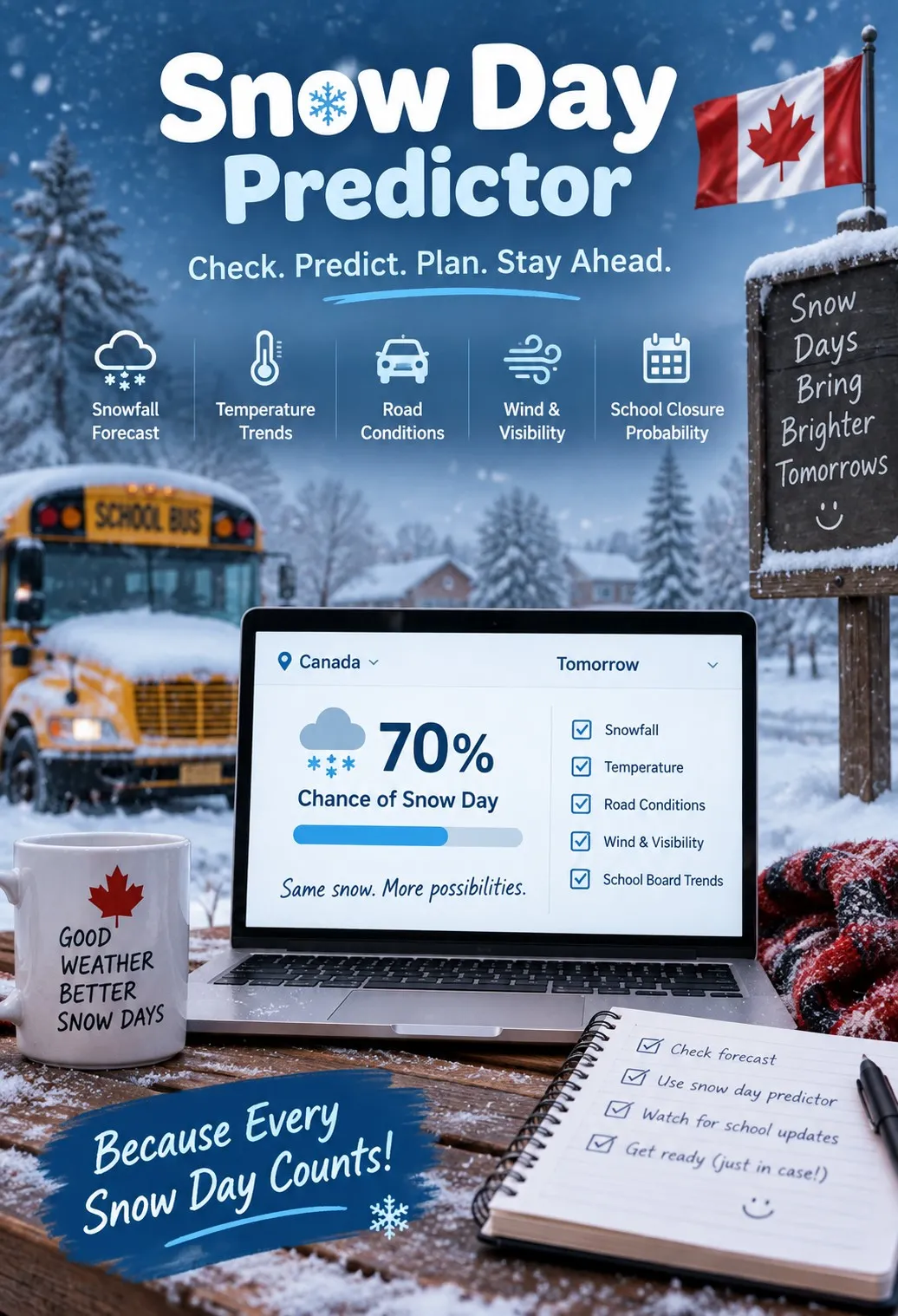
If a tool shows a 70% snow day probability, it does not mean that school officials have decided to close.
It means the available information points toward a relatively high likelihood according to that prediction system.
The remaining uncertainty can come from weather forecast changes, road conditions, transportation decisions, and local school policies.
This is why a 90% prediction can still be wrong.
It is also why a 30% prediction does not mean a closure is impossible.
Think of probability as information for planning, not a promise.
What People Actually Ask Before a Snow Day
Public discussions show that the real questions are often very specific.
Students ask:
- Will there be a snow day tomorrow?
- What are the chances?
- Why are two predictors giving different numbers?
- Is Monday going to be a snow day?
- Can buses be cancelled while school stays open?
- Which predictor is actually accurate?
Recent Reddit conversations in Ontario show users comparing different prediction tools, questioning percentage scores, and trying to determine whether a particular school board will close.
These questions are also useful examples of the type of natural-language searches people increasingly use with AI assistants.
Instead of searching only for “snow day calculator,” someone may ask an AI tool:
Will it be a snow day tomorrow in my area?
Or:
What is the probability of a snow day on Monday?
Or:
Why does one snow day predictor say 70% while another says 30%?
The underlying information need is the same: users want a simple explanation of the factors behind a possible school closure.
What About “Snowday Calculator” and Misspelled Searches?
Search behavior is not always perfectly spelled.
People may type:
snowday calculator
snowdaycalculatir
snow day calxulator
snow calculator
These variations can represent the same basic intent.
The important question is not the spelling. It is what the person wants to know: whether winter weather could affect school tomorrow.
Spanish-speaking users may also search for pronostico de nieve, which means “snow forecast.” That search is broader than school closure prediction, but snow forecasts are an important input when assessing possible snow days.
Snow Day Tomorrow: What Should You Check?
If you are trying to decide whether tomorrow could be a snow day, use a simple checklist.
Check the Weather
Look at the latest local forecast and active winter alerts.
Check the Snowfall Timing
Do not focus only on the daily total. Look at when the snow is expected to fall.
Check for Ice
Freezing rain and rapid temperature changes can create dangerous travel conditions.
Check Transportation
A bus cancellation does not always mean the entire school building is closed. Procedures differ between school systems.
Check the Official School Source
Your school board or district remains the final authority.
This last step is essential because a snow day checker is a prediction tool, not an official decision-making system.
When Is the Next Snow Day?
There is no fixed answer to when is the next snow day.
School closures depend on future weather and local decisions.
If a major winter storm is approaching, the useful approach is to monitor the forecast rather than trying to predict a snow day weeks in advance.
The same applies to searches such as snow day predictor for Monday. A prediction becomes more useful when the forecast window gets closer because there is less uncertainty about storm timing and intensity.
How a Snow Day Calculator Alert Can Help Families
A snow day calculator alert can be useful because it turns a changing weather situation into a simple planning signal.
For parents, an early indication can help with childcare or work arrangements.
For students, it can provide an early warning that tomorrow's schedule may change.
For teachers, it can signal that lesson plans or deadlines may need flexibility.
But the alert should always be treated as an early indication.
The official school announcement remains the final answer.
Final Takeaway
A snow day calculator alert is most useful when it helps people understand changing winter conditions rather than promising a guaranteed school closure.
Snowfall is important, but so are storm timing, freezing rain, wind, visibility, temperature, road conditions, transportation, and local school decisions.
The best way to use a prediction is simple:
Check the weather → review the prediction → prepare for both possibilities → wait for the official announcement.
Whether you search for a snow day calculator, snow day predictor, snow day forecast, or the chance of a snow day, remember that every percentage is an estimate.
The forecast tells you what weather may arrive. The predictor helps you understand what that weather could mean. The school board makes the final decision.
Questions People Ask AI About Snow Days
Will it be a snow day tomorrow?
A predictor can estimate the chance by looking at snowfall, storm timing, temperature, ice, wind, and other local conditions. The final answer comes from the school board or district, so check its official announcement before assuming school is closed.
How accurate is a snow day predictor?
Accuracy depends on forecast quality, local conditions, and how closely the prediction method matches the area's school closure patterns. Predictions are generally more useful for strong, well-defined storms than borderline events where a small weather change can affect the outcome.
Why do two snow day calculators give different percentages?
Different calculators may use different weather sources, update times, locations, algorithms, and assumptions about school closures. A changing percentage does not automatically mean one tool is wrong; it can reflect changing forecast information.
What should I check if the snow day chance is high?
Check the latest local weather forecast, winter weather alerts, road or transportation information, and your school board's official communication channels. A high probability is useful for planning, but it is not an official school closure notice.


















Sign in to leave a comment.