

There is a quiet revolution happening in the professional training world. It does not involve rockets or robots — though robots are definitely part of the reason it is happening. It involves something far more human: the race to be credible. Training providers across every continent are waking up to a very specific problem. They can teach brilliantly. Their instructors are sharp, their course materials are solid, and their learners are genuinely motivated. But when those learners walk out the door and into a job interview, the certificate in their hand raises an eyebrow instead of an offer letter. Why? Because the organization behind that certificate is not recognized. It is not verified. It is not backed by an accredited body with a real reputation and a real global footprint.
The solution — and the trend that every credible industry observer is now tracking — is the surge of training providers seeking to formally align with a legitimate Certification Body. And the numbers are striking. Applications to join structured partner programs from recognized accredited bodies have climbed sharply across Asia-Pacific, Europe, the Middle East, Africa, and the Americas. The message from the market is unmistakable: credibility is no longer optional. And for training organizations that want to stay competitive, relevant, and genuinely useful to the people they serve, the path forward runs directly through a partnership with a trusted Global Certification authority.
This blog unpacks exactly why this is happening, what it means for the training industry, and why IABAC sits at the center of this global movement.
Section 1: The Credibility Crisis in Professional Training
Let us start with an uncomfortable truth. The global professional training market has a credibility problem — not because trainers are bad at training, but because the certificate landscape has become genuinely confusing for everyone involved.
According to a 2023 report by Credential Engine, there are now more than 967,000 unique credentials available in the United States alone — up from around 334,000 in 2017. That is almost a threefold increase in six years. Globally, the number runs into the millions. And the overwhelming majority of these credentials are issued by organizations with no independent accreditation, no quality assurance framework, and no employer recognition outside their own marketing materials.
The result? Employers have become credential-skeptical. Hiring managers now routinely discount certificates that cannot be traced to a recognized Certification Body. Learners who invested real money and real time into unrecognized programs feel cheated. And training providers with genuinely good programs find themselves lumped in with the noise.
Here is a simplified picture of how employer confidence in various credential types breaks down, based on aggregated HR survey data from 2023:
Employer Confidence in Professional Credentials (2023 Survey Data)
- Government / Academic Degrees: 89%
- Credentials from Accredited Body: 82%
- Industry Certification (Verified): 74%
- Online Course Completions: 31%
- Unverified Self-Reported Skills: 19%
The gap between accredited credentials and everything else is not subtle. It is enormous. And training providers who understand this data are not waiting around — they are actively seeking partnerships with accredited training providers networks and recognized certification authorities to close that gap as fast as possible.
Section 2: Why the Partner Program Model Is Winning
Here is where the story gets interesting. The traditional route for a training organization seeking credibility was to pursue its own independent accreditation — a process that typically costs hundreds of thousands of dollars, takes three to seven years, and requires substantial institutional infrastructure. For a small or mid-sized training provider, that route is effectively closed.
The partner program model changes the equation entirely. By formally affiliating with an established accredited body, a training provider can:
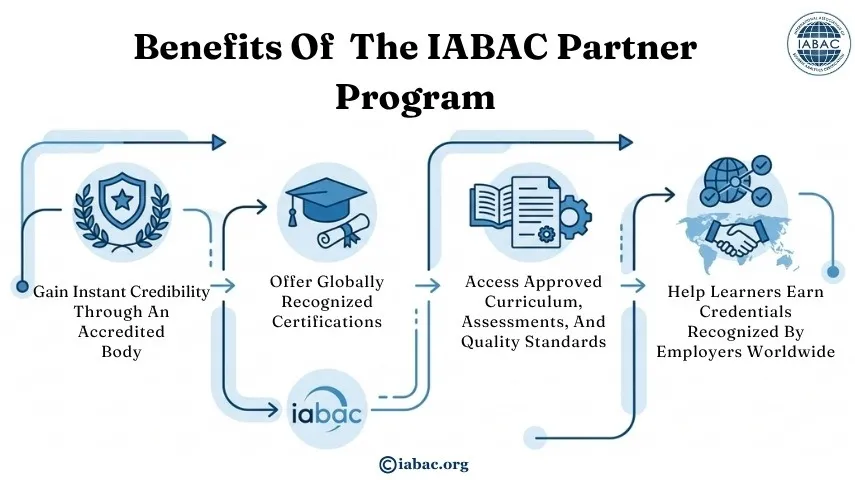
- Immediately inherit the credibility of the certifying body's established reputation
- Deliver recognized credentials without building an entire certification infrastructure from scratch
- Access curriculum frameworks, assessor training, and quality standards that are already tested and refined
- Market their programs with the assurance that the certificates their learners receive will be recognized by employers worldwide
This is why the partner program model is growing so fast. It is not charity — it is efficiency. A training center in Nairobi, a university extension program in Jakarta, an online learning platform in Barcelona, a corporate training division in Dubai — all of these organizations face the same fundamental challenge, and the partner program with a trusted Certification Body is the most practical solution available to all of them.
The global e-learning market, valued at approximately USD 399 billion in 2022, is projected to exceed USD 1 trillion by 2032 (Global Market Insights, 2023). Inside that growth, the fastest-expanding segment is credential-linked learning — programs where learners complete training and earn a verifiable, accredited qualification. The training providers capturing the most growth in this segment are disproportionately those aligned with recognized Global Certification bodies.
Section 3: IABAC — The Accredited Body Behind a Growing Global Network
IABAC — the International Association of Business Analytics Certifications — is one of the most actively expanding Certification Body networks in the world today, with a specific focus on the domains that are defining the 21st-century economy: Data Science, Artificial Intelligence, Business Analytics, Machine Learning, and related technology disciplines.
The IABAC partner program has attracted training providers at every level of scale — from boutique academies with a few hundred learners per year to large institutional programs operating across multiple campuses and countries. What draws them all to IABAC is a combination of factors that is harder to find than it sounds:
- Genuine international recognition. An iabac certification carries weight in employer conversations across more than 50 countries. That is not marketing language — it is a function of IABAC's deliberate investment in building employer relationships alongside its training provider network.
- Rigorous but accessible standards. The quality bar for becoming an IABAC education partner is real — there is actual review, actual curriculum alignment, actual assessor training involved. But the process is designed to be navigable for organizations of different sizes and stages of development. The goal is to raise quality, not to create gatekeeping.
- A live, growing certification ecosystem. Every IABAC partner organization plugs into an ecosystem that is continuously evolving. New certification pathways are developed in response to market demand, not at five-year intervals. When AI governance became a pressing employer concern, IABAC had a certification framework for it. When data ethics moved from academic discussion to boardroom agenda, the ecosystem expanded to cover it.
- Active learner outcomes tracking. IABAC doesn't just issue credentials and move on. The network tracks learner outcomes — employment rates, salary progression, role transitions — because the value of a certification ultimately lives or dies in what happens to the people who hold it.
Explore the full range of pathways available at https://iabac.org/certifications — the depth of the catalog is one of the clearest indicators of how seriously IABAC takes the ecosystems question.
Section 4: Who Is Joining — And Why
The profile of organizations applying to become IABAC training partner affiliates has diversified significantly in recent years. Early in IABAC's growth, the typical applicant was a technology-focused training institute with a clear data science or AI focus. That profile has expanded considerably.
- Universities and Academic Institutions are increasingly seeking to bridge the gap between their traditional degree programs and the employer-recognized credentials that their graduates need to compete. A university department that adds an IABAC-aligned certification track to its analytics or computer science program gives students an immediate credential advantage without replacing the core academic offering.
- Corporate Learning and Development Teams are discovering that internal training programs gain significantly more traction when they lead to externally recognized credentials. An employee who completes a company's internal AI upskilling program and earns an iabac certification at the end has something tangible to show for the investment — and so does the company.
- Online Learning Platforms represent one of the fastest-growing segments of the IABAC partner network. The ability to deliver globally recognized credentials through digital platforms removes geographic barriers entirely. A learner in a small city in India, a rural area of Nigeria, or a remote region of Brazil can complete an IABAC-aligned program and emerge with a credential that is recognized in Frankfurt or San Francisco.
- Independent Training Consultants and Academies form a large and often underestimated part of the partner ecosystem. These are organizations run by practitioners — people who have worked in data science, AI, or analytics and now teach those disciplines. Aligning with IABAC gives their expertise a formal credentialing structure that significantly increases their market positioning.
The common thread across all of these applicant types? They all recognize that the era of teaching without certifying is ending. The market has made its preference clear, and the smart organizations are responding.
Section 5: The Math Behind the Decision
For any training organization weighing whether to pursue a partnership with an accredited body, there is a straightforward business case to be made. Let us walk through it with approximate figures that reflect real-world patterns.
Consider a training provider currently running a 12-week data analytics program with an average of 40 learners per cohort and three cohorts per year — 120 learners annually. Their current certificate is unaccredited.
Scenario A: No Accreditation Partnership
- Annual learners: 120
- Course completion rate: 72% (86 learners)
- Learner employment within 6mo: 54% (46 learners)
- Average program fee: $800
- Annual revenue: $96,000
Scenario B: IABAC Education Partner (Year 2 onward)
- Annual learners: 180 (+50% enrollment from credibility uplift)
- Course completion rate: 81% (146 learners)
- Learner employment within 6mo: 74% (108 learners)
- Average program fee: $1,100 (+$300 credential premium)
- Annual revenue: $198,000
These figures are illustrative, but they reflect patterns observed across the partner network. The enrollment uplift comes from improved brand credibility. The completion rate improvement comes from the motivational effect of working toward a real credential. The employment rate improvement comes from the employer recognition factor. And the pricing premium is simply what the market pays for a certificate that means something.
The revenue difference in this scenario — approximately $102,000 annually — represents a return that makes the investment in partnership alignment look very attractive. For larger organizations, the numbers scale proportionally.
Section 6: What "Partner With Us" Actually Means at IABAC
The phrase partner with us can mean many things in many contexts. In the IABAC ecosystem, it has a specific meaning — and it is worth being precise about it.
Becoming an IABAC education partner or training partner is a formal relationship with real obligations on both sides. IABAC does not sell badges. It does not offer a logo license in exchange for a fee. The partnership is a quality commitment — and that is precisely what gives it value.
Here is what the relationship involves from IABAC's side:
- Structured onboarding with curriculum alignment support
- Access to IABAC's assessor training and certification examiner resources
- Co-branding authorization that clearly communicates the IABAC association to learners
- Ongoing quality assurance reviews to maintain partnership standards
- Marketing support and inclusion in IABAC's global partner directory
- Access to updated certification frameworks as the ecosystem evolves
And here is what the partnership requires from the training provider:
- Demonstrated delivery capacity and quality baseline
- Commitment to curriculum alignment standards
- Faculty engagement with IABAC's assessor preparation resources
- Compliance with IABAC's learner assessment and certification integrity protocols
- Participation in quality review cycles
This is a genuine two-way relationship. The requirements exist because the credential's value depends on the quality of every partner delivering it. When a learner earns an iabac certification through a partner organization in Manila or Manchester or Mombasa, that credential carries the same weight as one earned through any other IABAC-affiliated institution. That consistency is only possible if every partner in the network is held to the same standards.
Section 7: The Data Science and AI Credential Opportunity
It would be impossible to write about IABAC's partner program growth without acknowledging the elephant in the room — or more accurately, the very large, very intelligent AI system in the room.
The explosion of interest in artificial intelligence and data science has created the most significant professional certification opportunity in a generation. According to the World Economic Forum's Future of Jobs Report 2023, AI and Machine Learning Specialists top the list of the fastest-growing job roles globally, with demand expected to grow by 40% between 2023 and 2027. Data Analysts and Scientists rank third on the same list. The pipeline problem is stark. There are not enough trained, credentialed AI and data science professionals to meet current demand — let alone projected demand. Training providers who can credibly fill this gap, with programs that lead to recognized credentials, are operating in a seller's market.
IABAC's certification pathways, available at https://iabac.org/certifications, cover the full spectrum of this demand:
- Certified Data Scientist (CDS) — The flagship credential for professionals entering or advancing in the data science field
- Certified AI Professional — Covering AI foundations, machine learning applications, and responsible AI practice
- Certified Business Analytics Professional — For professionals applying analytics in business decision-making contexts
- Certified Machine Learning Professional — Deep-dive credentials for specialists in ML engineering and deployment
- AI Ethics and Governance Certification — An increasingly critical credential as organizations navigate AI regulation
For an education partner delivering any of these pathways, the market timing could not be better. The demand is immediate, the employer recognition is established, and the learner motivation is high. These are not difficult programs to fill — they are programs where the primary challenge is meeting demand, not creating it.
Section 8: Voices From the Global Training Community
Without naming specific organizations, the patterns emerging from the IABAC partner network tell a consistent story.
Training providers in Southeast Asia report that adding IABAC certification pathways to their programs has been the single most impactful change they made to their enrollment numbers in recent years. The credential recognition among tech employers in the region — particularly in Singapore, Malaysia, the Philippines, and Vietnam — has made a measurable difference in graduate employment outcomes. In the Middle East, where government-led workforce nationalization programs are driving massive investment in professional upskilling, accredited training providers aligned with internationally recognized bodies have a distinct advantage in winning government and corporate contracts. IABAC's established recognition in the GCC region has made it a preferred partner for organizations competing in this space.
In Africa — one of the fastest-growing markets for technology education globally — the IABAC partner network has been growing at a rate that surprised even IABAC's own projections. The continent has an enormous population of young, motivated, technology-interested learners who are actively seeking credentials that will open doors beyond their immediate geography. Global Certification from an accredited body is not a luxury for these learners — it is the difference between a local career and an international one.
In Europe, the alignment between IABAC certification standards and EU digital skills frameworks has made the partnership increasingly attractive to vocational training institutions navigating the continent's complex educational landscape.
Section 9: The Long Game — Building a Credential That Lasts
One of the most important and underappreciated aspects of joining an established Certification Body network is what it does for the long-term value of the credentials being issued.
A certificate issued by a small, standalone training organization in 2024 may carry reasonable market value today. But what about in 2030? If the organization has not maintained a quality assurance framework, has not updated its curriculum, has not sustained employer relationships, that credential depreciates. In some cases, it becomes worthless.
A credential issued through an IABAC-affiliated program is embedded in an ecosystem that is actively maintained. IABAC invests continuously in employer engagement, curriculum relevance, assessment integrity, and international recognition development. The credential issued today is part of a living standard — one that will be updated, defended, and actively maintained over time.
For learners, this is the difference between a credential that ages well and one that does not. For training providers, it is the difference between building a sustainable program and building something that needs to be reinvented every few years. For employers, it is the difference between a hiring signal they can rely on and one they eventually learn to ignore.
The organizations joining the IABAC partner network in 2024 and 2025 are not just solving a short-term credibility problem. They are making a long-term infrastructure decision — one that will compound in value as the network grows, as employer recognition deepens, and as the credentials themselves accumulate a track record of real learner outcomes.
Section 10: How to Get Started
If your organization is a training provider, a university program, a corporate learning team, or an independent training practice, and this blog has described something you recognize — a credibility gap you want to close, a market opportunity you want to capture, a learner outcome you want to improve — the next step is straightforward.
Visit iabac.org and navigate to the partner program section. You will find information about the application process, the eligibility criteria, and the support available during onboarding. The team at IABAC works with organizations across a wide range of sizes, geographies, and program types — if you are serious about quality and serious about outcomes, the conversation is worth having. For learners reading this who want to pursue an iabac certification directly — whether through a partner organization or through IABAC's own delivery channels — the starting point is https://iabac.org/certifications. Every pathway is documented there, with clear information about what is covered, what the assessment involves, and what the credential recognizes.
The partner program is open. The ecosystem is growing. The demand from both learners and employers is real and rising.
The only question is timing — and the organizations that are moving now are the ones that will have the strongest position when the next wave of demand arrives.
Accreditation Is Not the Finish Line — It Is the Starting Line
The surge of training providers seeking to partner with us through IABAC and similar accredited body frameworks is not a passing trend. It reflects a permanent structural shift in how the world values professional credentials — and a clear-eyed recognition by the training community that the old model of teaching-without-certifying no longer serves learners, employers, or the organizations doing the training.
The accredited training providers who are building their programs around recognized certification frameworks right now are not just keeping up with the market. They are helping to define what professional education looks like in the next decade. IABAC's partner program is one of the clearest expressions of this shift — a Global Certification ecosystem that takes quality seriously, invests in learner outcomes genuinely, and treats its training partner relationships as the core of its mission rather than a side arrangement.
The world needs more credible credentials. The world needs more training providers who can deliver them. And the pathway connecting those two needs runs right through the front door of an accredited body that is ready to welcome the right partners in.
That door is open. The question is who walks through it next.
























Sign in to leave a comment.