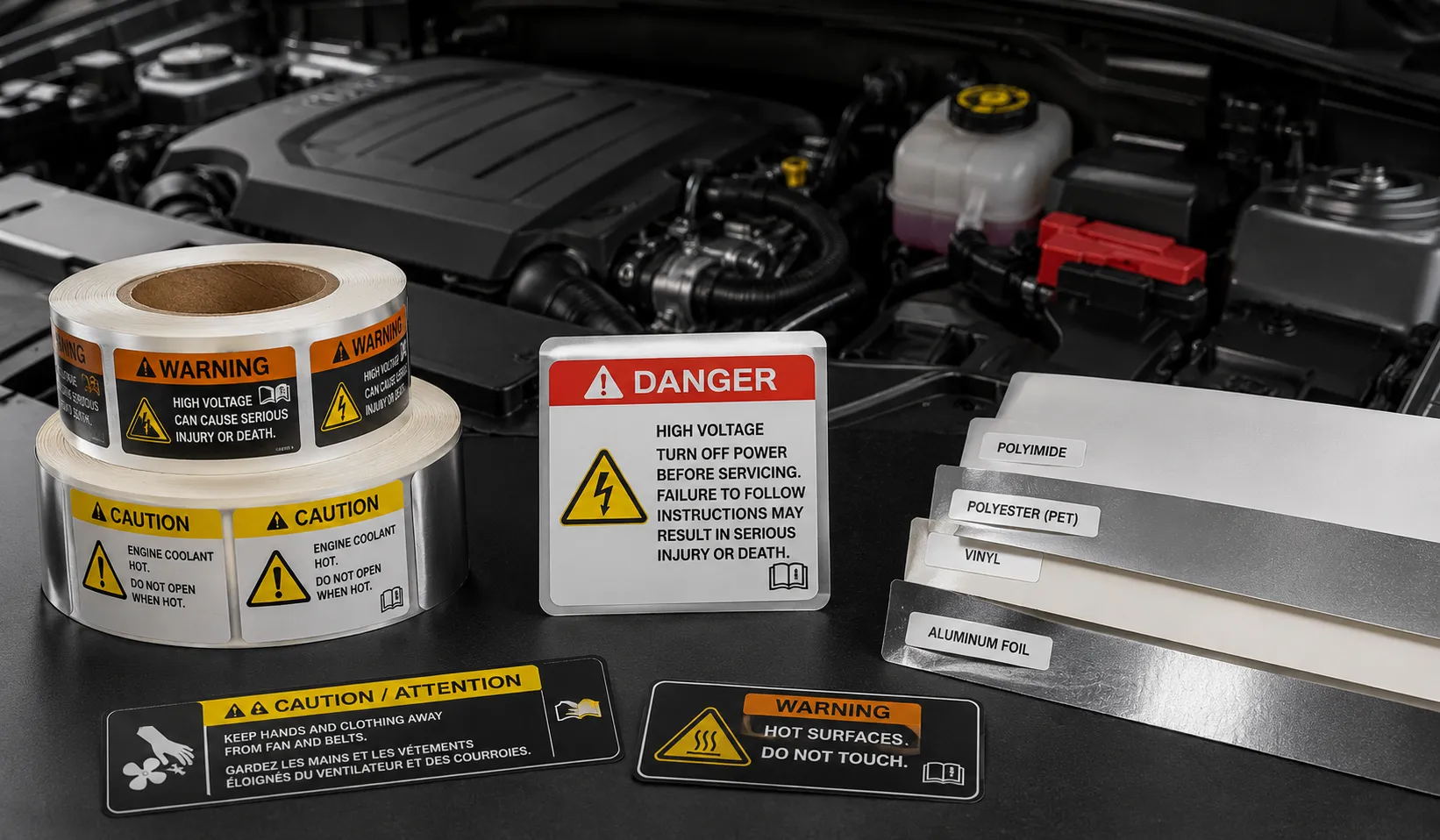

Under-hood warning labels are built almost entirely from polyester film, polyimide film, or aluminum foil laminate, paired with high temperature acrylic or silicone adhesives and a resin printed image. Paper and standard vinyl do not last in an engine bay. The heat, the fluids, and the vibration rule them out inside a single season.
The material choice is not one decision either. A finished label is a stack: facestock, ink system, sometimes an overlaminate, plus the adhesive and liner underneath. Every layer has to survive the same conditions, because the weakest one decides how long the whole thing stays readable.
Why the Engine Bay Destroys Ordinary Label Stock
Temperatures near exhaust routing and turbo housings can sit above 150 C for hours, then drop below freezing overnight. That cycling makes films shrink and adhesives creep at the edges, which is why under-hood warning labels get engineered rather than simply printed. A label only has to lift a millimeter before oil wicks underneath and finishes the job.
Chemistry does the rest of the damage. Motor oil, coolant, brake fluid, diesel exhaust fluid, fuel vapor, and degreasers all splash across the same surfaces that carry safety text. Warning labels on products in this environment have to resist wiping, spraying, and pressure washing without the print smearing away.
- Sustained heat plus overnight cold soak, repeated for years
- Oil, coolant, brake fluid, fuel, and cleaning solvents
- UV exposure whenever the hood sits open in daylight
- Constant vibration and occasional contact from tools and hands
Facestock Options for Under-Hood Warning Labels
Facestock is the printable film carrying the message, and it sets the temperature ceiling for the whole construction. Three materials cover the vast majority of automotive warning label materials in service today. The rest appear only in cooler, sheltered positions.
Cost climbs steeply as the temperature rating goes up. That is why a single vehicle carries several different constructions rather than one premium stock everywhere. Matching the film to the actual position saves real money across a production run.
1. Polyester (PET) Film
Polyester is the workhorse for under-hood warning labels in moderate positions such as fuse boxes, reservoirs, and inner fender panels. Industrial grade PET films commonly hold up to around 150 C while staying dimensionally stable. They resist most automotive fluids and take thermal transfer print cleanly.
White, silver, and clear finishes are standard, which matters when a label must match trim or read through a housing. Hard coated versions add scratch resistance where hands and tools reach. Most heat resistant label materials sold for automotive work start from a PET base for exactly that reason.
2. Polyimide Film
Polyimide, widely known by the Kapton trade name, takes over where polyester gives up. It stays stable and legible at continuous temperatures around 200 C and tolerates short excursions well above that. Engine components, exhaust adjacent brackets, and turbo shields are where polyimide labels earn their cost.
The film is thin, amber tinted naturally, and usually paired with silicone adhesive rather than acrylic. Printing needs a specialty high temperature resin ribbon so the image does not fail before the film does. It is the priciest common option, so it gets specified by position rather than by default.
3. Aluminum Foil Laminate
Foil laminates sit between the two films on temperature and beat both on abrasion. The metal layer will not stretch or tear, holds embossed detail, and gives the traditional rating plate look many engineers still prefer. Belt routing diagrams and permanent identification plates often use it.
The trade off is conformability. Foil does not wrap tight curves as willingly as film, and creases stay creased once they happen. On flat or gently curved panels it remains one of the toughest choices available.
4. Vinyl and Polypropylene
Vinyl and polypropylene appear on cooler positions such as strut towers, cowl panels, and hood liners. They conform well, print in full color cheaply, and handle ambient heat without complaint. Plenty of engine bay warning decals on production vehicles are exactly this.
Push them close to hot metal and they fail predictably. Vinyl shrinks and pulls away at the corners, and unstabilized polypropylene chalks under UV. Position, not preference, decides whether these belong in the specification at all.
Adhesives Do More Work Than the Film
Most field failures trace back to adhesive selection rather than the printed layer. Permanent acrylic adhesives cover the majority of under-hood warning labels because they hold through thermal cycling and resist fluids without softening. Silicone adhesives take the high heat positions where acrylic starts to flow.
Surface energy complicates the choice further. Polypropylene and TPO components usually sit below 35 dynes per centimeter, which starves a standard acrylic of the wetting it needs. Modified or rubber based formulations bond far better on those plastics, and peel data measured on the actual substrate settles the argument quickly.
- High temperature permanent acrylic: general under-hood use on metal and painted surfaces
- Silicone: continuous high heat on engine components and exhaust adjacent parts
- Modified acrylic or rubber based: low surface energy plastics and textured housings
- Removable grades: temporary service and transport markings only
Ink Systems, Ribbons, and Overlaminates
A facestock can outlive its own printing, and on under-hood warning labels that is a common failure. Thermal transfer with a full resin ribbon is the standard for durable text and barcodes, since resin bonds into the topcoat rather than sitting on it. Wax ribbons print beautifully and then smear at the first solvent wipe.
Screen printing and UV curable digital printing both handle multicolor safety graphics well. A clear polyester overlaminate adds abrasion and chemical protection, at the cost of some flexibility. On labels wiped at every service interval, that layer pays for itself.
Standards Behind the Wording and the Colors
The message format is regulated by convention as much as the material is by physics. ANSI Z535.4 defines product safety sign and label design in North America, including the DANGER, WARNING, and CAUTION signal words and their red, orange, and yellow color assignments. ISO 3864 covers the equivalent graphical symbols and safety colors used internationally.
Durability standards sit alongside them. UL 969 recognition covers marking and labeling system permanence, while ASTM D3330 measures peel adhesion and ASTM G154 runs the accelerated UV weathering behind outdoor life claims. Vehicle identification and emission labeling carry their own federal rules under 49 CFR Part 565 and related EPA requirements.
- ANSI Z535.4: Signal words, color coding, and safety message layout
- ISO 3864: International safety symbols and color standards
- UL 969: Durability and permanence of marking and labeling systems
- ASTM D3330 and G154: Peel adhesion and accelerated weathering testing
How to Specify a Construction That Lasts
Specifying starts with the position, not the artwork. Measure the continuous and peak temperature at the exact mounting point, then list the fluids that will realistically reach it. Caution labels for engine compartment use fail most often when someone specifies from a general category instead of a measured location.
After that, work upward through the stack. Good under-hood warning labels come from confirming the facestock rating, the adhesive chemistry, the print method, and whether an overlaminate is warranted. Suppliers who carry flame retardant label stock can also advise where UL 94 rated material is worth adding near wiring and heat shields.
- Measure continuous and peak temperature at the mounting point
- List every fluid and cleaning agent the surface will meet
- Identify the substrate material and its surface energy
- Choose facestock, then adhesive, then print method in that order
- Field test a batch on a running vehicle before production release
Write down the temperature, the fluids, and the substrate before you request a single sample. That one page turns a guessing game into a specification.
Frequently Asked Questions
What material is best for under-hood warning labels?
Polyester film with a high temperature acrylic adhesive suits most under-hood positions, and polyimide film with silicone adhesive covers the hottest ones. Aluminum foil laminate is the choice where abrasion resistance matters more than conformability. The right answer depends on the measured temperature at the mounting point rather than on a general engine bay rating.
How hot does an engine bay actually get?
Ambient engine bay temperatures often run between 90 C and 120 C in normal operation, with surfaces near exhaust components and turbochargers climbing well past 150 C. Heat soak after shutdown pushes local readings higher again briefly. Measuring at the mounting position is the only reliable way to specify material.
Are polyimide labels worth the extra cost?
They are when the position genuinely exceeds what polyester can hold, which usually means continuous exposure above roughly 150 C. Below that, polyester delivers similar chemical resistance and print quality at a fraction of the price. Specifying polyimide across an entire vehicle inflates cost with no measurable durability gain.
What do the DANGER, WARNING, and CAUTION signal words mean?
Under ANSI Z535.4, DANGER signals a hazard that will cause death or serious injury if not avoided, WARNING signals one that could, and CAUTION covers hazards that could cause minor or moderate injury. Each carries an assigned color: red, orange, and yellow respectively. Using the wrong level weakens the credibility of every other label on the vehicle.
Why do under-hood warning labels for cars fade or peel early?
The usual causes are an adhesive rated below the real service temperature, a facestock chosen for cost rather than position, or a wax based print that solvents remove. Poor surface preparation adds to it, since oil residue prevents proper adhesive from getting wet out. Most premature failures are specification problems rather than manufacturing defects.
Can one label construction cover the whole engine bay?
It can, but it means paying high temperature prices for cool positions. Most manufacturers run two or three constructions with matching artwork and finish instead. That approach keeps compliance intact while holding the material budget down.
Do aftermarket parts need the same warning label materials?
Any part mounted in the engine bay faces the same heat, fluids, and vibration, so the material logic does not change with the brand on the box. Safety messaging on aftermarket components should follow the same ANSI Z535.4 conventions as original equipment. Chemical resistant label material and a resin printed image remain the practical baseline.
Under-hood warning labels only work if the message survives as long as the hazard does. Measure the position, specify the full stack, and test it on a real vehicle before the first production order. Anything less is a decal with a countdown on it, and automotive label materials chosen properly cost far less than a field replacement program.

























Sign in to leave a comment.