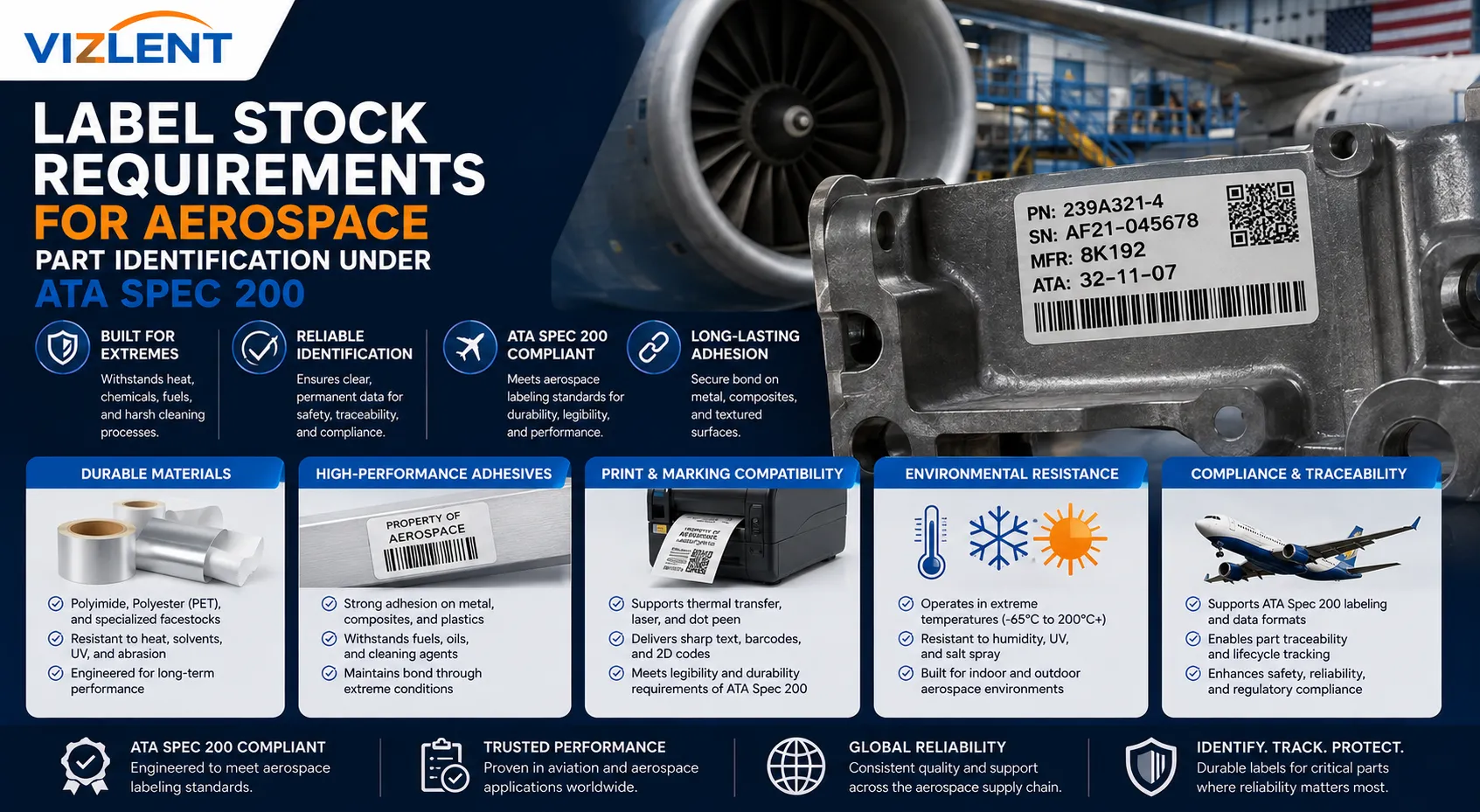

Label Stock Requirements for aerospace part identification are the substrate, adhesive, topcoat, and print specifications a label must meet so the marking stays attached, legible, and machine readable for the serviceable life of the part. That is a harder brief than almost any other industrial labeling job. A tag that lifts off a hydraulic actuator after four hundred flight hours is not a cosmetic problem, it is a traceability gap.
Drawings and purchase orders routinely call for ATA Spec 200 compliant marking. The reference is common, and it carries a piece of history worth untangling before material gets specified. Getting the standard right separates a qualified construction from a rejected first article.
Where ATA Spec 200 Ends and Spec 2000 Chapter 9 Begins
ATA Spec 200 was developed in the late 1950s to standardize the interchange of provisioning, order placement, and shipment information between airlines and suppliers. It was built around 80 column punch cards. Two dozen revisions later, the format had run out of room.
A joint airline and supplier task force formed in 1984 to define a replacement, and Spec 2000 was the result. Permanent part identification now sits in Spec 2000 Chapter 9, Automated Identification and Data Capture, covering bar coding, Data Matrix, and RFID. Boeing and Airbus adopted Chapter 9 as standard practice, and it was published internationally as ISO/TS 21849.
- So when a drawing cites ATA Spec 200 marking, the technical content in play is usually one of these:
- Permanent bar code identification applied to the part itself, per Chapter 9
- Bar code initiation and control procedures, in section 9-4
- RFID data structure and memory mapping, in section 9-5
- Shipping and receiving identification on packaging and documentation
The Core Label Stock Requirements for Aircraft Part Marking
Chapter 9 governs data content, symbology, and encoding. It does not hand a converter a bill of materials. Airline requirements published through IATA state the tag should remain attached for the serviceable life of the part unless the maintenance manual gives removal instructions, and that sentence drives most of the Label Stock Requirements that follow.
- Adhesion measured against a service life in decades, not shelf life
- Resistance to phosphate ester hydraulic fluid, jet fuel, lubricating oils, de-icing fluid, and degreasers
- Dimensional stability through repeated ground to cruise thermal cycling
- Abrasion and vibration tolerance with no edge lift
- Low outgassing near sensitive avionics
- Print permanence equal to substrate life, because a blank label is a failed label
Airframe OEMs publish their own qualification specifications, and those sit on top of the ATA framework rather than replacing it. Boeing standard 13-47J has been used to evaluate laser markable label materials against Skydrol, jet fuel, salt water, methyl propyl ketone, severe abrasion, and weatherability. A supplier who cannot produce data against a named specification is not offering an aerospace material.
Facestock Selection by Aircraft Zone
Material choice follows temperature and chemistry, not price. Polyimide film is the usual answer for engine, APU, and bleed air zones because it holds dimensional stability across an unusually wide thermal span. Polyester carries general airframe, avionics, and interior identification, and it is where most Label Stock Requirements land in daily practice.
- Polyimide, Kapton type: Engine and APU zones, commonly specified to 300 C and beyond
- Polyester, PET: Airframe, avionics bay, and interior tags, typically to around 150 C continuous
- Anodized aluminum foil: Structural and long term outdoor tags with severe UV exposure
- Destructible and tamper evident films: Warranty and shop control, not primary part marking
Constructions sold as heat resistant labels generally pair a polyimide or silicone coated facestock with a high temperature acrylic adhesive. Coated label stock paper keeps a legitimate role in aviation logistics, on shipping cartons, packing lists, and receiving documents. It has no role on the part itself.
Adhesive Systems and Application Discipline
Adhesive selection is where most field failures begin. Modified acrylics cover painted aluminum and primed surfaces, while silicone adhesives pair with polyimide for the hottest work. Low surface energy composites and freshly cured coatings need a primer or a high tack formulation, and this is one of the Label Stock Requirements most often skipped during prototyping.
Application conditions matter as much as chemistry. Surfaces should be clean and dry, the label applied inside the adhesive stated temperature window, and the bond given time to build before service. Aerospace label stickers are rarely stocked items, and nearly all are label stickers custom converted to a controlled drawing with defined corner radii.
Symbology, Print Systems, and Barcode Grade
Chapter 9 defines Code 39 and Code 128 as preferred symbologies for permanent parts identification, with Data Matrix used where marking area is limited. Those symbols encode CAGE and NSCM codes, the five position alphanumeric sequences identifying manufacturers, suppliers, and repair agencies. IATA guidance places practical minimum symbol dimensions near 0.75 inches square for a 2D code alone.
- Code 39 and Code 128 for linear permanent parts identification
- Data Matrix where surface area is constrained
- SAE AS9132 for Data Matrix quality requirements in aerospace
- ISO/IEC 15415 for print quality grading of 2D symbols
- Verification after environmental exposure, not only at the printer
Print system choice decides whether the symbol survives. Thermal transfer with a full resin ribbon is the standard route, since resin bonds to non porous synthetics and holds against solvents and abrasion in a way wax cannot. A label sticker printer running wax or wax resin will smear on first contact with hydraulic fluid, which is why print durability belongs inside the Label Stock Requirements rather than alongside them.
Flammability, Cabin Zones, and Supplier Qualification
Anything inside a pressurized compartment falls under FAR 25.853, which governs flammability of compartment interior materials. Labels are not exempt because they are thin. Materials sold as flame retardant labels generally carry UL 94 V-0 or VTM-0 self extinguishing ratings and halogen free construction, which supports the case without replacing testing against the aviation standard.
Documentation separates a qualified supplier from a hopeful one. Teams benchmarking label stock requirements China converters publish against North American datasheets should ask every candidate for the same evidence. Serious label stock manufacturers hand it over without hesitation.
- Technical datasheet naming facestock, adhesive, liner, and topcoat by grade
- Test data against a named chemical resistance specification, not a generic claim
- Batch traceability and a certificate of conformance per lot
- Sample rolls for adhesion and print trials on the production substrate
- Written notice of any formulation change before it ships
Frequently Asked Questions
What are the Label Stock Requirements for ATA Spec 200 part marking?
The label must stay attached and readable for the serviceable life of the part. In practice that means a synthetic facestock, an adhesive matched to the application surface, and a resin printed or laser marked symbol that resists aviation fluids and thermal cycling. Paper is acceptable only on packaging and paperwork.
Are ATA Spec 200 and ATA Spec 2000 the same specification?
No. Spec 200 was the 1950s provisioning and shipment data standard that Spec 2000 replaced. Part identification requirements now sit in Spec 2000 Chapter 9, also published as ISO/TS 21849, though drawings still cite the older number out of habit.
What label material resists aviation hydraulic fluid?
Polyimide performs best against phosphate ester fluids such as Skydrol, followed by topcoated polyester. Testing against Boeing 13-47J showed polyimide laser markable constructions outperforming polyester and acrylic across Skydrol, jet fuel, salt water, and abrasion. The topcoat and printed image need the same resistance as the film.
Which barcode symbologies does Chapter 9 specify?
Code 39 and Code 128 are preferred for permanent parts identification, with Data Matrix common where marking area is limited. These symbols carry CAGE and NSCM codes identifying the manufacturer, supplier, or repair agency. Data Matrix quality for parts marking is governed separately by SAE AS9132.
How small can an aerospace 2D code label be?
IATA guidance places the practical minimum near 0.75 inches square for a 2D code alone, and around 0.75 by 1.25 inches where a linear code and a 2D code appear together. Smaller symbols risk failing verification once wear sets in. Confirm the dimension against the program drawing.
Can label stock paper be used for aircraft part identification?
No. Coated label stock paper and consumer grade label sticker paper are built for indoor, short cycle use, and both delaminate under fluid exposure and thermal cycling. Paper stays appropriate for cartons, packing lists, and receiving documents, which Chapter 9 also addresses.
Is a desktop label sticker maker suitable for part marking?
A desktop label sticker maker is fine for bin identification, shop organization, and tooling control. It is not suitable for permanent part marking, which needs industrial thermal transfer or laser systems producing a verified symbol grade on qualified media. Printer, ribbon, and facestock qualify together.
Should aerospace labels be sourced through a local search?
Searching label stickers near me usually surfaces print shops stocking general purpose media. Aerospace work needs converters holding material qualification data, batch traceability, and certificates of conformance per lot. Specification support matters more than proximity.
Treat Material Selection as a Controlled Specification
Before releasing the next drawing revision, pull the Label Stock Requirements out of the print specification and manage them as a controlled material spec of their own. Request datasheets, run adhesion and print trials on the real production substrate, and verify symbol grade after environmental exposure rather than straight off the printer. That sequence costs a few weeks up front and prevents a fleet wide reidentification program later.
About the Author
Andy Qiu is a label materials engineer working with pressure sensitive constructions for industrial and high temperature identification, including polyimide, polyester, and metal foil systems.
How This Was Produced
Standards references were checked against ATA e-Business Program documentation for Spec 2000 Chapter 9, IATA aircraft part marking guidance, FAA advisory material, and published OEM material test reporting. AI tools assisted with drafting and structure; the technical review and standards interpretation are the author’s own.

























Sign in to leave a comment.