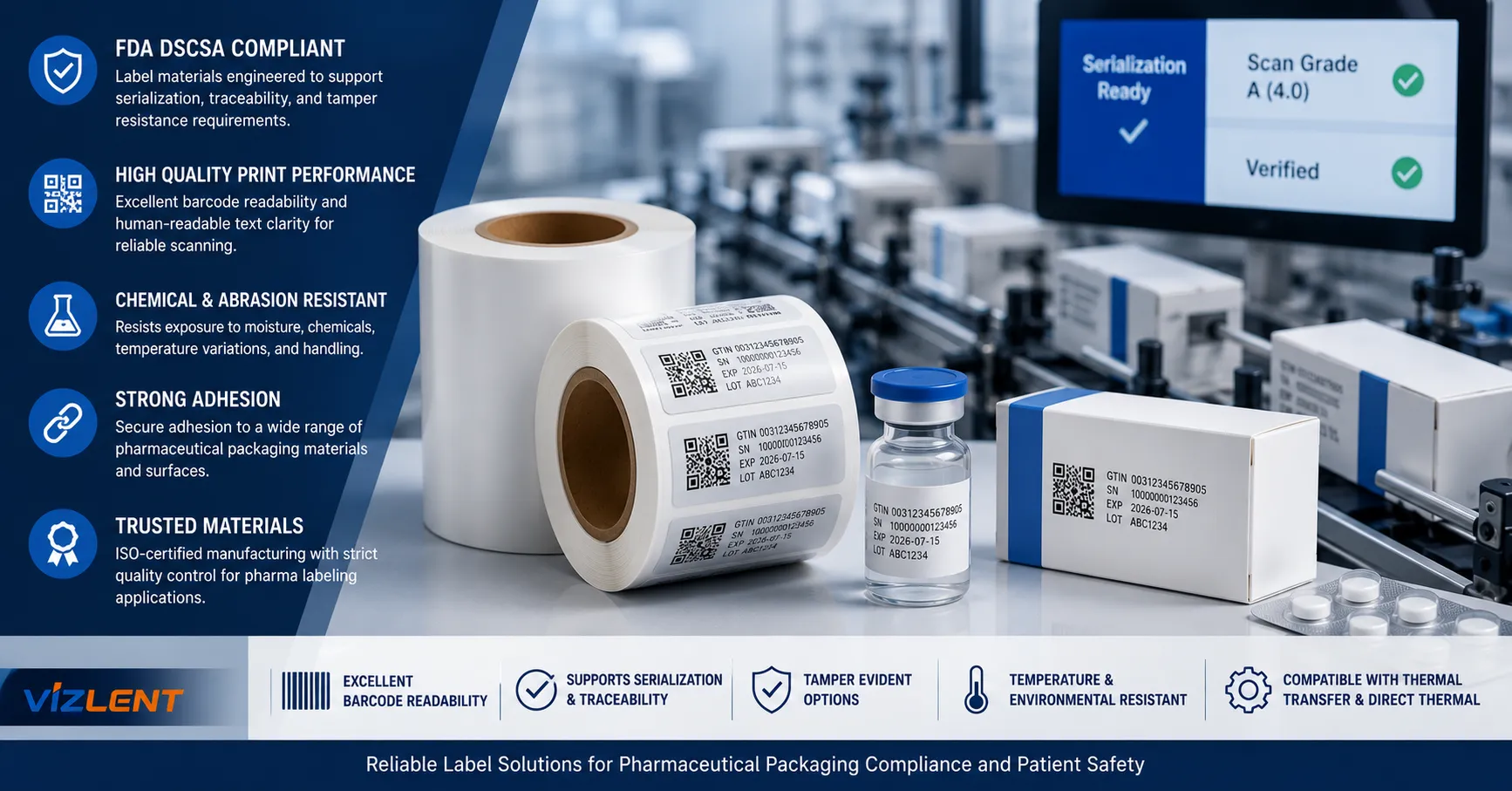

Label material for pharmaceutical serialization is the facestock, adhesive, and topcoat system engineered to carry a unique 2D DataMatrix product identifier that stays machine-readable from the packaging line through dispensing. The Drug Supply Chain Security Act, enacted as Title II of the Drug Quality and Security Act and signed on November 27, 2013, requires each package of prescription drug product to bear that identifier. It must encode the National Drug Code, a serial number, the lot number, and the expiration date, in both human-readable text and machine-readable form.
What the DSCSA Requires on a Serialized Package
The four data elements in a product identifier
Section 582 of the Federal Food, Drug, and Cosmetic Act sets the product identifier obligation. At package level, the machine-readable portion must be a two-dimensional data matrix barcode. Homogeneous cases may carry a linear barcode instead, which is why case and unit constructions are specified separately.
Where the compliance timeline stands today
The enhanced drug distribution security provisions took effect on November 27, 2023, followed by a stabilization period that closed on November 27, 2024. FDA then issued staggered exemptions ending May 27, 2025 for manufacturers and repackagers, August 27, 2025 for wholesale distributors, and November 27, 2025 for larger dispensers. Small dispensers, meaning companies with 25 or fewer full-time employees licensed as pharmacists or qualified as pharmacy technicians, remain exempt until November 27, 2026.
- National Drug Code for the specific product presentation
- Serial number assigned to that individual package
- Lot number tied to the production batch
- Expiration date in the standardized identifier format
- Human-readable text plus a 2D data matrix at package level
Label Material Specifications That Protect Barcode Grade
Why barcode grade is a material property
Print quality for 2D symbols is graded under ISO/IEC 15415, with a minimum grade set at print and a lower floor at scan. Label material specifications drive that grade through surface smoothness, topcoat receptivity, opacity, and reflectance uniformity. Inconsistent caliper or uneven topcoat produces ragged module edges, and the symbol loses grade before leaving the line.
Contrast, symbol size, and small-format limits
Contrast is most sensitive to facestock choice, because a DataMatrix depends on clean light and dark distinction across very small modules. Unit-of-use cartons and vial labels often constrain the symbol to roughly 5mm to 8mm square, leaving little tolerance for ink spread. Reviewing pharmaceutical and healthcare label materials that publish surface finish, opacity, and print compatibility data makes grade easier to hold at volume.
- Symbol contrast and reflectance uniformity across the printed area
- Facestock caliper consistency from roll to roll
- Topcoat receptivity matched to the ink or ribbon chemistry
- Opacity sufficient to prevent show-through from the container
- Abrasion and solvent resistance after printing
Label Material Types Used in Serialized Drug Packaging
Coated paper facestocks versus synthetic films
Label material types for serialized packaging divide into coated paper facestocks and synthetic films. Semi-gloss and gloss papers remain common on secondary cartons and shipper cases, where exposure is limited. Polyester, polypropylene, and polyolefin films take over on primary containers facing moisture, alcohol wipe-down, or cold storage.
Matching adhesive chemistry to storage conditions
Adhesive selection follows the same logic and is rarely interchangeable. Standard permanent acrylics turn brittle well above cryogenic temperatures, so refrigerated and frozen presentations need adhesives formulated for those ranges. Where counterfeiting risk is high, security label materials such as void-release films and destructible vinyls sit alongside the identifier.
- Coated paper facestocks for cartons, bundles, and shipper cases
- Polyester and polypropylene films for vials, ampoules, and IV bags
- Low-temperature adhesives for 2°C to 8°C and frozen presentations
- Void-release and destructible constructions for tamper evidence
- Overlaminate films where distribution abrasion is expected
Label Material for Pharmaceutical Serialization Regulations and Change Control
What FDA specifies and what it leaves to you
Label material for pharmaceutical serialization regulations do not prescribe a construction. FDA governs labeling content and legibility under 21 CFR Part 201 and sets the identifier requirement, but facestock, adhesive, and liner remain the manufacturer's responsibility under its own quality system. That shifts the burden from selecting an approved material to proving the selected material performs.
Managing material changes on approved products
Change control is where the burden becomes visible. A material change on an approved NDA, ANDA, or BLA product falls under 21 CFR 314 or 601 and may require an annual report or a prior approval supplement. Supplier reformulations that keep the same product code are the most common source of unplanned change events.
Label Material for Pharmaceutical Serialization in Manufacturing and Line Performance
Application accuracy and inline verification
Serialized constructions have to satisfy the labeller before they satisfy the scanner. Web tension stability, release force consistency, and dimensional tolerance decide whether applicators place labels squarely enough for inline vision systems. Release force that drifts across a roll causes skew, a frequent cause of verification rejects misdiagnosed as print failures.
Aggregation and parent-child data integrity
Aggregation adds a second layer of dependency. Once units are aggregated into bundles, cases, and pallets, one unreadable child code can stall the parent record. Materials that hold consistent print and placement performance across a campaign reduce that burden more reliably than any software fix.
- Consistent release force so applicators place labels square
- Dimensional tolerance matched to the die and the applicator
- Print stability across the full length of a slit roll
- Ribbon or ink compatibility verified on the actual construction
Label Material for Pharmaceutical Serialization Drug Product Needs by Presentation
Vials, ampoules, and curved primary containers
Container choice drives material choice long before the printer does. A lyophilised vial label must survive glass application, freeze-drying, cold storage, shipping, and handling. Small-diameter curvature on vials and ampoules adds a mandrel challenge that flat carton stock never faces.
Cold chain and cryogenic presentations
Cold chain presentations tighten the window further. Biologics held between 2°C and 8°C, frozen products near minus 20°C, and cryogenic material down to minus 196°C need adhesives that stay flexible at temperature. Condensation during freeze-thaw cycling catches paper facestocks, because moisture uptake distorts the printed symbol even when the bond holds.
Evaluating Label Material for Pharmaceutical Serialization Vendors
Documentation to request before sampling
Label material for pharmaceutical serialization vendors should be judged on documentation depth rather than catalogue breadth. Ask for coat weight uniformity data, release force values, and batch traceability, and confirm the supplier runs a recognised quality system. A label material factory that coats and slits in house can answer lot variance questions directly, while a trading intermediary often cannot.
Print system compatibility checks
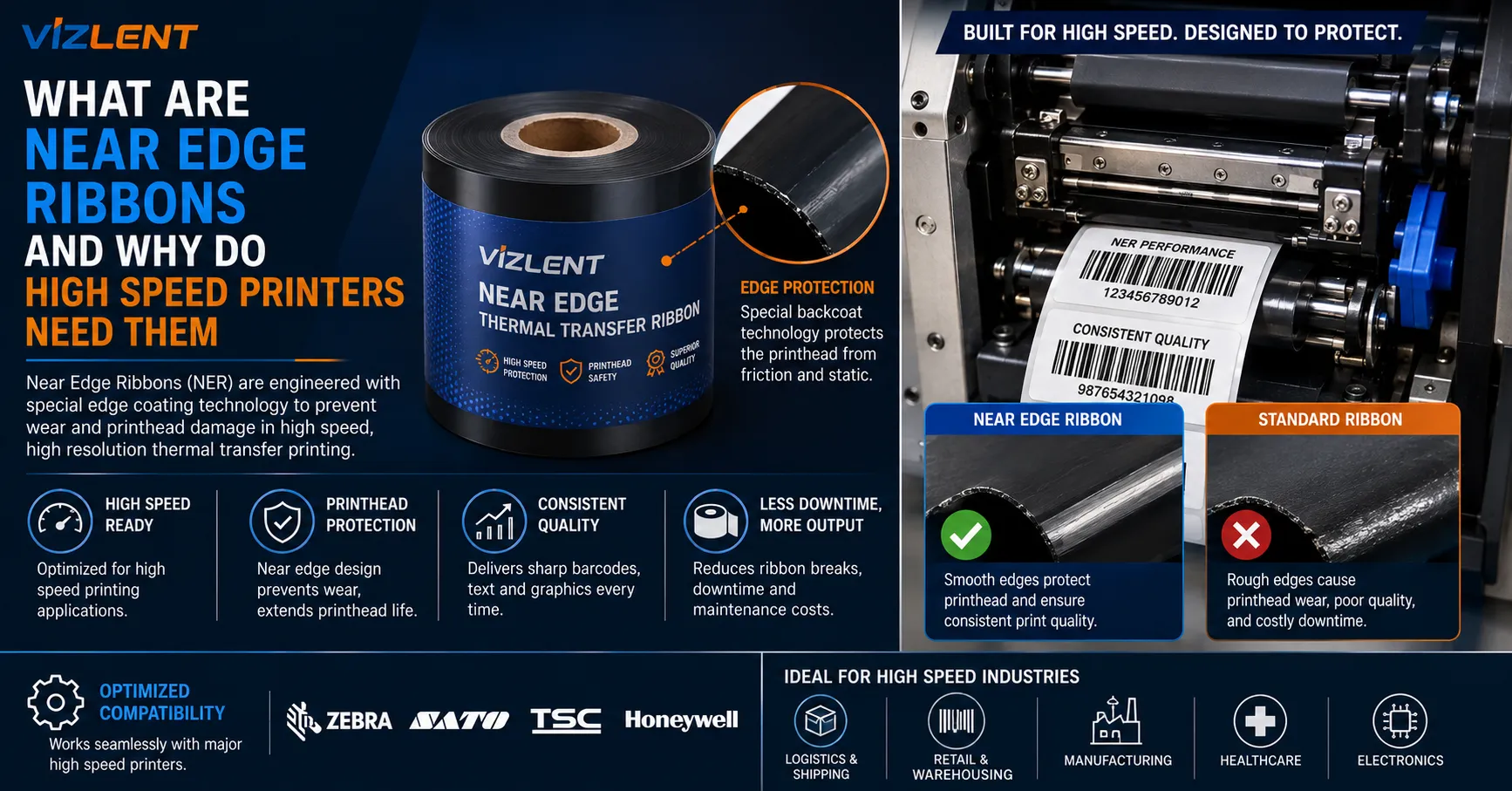
Print system compatibility is the second screen. Thermal transfer remains the dominant method for variable serialization data, and thermal transfer ribbons in resin grades behave differently from wax grades on the same stock. Verified data for the exact combination you intend to run beats a general datasheet.
- Request documented coat weight, caliper, and release force tolerances
- Confirm roll-by-roll inspection records and batch traceability
- Secure written notice of any raw material or formulation change
- Order samples large enough for a real converting and print trial
- Run the trial on your own press, applicator, and containers
Validating the Label Material for Pharmaceutical Serialization Process
Qualify the system, not the isolated variables
Material qualification should be treated as a system rather than as independent variables. Facestock surface, print resolution, ribbon or ink chemistry, and applicator settings interact, and optimising one in isolation often degrades another. A campaign trial on production equipment with production containers exposes interactions that bench testing does not.
Verification after launch
Ongoing verification matters as much as initial qualification. Inline verifiers grade every symbol at print, but offline grading after distribution simulation reveals abrasion, chemical, and humidity effects that appear only over time. Retaining graded samples gives quality teams a defensible record when a scan failure is reported downstream.
Start With the Specification, Not the Printer
Serialization compliance is decided at the specification stage, long before the first code is printed. Map the container, the exposure profile, and the print system first. Then request full technical data and trial quantities so the label material for pharmaceutical serialization is proven on your own line rather than on paper.
Frequently Asked Questions
What is label material for pharmaceutical serialization?
It is the combined facestock, adhesive, topcoat, and liner system used to carry a DSCSA product identifier on a prescription drug package. The construction must hold a printed 2D DataMatrix at a quality level suitable for reliable scanning. It must also stay adhered to the container through its full storage and handling profile.
Does the FDA approve specific label materials for serialization?
No. FDA sets requirements for labeling content, legibility, and the product identifier, but does not prescribe particular facestocks or adhesives. Material qualification sits with the drug manufacturer under its own quality system.
What barcode standard applies to DSCSA serialization codes?
The package-level identifier must be encoded in a 2D data matrix barcode. Print quality is commonly assessed against ISO/IEC 15415, with a minimum grade at print and a floor at scan. Homogeneous cases may use either a linear barcode or a 2D data matrix.
Which facestock performs best for serialization DataMatrix printing?
Semi-gloss and gloss coated facestocks generally support higher contrast and cleaner module edges than matte surfaces at small symbol sizes. On containers exposed to moisture, alcohol, or cold storage, polyester and polypropylene films are specified instead. The right answer depends on the container, print method, and exposure profile.
Why do serialization barcodes fail after distribution rather than at print?
Post-print degradation is usually caused by abrasion, chemical wipe-down, or humidity that alters contrast or damages module edges. A symbol grading well at the printer can drop below the floor by the time it reaches a dispenser. Distribution simulation testing catches this before launch.
How should a label material change be documented?
Changes should be routed through change control and assessed for impact on adhesion, print quality, serialization performance, and filing status. Depending on assessed risk, the change may require an annual report or a prior approval supplement. A quality agreement requiring advance written notice is the most effective preventive control.
What DSCSA deadlines still apply in 2026?
Manufacturers, repackagers, wholesale distributors, and dispensers with 26 or more full-time employees have passed their exemption end dates of May 27, 2025, August 27, 2025, and November 27, 2025. Small dispensers, meaning companies with 25 or fewer full-time employees licensed as pharmacists or qualified as pharmacy technicians, remain exempt from the enhanced requirements until November 27, 2026.
How much material is needed to qualify a serialization label construction?
There is no fixed quantity, but the trial should run on production equipment across a full roll and expose lot-to-lot variance. Most packaging engineers request enough for one campaign trial plus retained samples for distribution simulation. Those graded retains become the baseline for future comparison.


























Sign in to leave a comment.