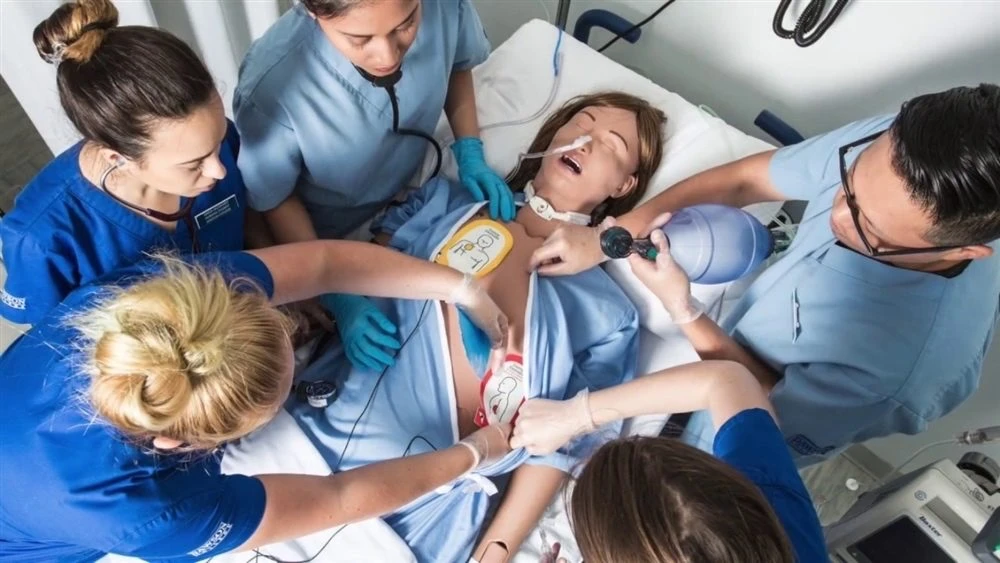

Patient simulators, designed to mimic human physiology and responses, serve as mannequins primarily employed in medical simulation. Medical simulation enables the acquisition of clinical skills through deliberate practice, rather than the traditional apprentice-style learning method. These simulation tools act as substitutes for real patients, providing a platform where trainees can make mistakes and learn from them without the fear of causing harm to actual patients.
Simulator creates an authentic training setting that mimics clinical scenarios for both students and healthcare practitioners. These simulators can replicate diverse medical conditions, enabling learners to practice their diagnostic, therapeutic, and decision-making skills within a secure and supervised environment. Consequently, they stand as a powerful instrument in enhancing patient care quality and safety by equipping healthcare professionals with practical experience, preparing them effectively for real-time situations.
Prime features of the patient simulator:
Situation-based training: Patient simulators offer situations for students to practice their abilities and decision-making skills in numerous medical scenarios, involving routine care and emergencies. Assessment and feedback: They often provide feedback to students, assessing their role and assisting them in enhancing performance through feedback sessions. Anatomy Analysis: Simulators commonly have a high level of accuracy in replicating human anatomy, including body parts, organs, blood vessels, airways, and more. This precision facilitates learners in practicing a wide range of procedures and interventions in a controlled and realistic setting.Allied Market Research published a report on the global patient simulator market. The report indicates that the industry is anticipated to display the fastest growth with a notable CAGR during the projected period. The growth of the industry is accelerated by the adoption of advanced technologies in the medical field, the surge in the adoption of minimally invasive surgeries, and an increase in focus on patient safety.
Patient simulators are commonly categorized into three levels of fidelity: low, mid, and high. Fidelity refers to how accurately and realistically these simulators can replicate human physiological functions.
Low-fidelity simulators:They are also known as task trainers, are simple and static models. They are frequently utilized for repetitive task training, such as practicing procedures like inserting urinary catheters or initiating intravenous (IV) lines.
Additionally, basic silicon wound models are used for practicing dressing changes and suturing techniques. Moreover, basic cardiopulmonary resuscitation (CPR) manikins play a significant role in training both healthcare professionals and the public on performing chest compressions and rescue breathing for CPR training.
Mid-fidelity simulators:They are advanced in design and often equipped with electrical components that replicate fundamental body functions such as cardiac and respiratory activities. They serve multiple purposes, including simple simulations where learners practice assessing vital signs. These manikins are also utilized in uncomplicated scenarios that do not necessitate understanding complex physiological functions. Their extensive use is observed in basic nursing education for training purposes.
High-fidelity simulators:These simulators closely mimic human anatomy. For instance, high-fidelity simulators have chests that inhale and exhale, varying respiratory rates, audible chest sounds, palpable pulses, audible representation of cardiac sounds, both normal and abnormal cardiac rhythms such as asystole, and simulated bowel sounds, among various other features. These manikins can simulate crying, pupil constriction, shaking akin to a seizure, and even speech capabilities.
Virtual patient simulator: An advanced technology with multiple benefits
Institutions are opting for virtual patient simulators for medical and healthcare training, education, and assessment purposes. Virtual patient simulators present numerous advantages to medical students, notably by decreasing training variability and enhancing standardization in education. Trainers can customize virtual patients with ease and motivate students to engage in computer-based simulations, enabling them to receive immediate feedback.
Virtual patient simulators possess the capability to replicate a thorough patient encounter, enabling students to navigate through various aspects including medical history, examinations, differentials, diagnoses, and treatment options. Moreover, the fidelity level of virtual patient simulators in an immersive environment can vary, ranging from low to high fidelity based on the specific simulation goals and the desired learning outcomes.
Recent developments revolutionizing the patient simulator industry:
Inovus Medical declared the launch of the hysteroscopy simulator on 17th January 2022
Inovus Medical® revealed the launch of their latest hysteroscopy simulator, HystAR™, which integrates the company’s patented cloud-based learning system and Augmented Reality technology. This combination, along with the authentic tactile sensation provided by its simulated tissue models, offers an exceptionally realistic, expandable, and monitored training experience for hysteroscopy skills.
HystAR™ marks the third addition to Inovus' hysteroscopy simulator lineup, complementing the highly successful Bozzini Hysteroscopy range available since 2018. Distinguishing itself from the predominantly analogue Bozzini simulators, HystAR™ incorporates the similar cloud-based learning platform featured in the LapAR™, the company's high-fidelity laparoscopic simulator. This innovative platform empowers practicing surgeons to assess and scrutinize their performance metrics. Additionally, it facilitates global connectivity for faculty to offer written feedback, engage with their learners, evaluate progress, assign tasks, grant competency certificates from any location across the globe.
Gaumard Scientific has revealed the initial implementation of a Robotic Patient Simulator along with conversational speech
Gaumard Scientific Co., a frontrunner in healthcare education and training simulation technology, has declared the installation of HAL® S5301, the most advanced interdisciplinary patient simulator, at the Emory University Nell Hodgson Woodruff School of Nursing's advanced simulation and learning facility.
HAL S5301 presents several pioneering features, such as Conversational Speech enhanced by artificial intelligence, incredibly realistic motor movement, and advanced simulated physiology. This innovative design enables HAL to replicate symptoms of conditions like stroke and various medical scenarios. As a result, educators can create remarkably authentic clinical training scenarios in emergency, trauma, ICU, and medical-surgical care. This level of fidelity was previously unattainable, enhancing the training experience significantly.
HAL S5301's functionalities enable students to engage in immersive training scenarios that refine critical thinking skills and strengthen the application of these acquired experiences to real-time clinical practice.
In short, the patient simulator is an integral part of healthcare practices and the demand for it is estimated to rise with technological advancements in the upcoming years.
Ref: https://www.alliedmarketresearch.com/south-africa-healthcare-it-consulting-market-A207982
Ref: https://www.alliedmarketresearch.com/veterinary-imaging-market
Author Bio- Gayatri Mohite is an emerging author who loves to explore new things. An addiction to reading motivates her to write. She also loves to sing, travel, and cook. A fresher who is constantly upgrading her skills has embarked on a new journey to touch up her expertise even more.
Email: [email protected]




























Sign in to leave a comment.