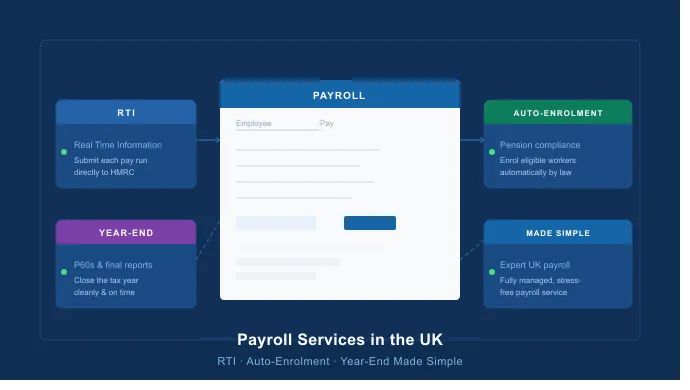

Running payroll in the UK is more than just paying salaries. It involves real-time reporting, pension compliance, tax deductions, and year-end reconciliation. For many business owners, payroll feels technical and intimidating — but it doesn’t have to be.
Understanding how payroll services in the UK work — particularly RTI, auto-enrolment, and year-end processes — can remove uncertainty and help you stay compliant without stress.
Whether you run a startup, manage a growing team, or operate an ecommerce business, this guide breaks everything down clearly.
What Are Payroll Services in the UK?
Payroll services cover the process of:
- Calculating employee wages
- Deducting PAYE tax and National Insurance
- Submitting reports to HM Revenue and Customs
- Managing workplace pension contributions
- Producing payslips and year-end forms
For growing businesses, outsourcing payroll to professional providers offering accountancy services Birmingham ensures compliance while freeing up valuable time.
Understanding RTI (Real Time Information)
RTI is one of the most important elements of UK payroll.
Introduced by HMRC, Real Time Information requires employers to submit payroll data every time employees are paid — not just at year-end.
How RTI Works
Each time you run payroll, you must submit a Full Payment Submission (FPS) to HMRC.
This includes:
- Employee pay
- PAYE tax deducted
- National Insurance contributions
- Student loan deductions
- Pension contributions
The submission must be made on or before the payday.
Failure to comply can result in penalties.
Why RTI Matters
RTI ensures:
- HMRC receives up-to-date payroll information
- Employees’ tax records remain accurate
- Benefits and tax credits are calculated correctly
For businesses managing remote teams — including those supported by Ecommerce accounting Birmingham services — automated RTI submissions are essential to avoid errors.
Auto-Enrolment: Pension Compliance Made Clear
Auto-enrolment is a legal requirement for employers in the UK.
Under rules set by The Pensions Regulator, employers must:
- Automatically enrol eligible employees into a workplace pension
- Make minimum pension contributions
- Provide required communications
- Re-enrol staff every three years
Who Must Be Enrolled?
Employees must be auto-enrolled if they:
- Are aged between 22 and State Pension age
- Earn above the minimum earnings threshold
- Work in the UK
Even small businesses with one employee may have duties.
Contribution Requirements
Minimum pension contributions are:
- 5% employee contribution
- 3% employer contribution
These percentages are based on qualifying earnings.
Payroll systems must calculate these automatically.
What Happens If You Ignore Auto-Enrolment?
Failure to comply can lead to:
- Fines from The Pensions Regulator
- Backdated contributions
- Compliance investigations
This is why many companies choose professional accountancy services UK to manage pension duties alongside payroll.
Year-End Payroll: What Changes?
Year-end payroll in the UK runs from 6 April to 5 April.
At the end of the tax year, employers must:
- Submit a final FPS or Employer Payment Summary (EPS)
- Issue P60 forms to employees
- Prepare P11D forms (if applicable)
- Reconcile payroll totals
Why Year-End Matters
Year-end ensures:
- Employees receive accurate tax summaries
- HMRC records match employer data
- Benefits in kind are properly reported
Mistakes during year-end can cause:
- Employee tax issues
- HMRC penalties
- Delays in personal tax returns
Professional oversight from accountants Birmingham helps ensure year-end runs smoothly.
Common Payroll Challenges UK Businesses Face
Even experienced business owners encounter payroll challenges:
1. Late RTI Submissions
Missing deadlines can result in automatic fines.
2. Incorrect Tax Codes
Applying the wrong tax code leads to employee dissatisfaction and corrections later.
3. Pension Contribution Errors
Incorrect calculations may require backdated adjustments.
4. Director Payroll Complexity
Company directors have slightly different National Insurance calculations.
These issues highlight why structured payroll systems matter.
How Payroll Links with Ecommerce and Growing Businesses
Ecommerce businesses often scale quickly. Hiring staff for:
- Customer support
- Marketing
- Fulfilment
- Admin
…introduces payroll responsibilities.
Businesses supported by Ecommerce accounting Birmingham services often integrate payroll with VAT and bookkeeping systems to maintain consistency.
Should You Outsource Payroll?
Many small businesses start by managing payroll themselves. But as teams grow, complexity increases.
Outsourcing payroll provides:
- Automated RTI compliance
- Accurate pension calculations
- Secure employee data handling
- Time savings
- Reduced compliance risk
This is why professional accountancy services UK often include payroll as part of a broader compliance package.
Payroll Checklist for UK Employers
To stay compliant:
- Register as an employer with HMRC
- Set up PAYE correctly
- Submit RTI on or before payday
- Monitor pension eligibility
- Keep employee records updated
- Prepare for year-end early
Consistency is key.
Best FAQs About Payroll Services in the UK
1. Do Small Businesses Need to Use Payroll Services?
Yes, if you pay employees — even just one — you must operate PAYE and comply with RTI reporting.
Even directors paying themselves through payroll must submit RTI.
While small businesses can manage payroll themselves, errors become costly quickly. Professional payroll services reduce compliance risk.
2. What Happens If I Miss an RTI Deadline?
HMRC may issue penalties automatically.
Repeated late submissions increase the likelihood of:
- Financial penalties
- Compliance scrutiny
- Payroll audits
It’s important to submit payroll information on or before payday every time.
3. How Does Auto-Enrolment Affect My Business Costs?
Employers must contribute at least 3% of qualifying earnings to pension schemes.
While this increases payroll costs, it is a legal obligation.
Failing to contribute can result in significant fines and backdated payments.
Planning for pension contributions as part of overall payroll budgeting avoids surprises.
4. Can Payroll Software Replace Professional Accountants?
Payroll software helps automate calculations, but it doesn’t eliminate compliance responsibility.
Errors in setup, tax codes, or pension settings can still occur.
Professional oversight ensures:
- Correct configuration
- Compliance monitoring
- Year-end reconciliation
Software supports payroll — it doesn’t replace expertise.
5. What Is the Difference Between P60 and P11D?
P60:
Issued to employees at year-end summarising total pay and tax deducted.
P11D:
Reports benefits in kind such as company cars or private health insurance.
Both forms are part of year-end compliance and must be accurate.
Final Thoughts
Payroll in the UK isn’t just about paying staff — it’s about ongoing compliance.
With:
- RTI submissions
- Auto-enrolment obligations
- Year-end reconciliation
- Accurate tax calculations
…payroll becomes a structured process rather than a stressful one.
For growing businesses, outsourcing payroll through experienced accountants birmingham ensures:
- Accuracy
- Compliance
- Time savings
- Peace of mind
When payroll is handled properly, you can focus on building your business — not worrying about HMRC deadlines.
























Sign in to leave a comment.