

A marketing case study on how Pepsi India kept experimenting after Pepsi Blue.
In Pepsi Blue: When Standing Out Became the Problem, we looked at a drink that was hard to ignore and hard to keep buying. This piece asks what Pepsi did next. It would be tidy to say Pepsi Blue taught the brand a lesson and the later campaigns were the result, but I haven't found evidence for that, so I won't claim it.
After Pepsi Blue: The Brand Didn't Stop Experimenting
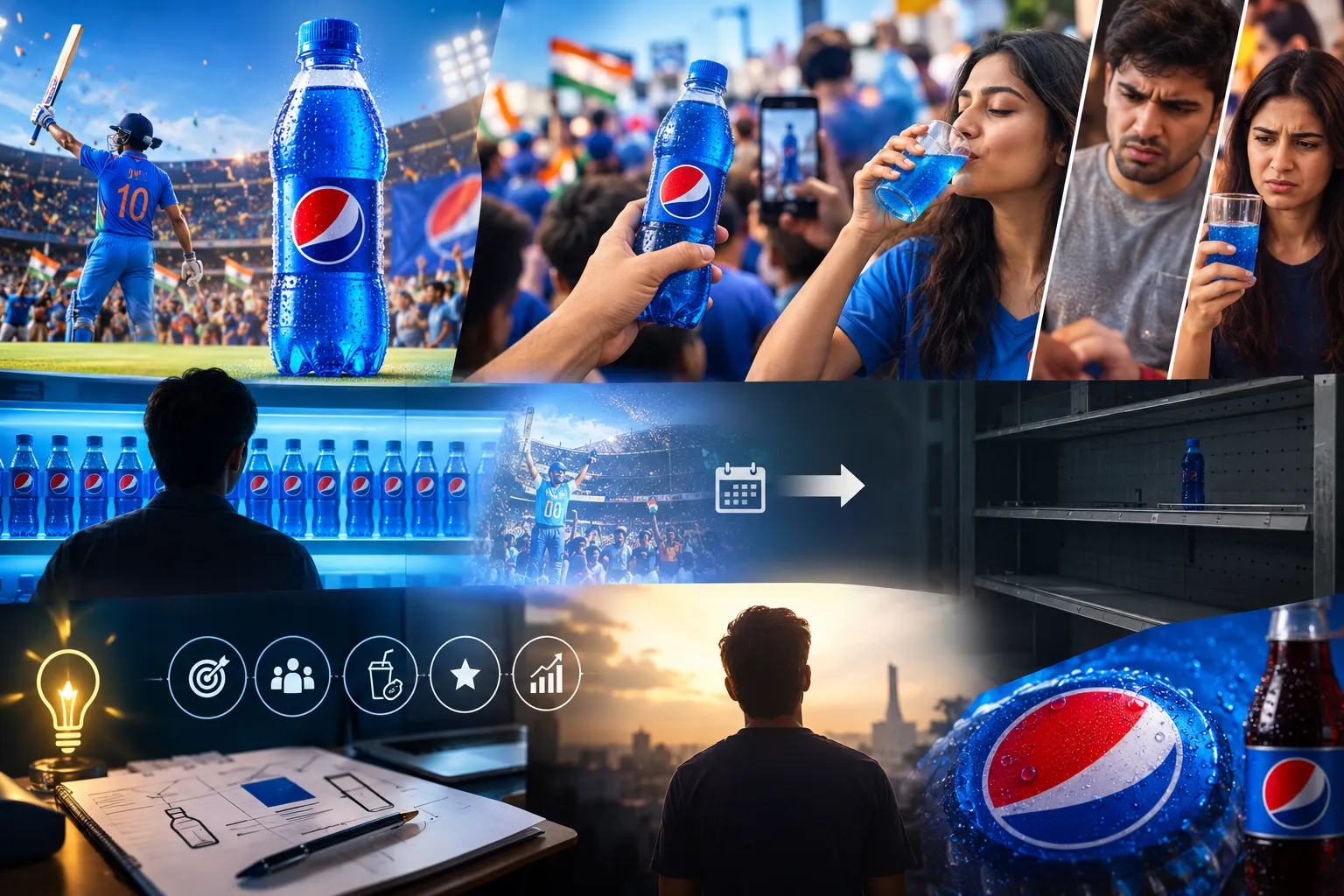
Pepsi Blue was announced in 2002 and sold in the United States and Canada until 2004. In India, it was launched during the 2003 Cricket World Cup, tied to the blue jerseys of the national team. That makes it a useful starting point for the Indian story. Even the flop was built around cricket.
What follows is a pattern, not a cause-and-effect chain. Over the next decade, Pepsi India's marketing moved from selling a novelty product to selling an attitude, then an experience, then a role in the advertising itself. Each step gave the audience more to do.
Youngistaan: Speaking the Language of Youth (2008)
In February 2008, PepsiCo India launched Youngistaan, featuring Ranbir Kapoor and Deepika Padukone alongside Shah Rukh Khan. The first film broke in mid-February, with the line “Yeh Hai Youngistaan Meri Jaan.”
The word was coined for the campaign, and that was the point. Coverage at the time described it as not a place but an attitude. The campaign's early films introduced it, then later ads defined it around the philosophy "Chaho Toh Sab Kuch Hai Aasan." JWT's Hari Krishnan described the idea as a feeling racing through every youthful nerve in the country.
Pepsi's own marketing head called it almost a currency for today's generation to speak their mind and display their attitude. That claim is promotional, but the strategic logic holds up. Giving young people a word they could own is more durable than describing a flavor. The idea also stretched across formats. Pepsi ran a Pizza Hut tie-in with a "Youngistaan Card", an IPL film about "Youngistaan's cricket", and even spoof ads aimed at rival brands, which rivals then spoofed back. In 2010 the idea was refreshed with a new tagline, "Youngistaan ka Wow".
There is a fair criticism. Youngistaan leaned heavily on celebrity casting, which is the standard Indian cola playbook. A creative director quoted by afaqs found Pepsi's teaser-and-reveal format fairly predictable. The idea's real strength was the label, not the stars.
Change the Game: Turning Cricket into an Experience (2011)
By 2011 the World Cup was coming to India. It was being held in India for the first time in 15 years, and Pepsi was the official global partner. Pepsi had history here. During the 1996 Cup it was the unofficial challenger with "Nothing official about it," aimed at rival Coca-Cola. Now it was the official sponsor, which is an awkward position for a brand built on irreverence.
The answer was to make irreverence the official position. Pepsi's marketing head said the brand wanted to be the official sponsor of everything unorthodox about cricket. Conceived by Taproot India, the campaign's first film showed Dhoni's helicopter shot being taught to him by a villager. The set also covered Sehwag, Harbhajan Singh, Dilshan and Pietersen, each celebrated for a signature shot or trick.
The campaign went beyond TV spots in several ways:
- It was a 360-degree effort running in two phases from January 15, with outdoor and radio components.
- A contest called Change the Game 11 began on January 17, inviting fans to submit innovative cricket shots and commentary. Eleven selected entries received the opportunity to watch India's World Cup matches.
- Pepsi also used radio and other media to extend the campaign beyond television.
On results, I'd separate what was reported from what was independently verified. According to the brand's Cannes entry, the Wall Street Journal ranked it the best campaign of the World Cup and Facebook fans rose 300% to over 2 million. Pepsi also said independent studies showed the highest recall among all brands advertised during the tournament. Industry recognition is easier to confirm: the campaign won the Grand EFFIE at the 2011 EFFIE India Awards. Luck helped too. India's win gave the campaign a lot of extra mileage. Whether it would have worked as well in a quarter-final exit is an open question.
Pepsi T20 Football: Breaking Away from Cricket Marketing
A note on the date. The original brief places this in 2013, but the sources show the launch in March 2012. Pepsi launched Pepsi T20 Football on March 14, 2012, as part of its first football-themed campaign in India, and the grand finale was in June 2012. The WARC case study about it was published in September 2013, which may explain the confusion.
The format was a mash-up. It was a seven-a-side amateur tournament for ages 14 to 30, played in a metal cage in 20-minute knockout matches across seven cities. The reported scale was 448 teams and 3,136 players. The prize was coaching from Didier Drogba, a Pepsi ambassador since 2009, before facing a squad including Dhoni, Kohli, Raina and Harbhajan Singh.
The launch was unconventional too. Pepsi introduced the campaign through a television commercial featuring Ranbir Kapoor, using Bollywood and cricket stars to bring football into the conversation. The idea was to make the sport more accessible to a cricket-focused audience rather than simply asking people to embrace something unfamiliar. The campaign then extended beyond advertising through its grassroots tournament, digital engagement and celebrity involvement.
Football purists were not all convinced. One Indian football blogger wrote that the rules mocked the beautiful game and that the cricketers risked hogging the limelight. The same writer conceded that the stars brought football skills to mainstream attention. The case study published by WARC says Pepsi gained share points and youth scores within six months. Those are the case study's reported outcomes, not an independent audit.
Crash the Pepsi IPL: When Consumers Became Creators (2015)
By 2015, Pepsi was the IPL's title sponsor, and the invitation was bold. On March 12, Pepsi challenged consumers to make a 30-second ad, with winning entries replacing the brand's official ad on air during IPL 8, which ran April 8 to May 24. Entrants uploaded to YouTube and submitted the link on a campaign site, and finalists got Rs 1 lakh and VIP access. Ranbir Kapoor sat on the judging panel.
The numbers reported by the campaign's chroniclers were 2,600+ entries, 900+ shortlisted and 5 winners aired during the IPL. Pepsi's pitch to its young audience, according to the Cannes entry, was to get them to re-evaluate their relationship with the brand. Another source said YouTube views grew 44%. A sports site listed it among the best IPL ads and claimed 68 million consumers reached, but I couldn't trace that to a primary source, so treat it cautiously.
The strategic shift is clear. The audience stopped being the target of the advertising and became the supplier of it. For a brand, that is risky, since someone else is now writing your commercial. It also solves a real problem: on the biggest sports property in the country, with every brand shouting, the unexpected move was to hand over the microphone. One candid caveat is that the winning ads were still chosen by a jury of Pepsi and industry people. The crowd generated; the brand curated.
In October 2015, PepsiCo exited its five-year IPL title sponsorship deal two years early. The original deal was worth Rs 396.8 crore, and the exit came amid concerns about the IPL's credibility following the 2013 spot-fixing scandal.
What Pepsi's Marketing Evolution Teaches Us
A failed product doesn't define a brand. Pepsi Blue came and went, and the brand's identity was never tied to it. Brands are larger than any single SKU, which is exactly why experiments are survivable.
Attention and engagement aren't the same. Pepsi Blue got noticed. Change the Game and T20 Football asked people to do something: submit an idea, join a team, play. That is a harder and more valuable result, though it is also harder to measure honestly.
People want a role, not just a message. From Change the Game 11 to Crash the Pepsi IPL, each campaign gave the audience a bit more of the pen.
Cultural relevance can matter as much as innovation. Youngistaan didn't change the drink at all. It changed what drinking it said about you.
Understanding the audience beats novelty. Pepsi Blue was developed around what teenage and young adult consumers said they wanted. But attracting that audience wasn't enough to achieve broader market acceptance. The later campaigns worked, where they did, by reading how young Indians actually behaved: obsessed with cricket, curious about football, fluent in social media.
None of this was flawless. The celebrity dependence, the self-reported results and the IPL exit are all part of the story.
The Real Story Is What Comes Next
One unsuccessful product experiment doesn't define a brand. Sometimes, the real story is what the brand does next.




















Sign in to leave a comment.