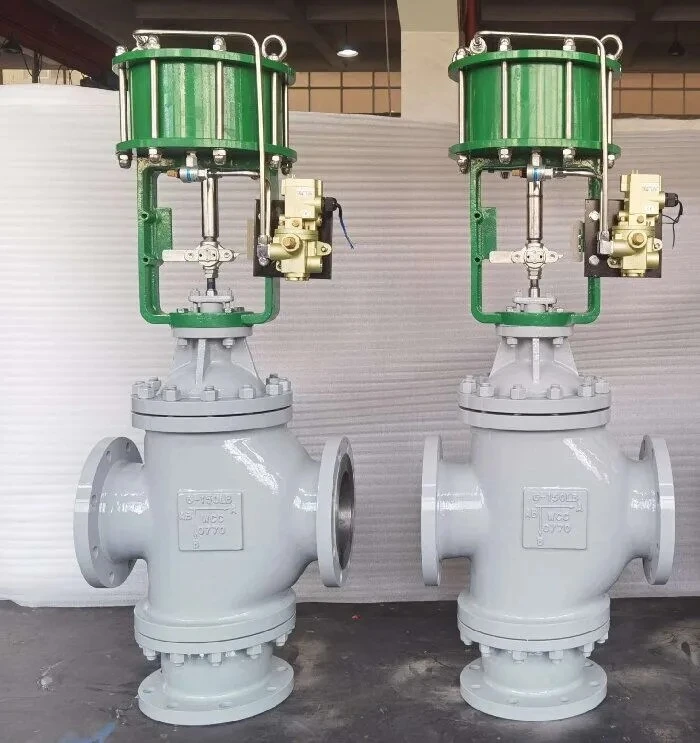

Pneumatic Three-Way Control Valves
Introduction
Pneumatic three-way control valves play a vital role in industrial systems by precisely managing the flow of fluids such as water, steam, or gas. Engineered for either mixing or diverting service, these valves offer exceptional versatility, making them ideal for a wide range of applications—including thermal regulation in heat exchangers and other temperature-sensitive systems. Known for their reliability and accuracy, they are a preferred choice in critical flow control environments.
These valves are typically equipped with a multi-spring diaphragm actuator featuring a compact, high-output design. This configuration delivers consistent performance even under high differential pressures while maintaining a simplified operating mechanism.
Key Specifications
- Hysteresis Error
- Without positioner: ≤ 3% F.S.
- With positioner: ≤ 1% F.S.
- Linearity
- Without positioner: ±5% F.S.
- With positioner: ±1% F.S.
These performance metrics demonstrate the valve's superior control accuracy, particularly when integrated with a positioner.
Working Principle
A pneumatic three-way control valve uses compressed air to actuate internal components that regulate fluid flow through three ports—either one inlet with two outlets (diverting) or two inlets with one outlet (mixing). The multi-spring diaphragm actuator converts pneumatic signals into mechanical motion, enabling precise and responsive valve positioning.
In heat control systems, for example, these valves can divert hot or cold media to maintain optimal operating temperatures, ensuring efficient energy use and system reliability.
Key Benefits
1. Versatility
Suited for use with steam, gas, or water in mixing and diverting applications.
2. Precision Control
With minimal hysteresis and excellent linearity (especially when used with a positioner), these valves deliver high-accuracy flow regulation.
3. Robust and Durable
Engineered to withstand high-pressure differentials and challenging industrial environments.
4. Compact Design
The compact diaphragm actuator design simplifies installation and reduces system footprint.
5. Energy Efficiency
Optimized flow regulation enhances overall energy efficiency in HVAC and process systems.
6. Low Maintenance
A straightforward mechanical structure reduces wear, increasing service life and minimizing downtime.
Maintenance Guidelines
To maintain optimal performance and extend service life, follow these maintenance best practices:
- Regular Inspections: Check diaphragms, seals, and actuator components for wear or damage.
- Lubrication: Keep moving parts well-lubricated to reduce friction and wear.
- Cleaning: Remove debris and deposits, especially in systems handling steam or hard water.
- Calibration: Periodically calibrate the valve and positioner for continued precision.
- Leak Checks: Inspect for leaks in the pneumatic line or valve body and repair immediately.
- Component Replacement: Replace worn parts such as seals and diaphragms as needed.
Two-Way vs. Three-Way Valves: Which Is Right for You?
FeatureTwo-Way ValveThree-Way ValveFunctionOne inlet, one outletOne inlet/two outlets or vice versaApplicationsBasic flow regulation, on/off controlMixing, diverting, and complex flow controlAdvantagesSimple, cost-effective, easy to installVersatile, energy-efficient, precise controlLimitationsNot suitable for mixing/diverting tasksMore complex and costly
Decision Tip: Choose a two-way valve for simple flow control needs. Opt for a three-way valve when your system requires temperature regulation, flow mixing, or diversion between multiple streams.
Common Applications
- HVAC Systems: Maintain temperature by regulating heating or cooling media.
- Heat Exchangers: Ensure consistent thermal performance through precise flow control.
- Industrial Processing: Direct or combine fluid flows in complex production lines.
- Water Treatment: Regulate chemical and fluid distribution in treatment processes.
- Steam Systems: Manage steam flow for heating or power generation purposes.
Conclusion
Pneumatic three-way control valves are indispensable for industries requiring reliable, precise, and energy-efficient fluid control. Their robust construction, coupled with high-performance actuation and minimal maintenance demands, make them an ideal solution for diverse applications ranging from HVAC to water treatment.
By selecting the right type of valve and adhering to proper maintenance routines, businesses can optimize operational efficiency, minimize downtime, and extend equipment lifespan. Investing in quality pneumatic three-way valves ensures long-term performance and adaptability in evolving industrial environments.Know more about Google SEO Directory





Sign in to leave a comment.