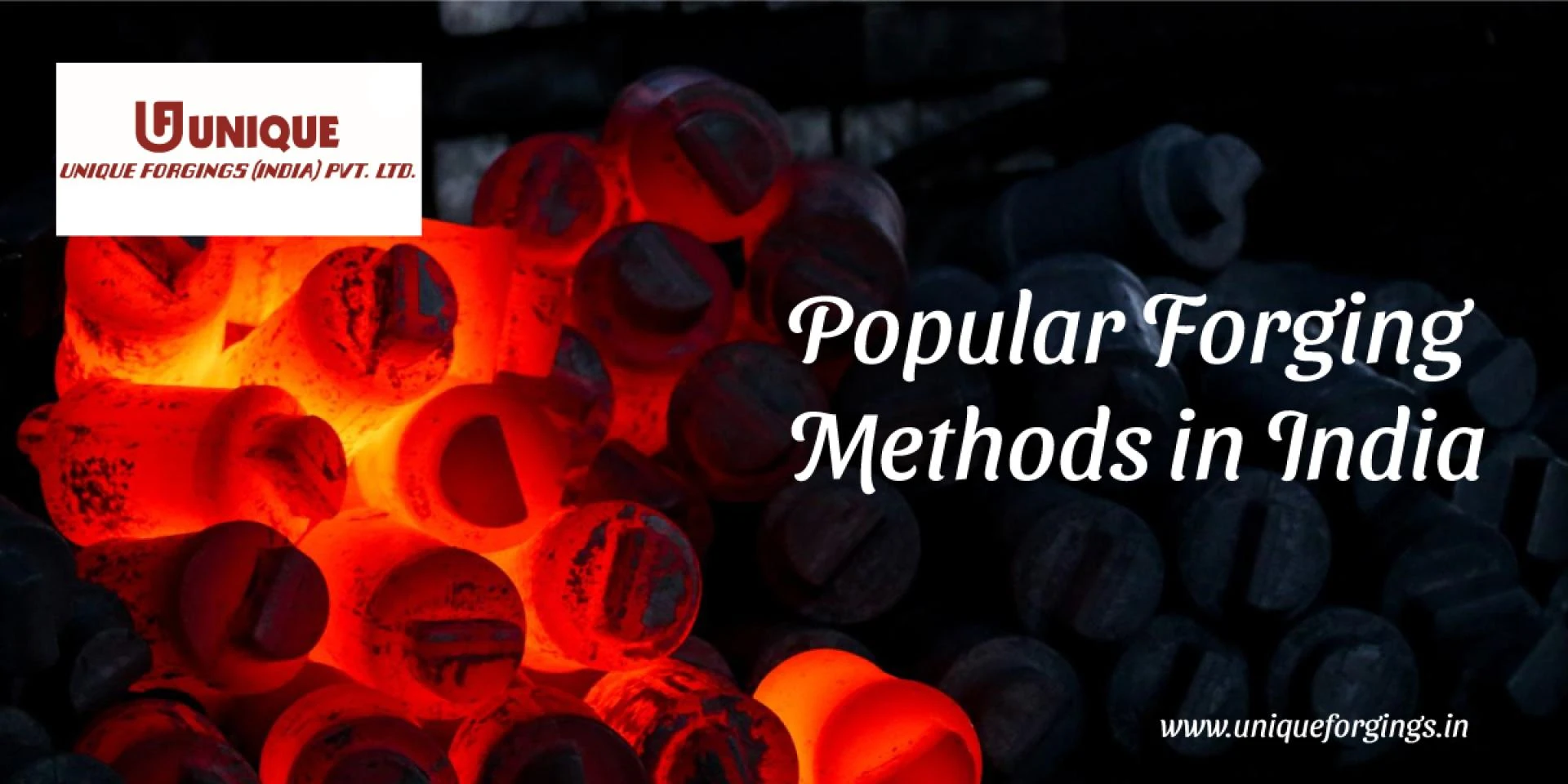

There are many forging methods available, each with its own set of capabilities and advantages. Drop forging and roll forging are two of the most widely used forging techniques.
Unique Forging is one of the Top forging companies in India.
[caption class="snax-figure" align="aligncenter" width="1140"][/caption]
Drop forging:
Drop forging gets its name from the act of striking metal with a hammer to form it into the shape of the die. The surfaces that come into contact with the metal are referred to as the die. Open-die and closed-die drop forging are the two forms of drop forging. Die surfaces are usually smooth, but some have uniquely designed surfaces for specific operations.
Open-die forging:
Smith forging is another name for open-die forging. On a stationary anvil, a hammer strikes and deforms a metal. The metal is never entirely confined in the dies in this form of forging, allowing it to flow except where it comes into contact with the dies. Simple and large sections, as well as personalized metal components, are ideal for open-die forging.
If you are looking for Open die forging Manufacturing in India, Unique Forging is the best choice to go with.
Closed-die forging:
Impression-die forging is another name for closed-die forging. The metal is pressed into a die and hammered against an anvil. The metal is struck with a hammer, which causes it to flow and fill the die cavities. On a millisecond scale, the hammer is timed to make several contact points with the metal. Flash occurs as excess metal is forced out of the die cavities. Since the flash cools faster than the rest of the stuff, it outlasts the metal in the die. The flash is extracted after forging.
Unique Forging is one of the most dominant Closed Die forging manufactures in India.
Roll forging:
Two cylindrical or semi-cylindrical horizontal rolls deform a round or flat bar stock in roll forging. This reduces its thickness while increasing its length. This heated bar is inserted and rolled between two rolls, each with one or more shaped grooves, and is gradually shaped as it passes through the process. This procedure is repeated until the desired shape and size are obtained.
Press forging:
Instead of the impact used in drop-hammer forging, press forging uses a steady, constant pressure or force. Since the ram travel is slower, the deformation occurs at a deeper level, affecting the entire volume of the metal. Drop-hammer forging, on the other hand, sometimes only deforms the surface of the metal, leaving the interior relatively undamaged. Internal strain can be controlled in press forging by adjusting the compression rate.
Upset forging:
Upset forging is a manufacturing method that compresses the length of metal to maximize its diameter. In upset forging, crank presses, a form of high-speed machine, are used. Crank presses are usually placed on a horizontal plane to increase productivity and allow for faster metal exchange between stations. There are also hydraulic presses and vertical crank presses.
Automatic hot forging:
Mill-length steel bars are placed into one end of the forging system at room temperature, and hot forged goods emerge from the other end in automatic hot forging. In less than 60 seconds, high-power induction coils heat the bar to a temperature ranging from 2190–2370°F. With the aid of rollers, the bar is descaled and divided into blanks. The metal is then passed through a series of forming stages, some of which can be combined with high-speed cold-forming operations. The cold-forming operation is usually delegated to the finishing point.
Precision forging (net-shape or near-net-shape forging):
Precision forging necessitates very little final machining. It's a forging technique designed to reduce the expense and waste of post-forging operations. The reduction of material and resources, as well as the reduction of machining, results in cost savings.
Isothermal forging:
Isothermal forging refers to a forging technique in which the metal and die are both heated to the same temperature. There is no net mass or thermal exchange between the device and the external world, so adiabatic heating is used. Internal changes have resulted in highly regulated strain rates, which have caused the changes. Smaller machines can be used for this forging process due to the lower heat loss.










Sign in to leave a comment.