
A med spa website is often the first place people go when they are thinking about a treatment. They want to see what you offer, understand their options, check whether they can trust you, and find an easy way to book. If your website feels confusing, outdated, or difficult to use, they may simply move on to another med spa.
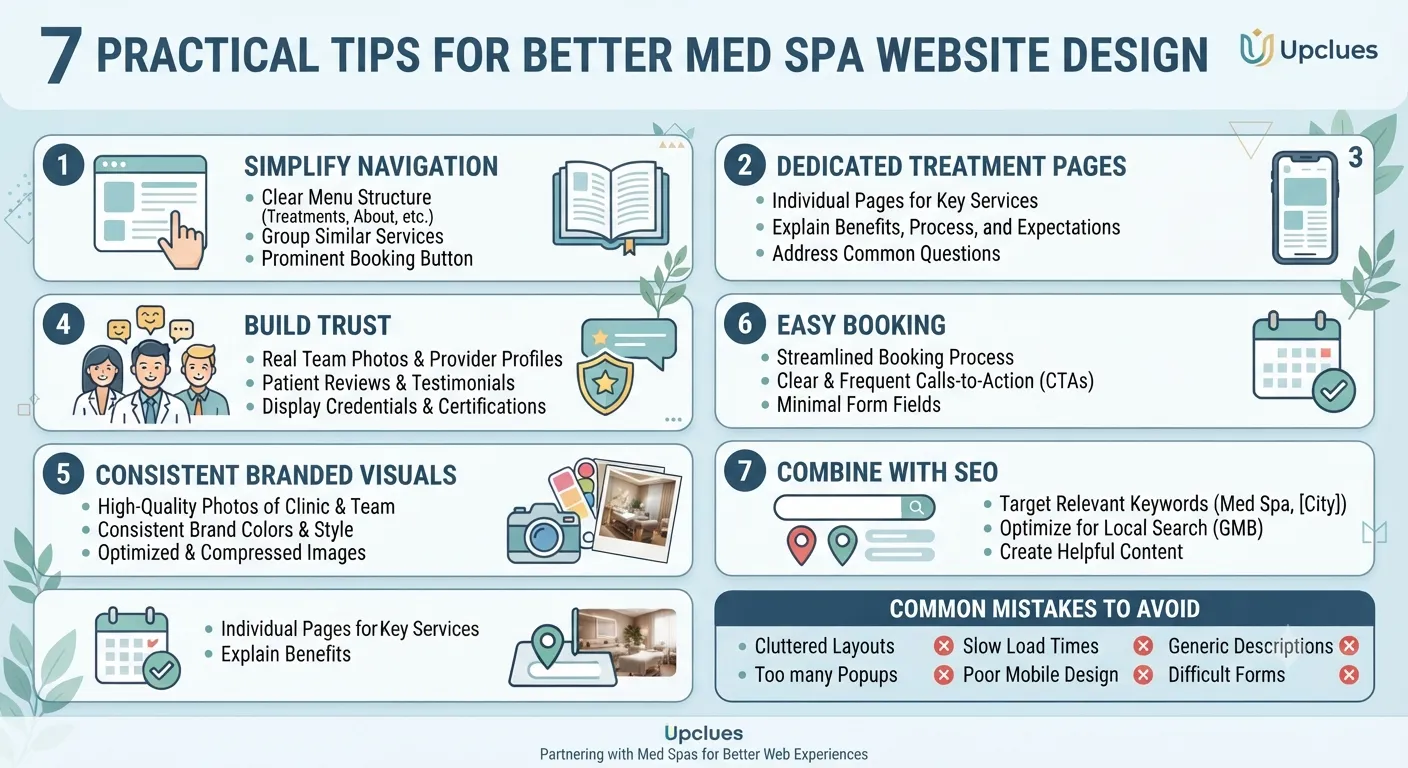
Good med spa website design does not mean adding every new design trend. It means creating a website that feels welcoming, answers common questions, works well on phones, and makes booking simple. Here are seven practical tips to help you create a better website experience.
1. Keep Your Website Simple and Easy to Navigate
Visitors should not have to hunt around your website to find a treatment or contact option.
Keep your main navigation simple with sections such as Treatments, About, Results, Reviews, Blog, and Contact. Group similar services together so visitors can quickly understand what you offer.
For example, if you provide injectables, skin treatments, and body contouring, organize them into clear categories rather than displaying a long list of unrelated services.
Also, make your booking button easy to spot. A visitor who decides they are ready to book should not have to search for the next step.
2. Give Your Main Treatments Their Own Pages
Putting every treatment on one services page can make your website difficult to use. Instead, create a dedicated page for important treatments.
Each treatment page should explain the basics in simple language:
- What the treatment does
- Who it may be suitable for
- Main benefits
- How the treatment works
- What to expect afterward
- Possible downtime
- Common questions
- How to book
Individual treatment pages can also help your website appear for more specific searches. They give both visitors and search engines a clearer idea of what each service is about. The Upclues reference page similarly recommends dedicated treatment pages with useful details and clear conversion paths.
3. Make the Website Work Great on Mobile
Your website might look fantastic on a desktop, but that does not help much if it becomes difficult to use on a phone.
Make sure your text is easy to read, buttons are large enough to tap, images resize properly, and menus do not take up the entire screen.
Your booking option should also work smoothly on mobile. If someone finds your med spa while searching from their phone, they should be able to move from a treatment page to an appointment request without struggling with tiny buttons or complicated forms.
Fast loading also matters. Large images and unnecessary website elements can slow pages down, so keep the experience lightweight.
4. Show People Why They Should Trust You
People are careful when choosing a med spa. They want to know who will perform their treatment and whether other patients have had a good experience.
Use your website to answer those concerns.
Add real team photos, provider profiles, relevant credentials, patient reviews, testimonials, and before-and-after results where appropriate. These details give visitors something more useful than generic marketing claims.
Try to keep your trust signals genuine. A real photo of your team can feel much more relatable than a stock image of a model who has never visited your clinic.
You can also place reviews and credentials on relevant treatment pages instead of hiding everything on a separate About page.
5. Use Visuals That Feel Like Your Brand
Med spas are visual businesses, so your website should look polished. But polished does not have to mean overly complicated.
Use high-quality photos of your actual clinic, treatment rooms, team, and services. Keep your colors, fonts, photography style, and overall layout consistent across the website.
Before and after galleries can also help visitors understand the type of results you provide. Make sure images are presented clearly and responsibly.
One important thing to remember is website speed. High-resolution images can look great but may slow down your pages. Compress them before uploading so your website stays attractive without becoming unnecessarily heavy.
6. Make Booking as Easy as Possible
A visitor may be interested in a treatment but still leave if booking feels like too much work.
Keep your booking process short and straightforward. Add clear CTAs such as Book a Consultation, Schedule an Appointment, or Get Started throughout important pages.
Do not make visitors go back to the homepage just to find your booking option.
Your forms should only ask for information you actually need at that stage. If someone has to complete a long form before they can even request an appointment, you are adding unnecessary friction.
The Upclues reference page also emphasizes visible booking buttons, fewer form fields, and a simpler path between interest and appointment.
7. Combine Website Design With SEO
A beautiful website is not very useful if potential patients cannot find it.
Build your website around the treatments and questions people actually search for. Use relevant keywords naturally in page titles, headings, treatment content, FAQs, and other important areas.
Local SEO is especially useful for med spas. Make your location, address, phone number, service areas, and other business details easy to find. Your website should also work alongside your Google Business Profile to support local discovery.
Helpful content can strengthen this further. Create blog posts and FAQs that answer real questions about treatments, recovery, costs, preparation, and results.
Good SEO should feel natural. Write for people first, then make sure search engines can understand the content.
Common Mistakes to Avoid
Even a well-designed website can lose visitors because of small problems. Watch out for:
- Cluttered layouts
- Too many popups
- Weak or unclear CTAs
- Slow-loading pages
- Poor mobile design
- Generic treatment descriptions
- Difficult booking forms
- Outdated information
- Low-quality or overly generic images
These issues can create friction at different points in the patient journey.
Final Thoughts
Creating better med spa website design does not have to mean completely changing everything at once. Start with the basics: make navigation easier, improve treatment pages, build trust, optimize the mobile experience, use better visuals, simplify booking, and support the site with SEO.
At Upclues, we combine website design, user experience, SEO, and conversion-focused thinking to help med spas create websites that look good and make it easier for potential patients to take the next step.
If your current website feels outdated, difficult to navigate, or is not bringing in enough inquiries, it may be time to rethink the experience from the visitor's point of view.





















Sign in to leave a comment.