

In the evolving landscape of blockchain technology, businesses and developers face a pivotal decision: should they adopt a private blockchain or leverage a public blockchain? Both types of blockchains offer unique advantages and cater to different use cases, making the choice critical to the success of your blockchain initiative.
In this comprehensive guide, we’ll explore the key differences between private and public blockchains, their core features, and how to determine which one aligns best with your business objectives.
Understanding Blockchain Basics
Before diving into the comparison, it’s essential to understand what blockchain technology entails. At its core, a blockchain is a decentralized, distributed ledger that records transactions across multiple computers in a way that ensures data integrity and transparency. However, not all blockchains are created equal—how the network is managed, who can access it, and its governance structure varies significantly between private and public blockchains.
What is a Public Blockchain?
Public blockchains are open networks accessible to anyone worldwide. They are fully decentralized and transparent, where every participant (or node) can read, write, and verify transactions. Examples include Bitcoin, Ethereum, and other well-known cryptocurrencies.
Key Features of Public Blockchains:
- Open Access: Anyone can join, participate, and contribute to the network.
- Decentralized: No central authority controls the network.
- Transparency: All transactions are visible to the public.
- Security Through Consensus: Use of consensus algorithms like Proof of Work (PoW) or Proof of Stake (PoS) to validate transactions.
- Immutability: Once recorded, transactions cannot be altered or deleted.
Use Cases for Public Blockchains:
- Cryptocurrencies and digital payments
- Decentralized finance (DeFi) platforms
- Token issuance and NFT marketplaces
- Transparent voting systems
What is a Private Blockchain?
Private blockchains, in contrast, operate in a restricted environment where access is controlled by a single organization or consortium. Only approved participants can join, read, or write to the blockchain, making it more centralized than public blockchains.
Key Features of Private Blockchains:
- Restricted Access: Only authorized participants can interact with the network.
- Controlled Governance: A central authority or consortium manages permissions and rules.
- Enhanced Privacy: Transaction details are visible only to permitted parties.
- Faster Transactions: Due to limited nodes and simplified consensus mechanisms.
- Customizable: Protocols and features can be tailored to specific business needs.
Use Cases for Private Blockchains:
- Supply chain management within a consortium
- Internal enterprise data sharing
- Inter-bank settlements and financial reconciliations
- Healthcare data management and compliance
Private vs Public Blockchain: Core Differences
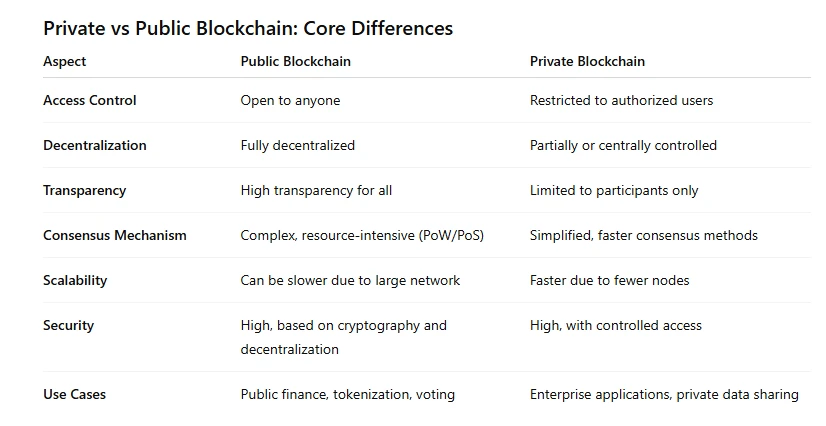
Which Blockchain is Right for You?
When to Choose a Public Blockchain:
If your project demands transparency, global participation, and censorship resistance, a public blockchain is the ideal choice. Public blockchains foster trust through openness and immutability, which is essential for decentralized applications (dApps), cryptocurrencies, or any platform where users need assurance that the network is unbiased and cannot be controlled by a single party.
When to Choose a Private Blockchain:
On the other hand, if your use case requires controlled access, privacy, and fast transaction speeds within a closed group, private blockchain development is preferable. Enterprises that handle sensitive data, regulatory requirements, or need efficient inter-organizational workflows will benefit from the customizable nature of private blockchains. They provide a secure environment where only vetted parties participate, ensuring compliance and confidentiality.
Hybrid and Consortium Blockchains: A Middle Ground
It's worth noting that many organizations now explore hybrid or consortium blockchains, which combine elements of both public and private models. These blockchains offer controlled access while leveraging the security and transparency benefits of public chains, creating flexible solutions tailored to complex business needs.
Final Thoughts
Choosing between private and public blockchain development ultimately depends on your specific project goals, industry requirements, and trust model. Both have distinct strengths:
- Public blockchains excel in decentralization and transparency.
- Private blockchains provide enhanced control and privacy.
By evaluating your need for openness versus confidentiality, speed, scalability, and governance, you can select the blockchain architecture that best empowers your digital transformation journey.
Talk to Our Experts Today
Call/WhatsApp: +918778074071
Telegram: @malgotechnologies


























Sign in to leave a comment.