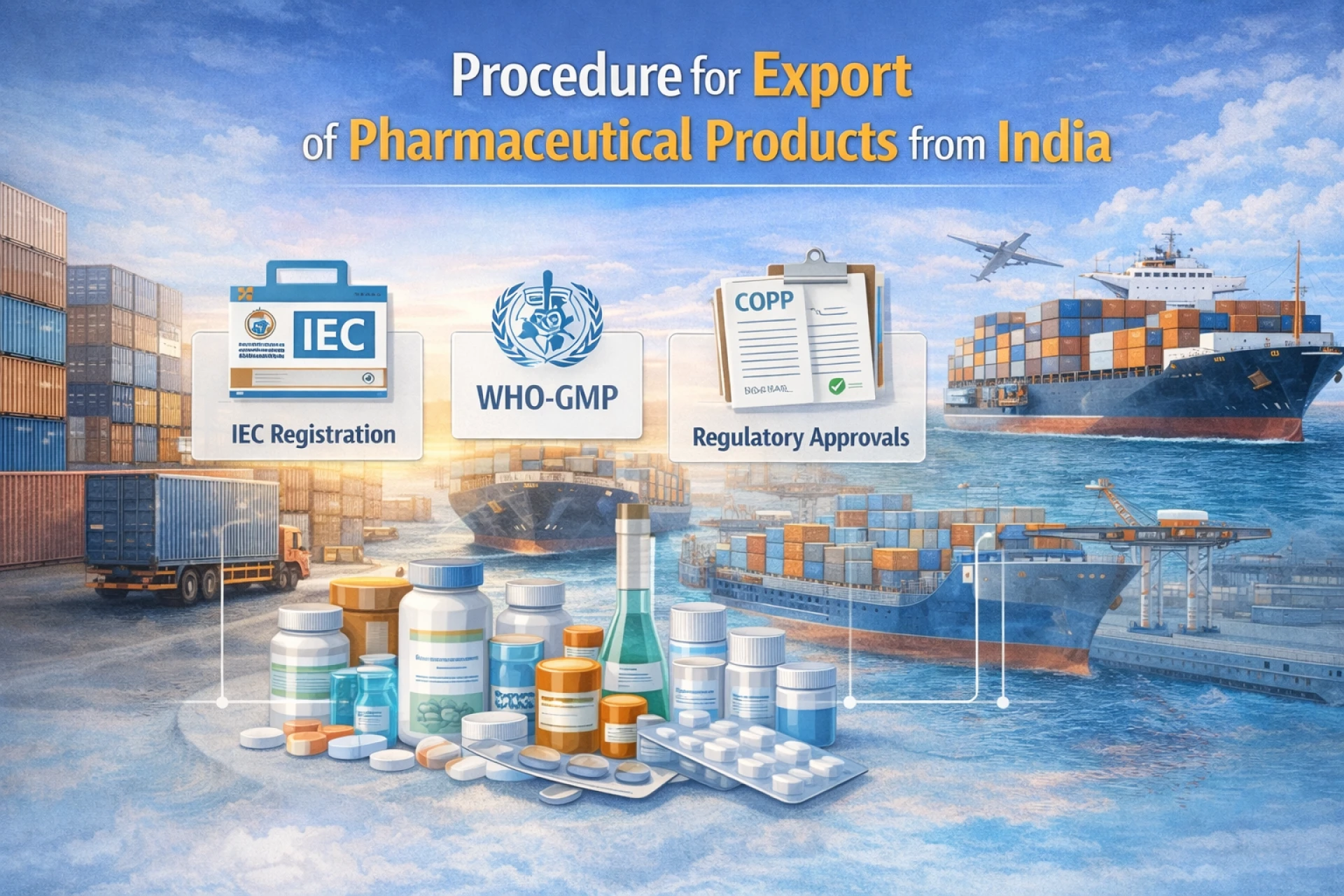

The export of pharmaceutical products from India follows a regulated process designed to protect public health, satisfy importing-country laws, and prevent exporters from doing something reckless and expensive. Whether you are a new pharmaceutical exporter in India or an established company expanding globally, the steps below are unavoidable.
Skipping steps does not make you fast. It makes you non-compliant.
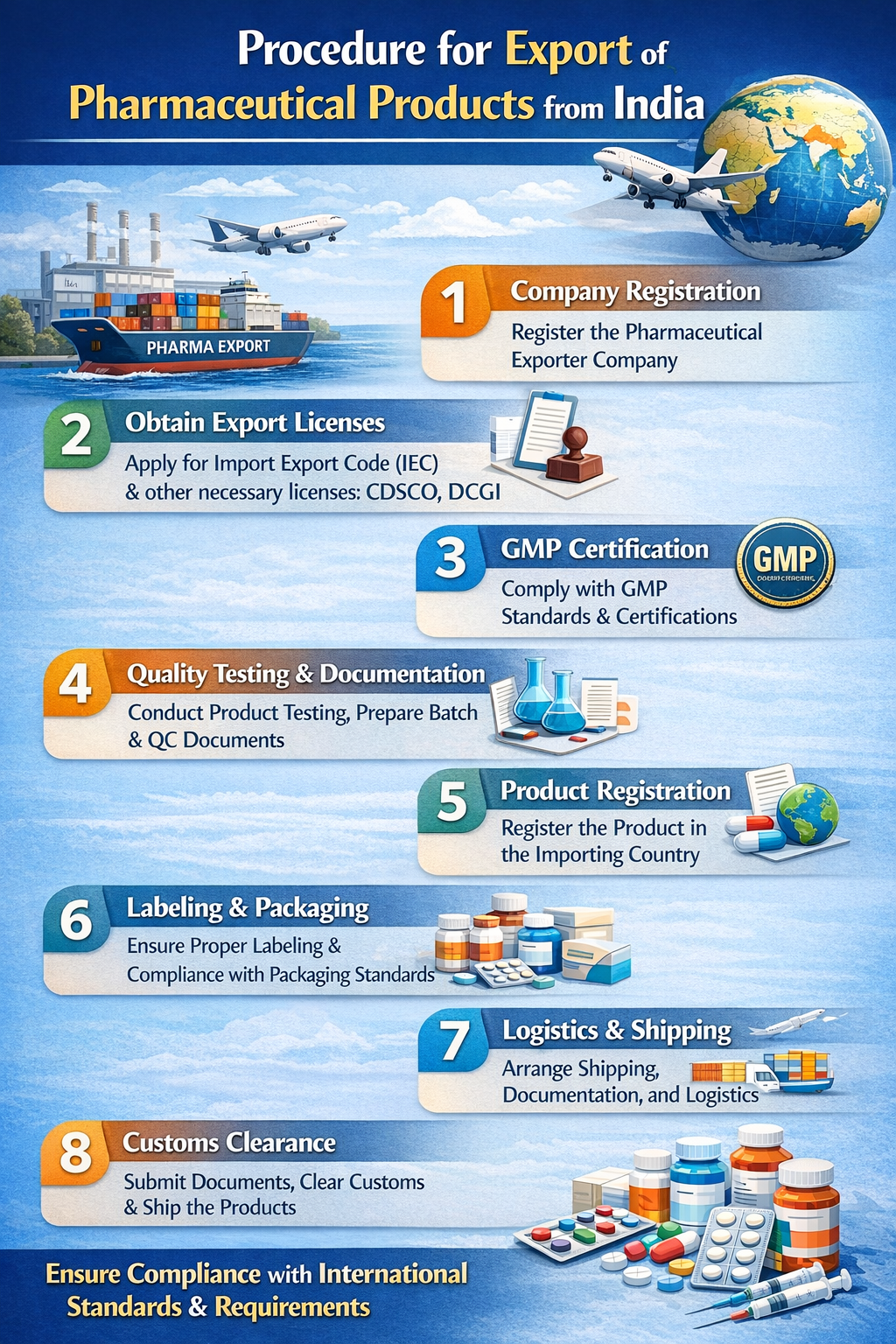
Step 1: Company Registration and Legal Setup
Before anything else, the exporter must be a legally registered business in India.
You need:
- Company registration (Private Limited, LLP, Partnership, etc.)
- PAN card
- Current bank account in the company name
Only registered entities are allowed to operate as a pharmaceutical exporter India for international trade.
Step 2: Obtain Import Export Code (IEC)
An Import Export Code (IEC) is mandatory for the export of pharmaceutical products from India.
Issued by:
- Directorate General of Foreign Trade (DGFT)
Without IEC:
- You cannot ship products
- You cannot receive foreign payments
- You cannot legally export anything, pharmaceutical or otherwise
This is non-negotiable.
Step 3: Drug Manufacturing or Marketing Authorization
To export pharmaceutical products, you must either:
Option A: Be a Manufacturer
You need:
- Drug Manufacturing License issued by State Drug Control Authority
- WHO-GMP compliant manufacturing facility
Option B: Be a Marketing / Export Company
You must:
- Have agreements with licensed manufacturers
- Ensure products are manufactured at approved facilities
- Maintain full traceability
Both models are accepted in Global Pharma Sourcing from India, as long as transparency is maintained.
Step 4: Product Registration and Regulatory Compliance
Different countries require different approvals.
Common requirements include:
- Product dossiers
- Stability data
- Certificate of Pharmaceutical Product (CoPP)
- Free Sale Certificate
- Labeling and packaging compliance as per importing country norms
Reliable pharmaceutical exporters from India understand that regulatory approval drives timelines, not sales pressure.
Step 5: Apply for Export No Objection Certificate (NOC)
For certain pharmaceutical products, especially regulated medicines, an export NOC is required.
Issued by:
- CDSCO (Central Drugs Standard Control Organization)
This step ensures:
- Controlled drugs are tracked
- Domestic supply is not disrupted
- Export is legally approved
Step 6: Quality Control and Batch Documentation
Each export shipment must include proper quality documentation such as:
- Certificate of Analysis (COA)
- Batch Manufacturing Records
- Stability reports if required
- MSDS for APIs and bulk drugs
This is where many exporters fail quietly. Incomplete documents delay shipments and damage credibility in Global Pharma Sourcing from India.
Step 7: Packaging, Labeling, and Serialization
Pharmaceutical exports require precise packaging.
Key points:
- Labels must match importing country language and format
- Batch number, expiry date, and storage conditions must be clear
- Tamper-proof packaging is mandatory in most markets
Errors here lead to rejections. Rejections cost more than compliance.
Step 8: Customs Clearance and Shipping
The exporter must prepare:
- Commercial invoice
- Packing list
- Shipping bill
- HS code declaration
- Insurance documents
Products are cleared through Indian customs before being shipped via:
- Air cargo (urgent or temperature-sensitive products)
- Sea freight (bulk shipments)
A professional pharmaceutical exporter India works with experienced clearing agents to avoid delays.
Step 9: Foreign Exchange Realization
After shipment:
- Payment must be received through approved banking channels
- Foreign Inward Remittance Certificate (FIRC) must be obtained
- Compliance with RBI and FEMA regulations is mandatory
Exporting without proper payment documentation invites audits. Audits are not fun.
Step 10: Post-Shipment Compliance and Support
Reliable exporters provide:
- Tracking and delivery confirmation
- Post-shipment documentation
- Regulatory support for buyer audits
- Long-term supply consistency
This is why buyers prefer structured exporters when choosing Global Pharma Sourcing from India.
Conclusion
The export of pharmaceutical products from India is not complicated, but it is strictly regulated. Success depends on compliance, documentation accuracy, and understanding international regulatory expectations.
A trusted pharmaceutical exporter India focuses on:
- Legal approvals
- Quality assurance
- Regulatory transparency
- Long-term global partnerships
Do it properly once, and you export for years. Cut corners once, and you explain yourself to regulators forever.




























Sign in to leave a comment.