
Most people study by reading their notes again. Or highlighting. Maybe rewatching a lecture.
It feels like learning. It usually isn't.
The problem is rarely effort — it's method. The techniques most students default to don't do much for long-term memory. Re-reading, underlining, passive review — they feel productive and leave little behind.
A few changes to how you study can change how much actually sticks. This piece covers study techniques that hold up in research and work in practice.
What Makes a Study Technique Actually Work
Not all study methods are equal. Some feel productive but don't move the needle on memory.
The difference usually comes down to cognitive effort. Techniques that force your brain to work or to retrieve, organize, or apply information build stronger memory traces. Passive methods don't challenge the brain enough to create lasting retention.
A 2013 study published in Psychological Science compared ten study methods and ranked them by long-term effectiveness. Re-reading came near the bottom. Practice testing came out on top.
Yet re-reading is what most people do most of the time.
There's also something called the fluency illusion. When you re-read familiar material, it feels easy and familiar, and your brain mistakes that ease for understanding. You think you know it. Often, you don't.
Good study techniques break that illusion. They force you to find out what you actually know versus what just looks familiar on the page.
Active Recall - Stop Reviewing, Start Retrieving
Active recall means testing yourself on material instead of passively looking at it again.
Instead of reading your notes, close them. Try to write down everything you can remember. Then check.
When you struggle to retrieve information, your brain strengthens that memory pathway. Each retrieval attempt — successful or not — makes the next one easier and more durable. This is sometimes called the testing effect, and it's one of the most well-replicated findings in memory research.
Ways to use active recall:
- After reading a chapter, put the book aside and write what you remember without looking
- Convert your notes into questions and study the questions, not the answers
- Use flashcards — but actively quiz yourself rather than just flipping through them
- Try the Feynman Technique: pick a concept and explain it out loud in simple words as if you're teaching someone who has never heard of it. Where you stumble is where your understanding has gaps
I started using active recall during university after spending hours re-reading the same pages and still going blank in exams. Switching to self-testing cut my study time and improved my results noticeably. The sessions felt harder in the moment — that's exactly why they worked.
Spaced Repetition: Review Before You Forget
Spaced repetition means reviewing material at increasing intervals over time rather than cramming it in one session.
Memory fades. But if you review just before you forget, you strengthen the memory and push the next forgetting point further out. Do this several times and the knowledge becomes durable.
The idea goes back to researcher Hermann Ebbinghaus, who documented the "forgetting curve" in the 1880s. His core finding still holds: memory drops steeply after initial learning, but each review slows that drop significantly.
A simple manual schedule:
- Study the material on Day 1
- Review after 1 day
- Review after 3 days
- Review after 7 days
- Review after 2–3 weeks
- Review after a month
Apps like Anki automate this. You rate how well you recalled each card, and the app schedules your next review accordingly. Material you know well comes up less often. Weaker cards appear more frequently.
Cramming gets you through tomorrow's test. Spaced repetition keeps the knowledge months later.
Three More Techniques Worth Using
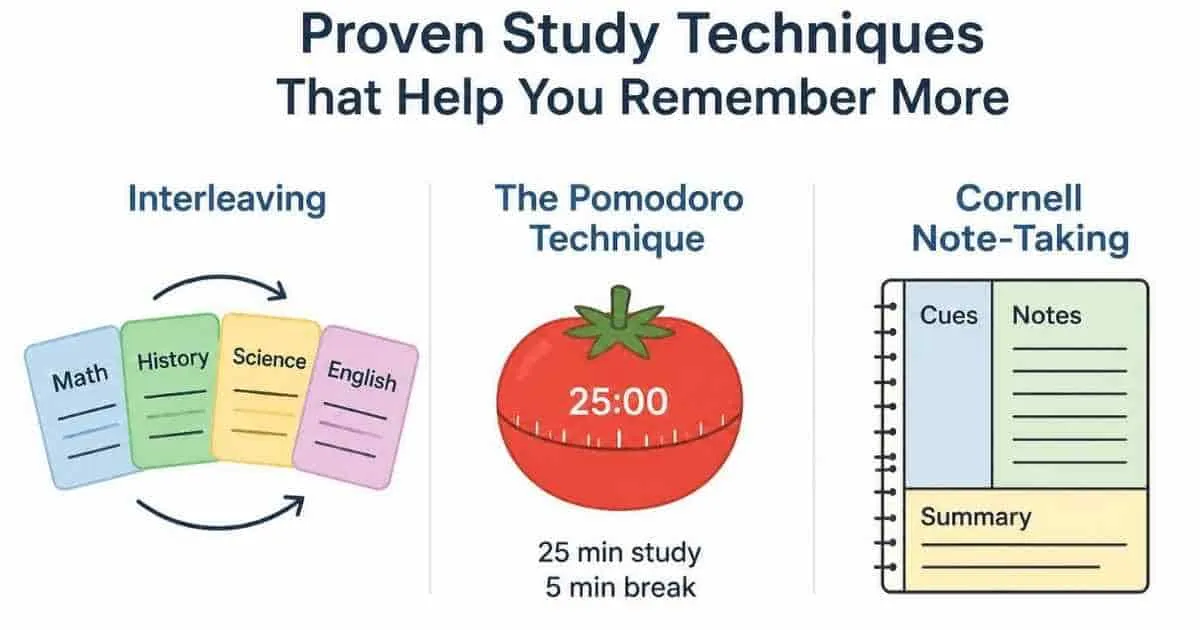
Interleaving:
Most students study one topic until finished, then move to the next. This is called blocked practice. It feels logical and smooth.
Interleaving means mixing topics within a single session — math, then history, then math again, then biology.
This feels messier and you will likely score lower on practice problems in the moment. But weeks later, long-term retention is significantly better. A study in Applied Cognitive Psychology found that interleaved practice improved test scores by around 43% compared to blocked practice — even though students felt less confident during the interleaved sessions.
If studying feels too easy, it might not be working.
The Pomodoro Technique:
This is a focus method rather than a memory technique — but focus is where retention starts.
Work in 25-minute blocks with a 5-minute break. After four cycles, take a longer break of 15–30 minutes. The structure removes the intimidation of "studying for three hours" and gives your brain regular rest.
The real trap is using Pomodoro for passive tasks like re-reading. Pair it with active recall and you've built a real system: focused input followed by active retrieval.
Cornell Note-Taking:
Divide your page into three sections: a narrow left column for cues, a larger notes area on the right, and a summary box at the bottom.
During a lecture or reading session, write main notes on the right. Afterward, write key questions and terms in the left column. Then write a short summary in your own words at the bottom.
The summary and cue sections aren't just organizational — they're retrieval practice built into the act of note-taking. Most students skip them. That's where the actual value of the method lives.
Common Mistakes That Kill Retention
Highlighting everything:
If everything is highlighted, nothing is. Heavy highlighting creates an illusion of engagement while doing very little for memory. Try writing brief summaries instead.
Studying in the same place every time:
Varying your location slightly can improve recall. The brain links memory to context — different environments give information more mental anchors.
Cutting sleep to study more:
Sleep is when the brain consolidates memory. Staying up late to study trades short-term familiarity for long-term retention. A rested review session beats a late-night cram almost every time.
Drilling only what you already know:
It's comfortable to review material you've mastered. But time spent on weak spots builds more than time reinforcing strengths. Find your gaps and go at them directly.
Skipping breaks during long sessions:
Mental fatigue degrades both focus and retention. Short, consistent sessions spread over several days outperform one long session the night before a deadline.
Building a System You'll Actually Stick To
Knowing the right study techniques matters less than using them regularly.
Start with one method, not six. Active recall is the most accessible — no apps, no special setup. Try it with one subject this week. After reading a section, close the material and write what you remember. That's it.
Keep a simple log of what you studied and when. Even a basic notebook works. It makes it much easier to maintain a spaced repetition schedule without relying on memory to track your memory.
For students and writers looking for practical content on learning and productivity, bloket.blog is worth bookmarking — the site covers these topics in a useful, grounded way.
One thing worth saying: the first session with active recall will feel awkward and harder than re-reading. That's normal. Stick with it past the initial discomfort. The methods that feel least like studying — the ones that make you work — tend to do the most for retention. I came across a piece on bloket that made a similar point from a writing angle — the methods that feel hardest in the moment tend to produce the clearest recall later.
Pick one technique. Apply it this week. Build from there.
Written for informational purposes. Study results vary depending on individual learning habits and consistency.


























Sign in to leave a comment.