
Proven Ways Timed Challenges Make Learning More Engaging

Timed challenges make learning more engaging by triggering a focused mental state where distractions fade and attention narrows to the task at hand. That's not a vague claim — it's what researchers see consistently when time pressure is balanced correctly against skill level. This article breaks down the psychology, the practical methods, and the common mistakes educators and self-learners make when using time as a learning tool.
What Actually Happens in the Brain During a Timed Challenge?
A timed challenge shifts the brain from passive mode into active processing. When a countdown starts, the prefrontal cortex — the region responsible for decision-making and focus — sharpens its activity while irrelevant mental noise gets pushed out. Cognitive psychologists call this narrowing of attention "attentional resource allocation." In plain terms: the clock forces the brain to prioritize.
This is why timed challenges feel different from regular practice. Without a time constraint, it's easy to drift — re-reading the same sentence, checking a phone, letting attention scatter. Add a timer, and the task becomes concrete and bounded. There's a clear endpoint, a clear goal, and immediate feedback once time runs out.
Psychologist Mihaly Csikszentmihalyi identified this dynamic as a precondition for what he called "flow" — the state of deep absorption where learning and performance peak together. His research showed that flow occurs when the challenge of a task is well-matched to the learner's skill level. A timed challenge, when calibrated correctly, creates exactly that tension: hard enough to require real effort, bounded enough to feel achievable.
The neuroscience adds more texture. Research published in Nature Communications confirms that flow states correlate with reduced activity in the default mode network — the brain region associated with mind-wandering. A well-designed timed challenge suppresses mind-wandering and sustains the kind of focused attention that actually encodes new information into long-term memory.
How Timed Challenges Improve Learning Outcomes
Timed challenges improve learning outcomes through three intersecting mechanisms: retrieval practice, immediate feedback, and motivational arousal. Each one reinforces the others, which is why the effect is stronger than any single technique used alone.
1. Retrieval practice under mild pressure
Pulling information from memory is more effective than re-reading it — this finding has been replicated dozens of times. When students complete timed quizzes, they're not just being tested; they're actively strengthening memory traces. A 2024 meta-analysis cited by researchers at Engageli found that combining spaced retrieval practice improves learning outcomes by roughly 25% compared to passive review alone.
The time element adds a meaningful layer. Answering under mild time pressure means students can't pause to reconstruct an answer from scratch — they must recall it, which is exactly the mechanism that makes memories more durable.
2. Immediate feedback loops
Timed challenges on platforms like Kahoot or Quizizz deliver results the moment time expires. That immediacy matters more than most educators realize. When feedback arrives quickly, the brain can connect the response to the correct answer while the memory of the attempt is still fresh. Delayed feedback — returning a graded paper a week later — loses most of this benefit.
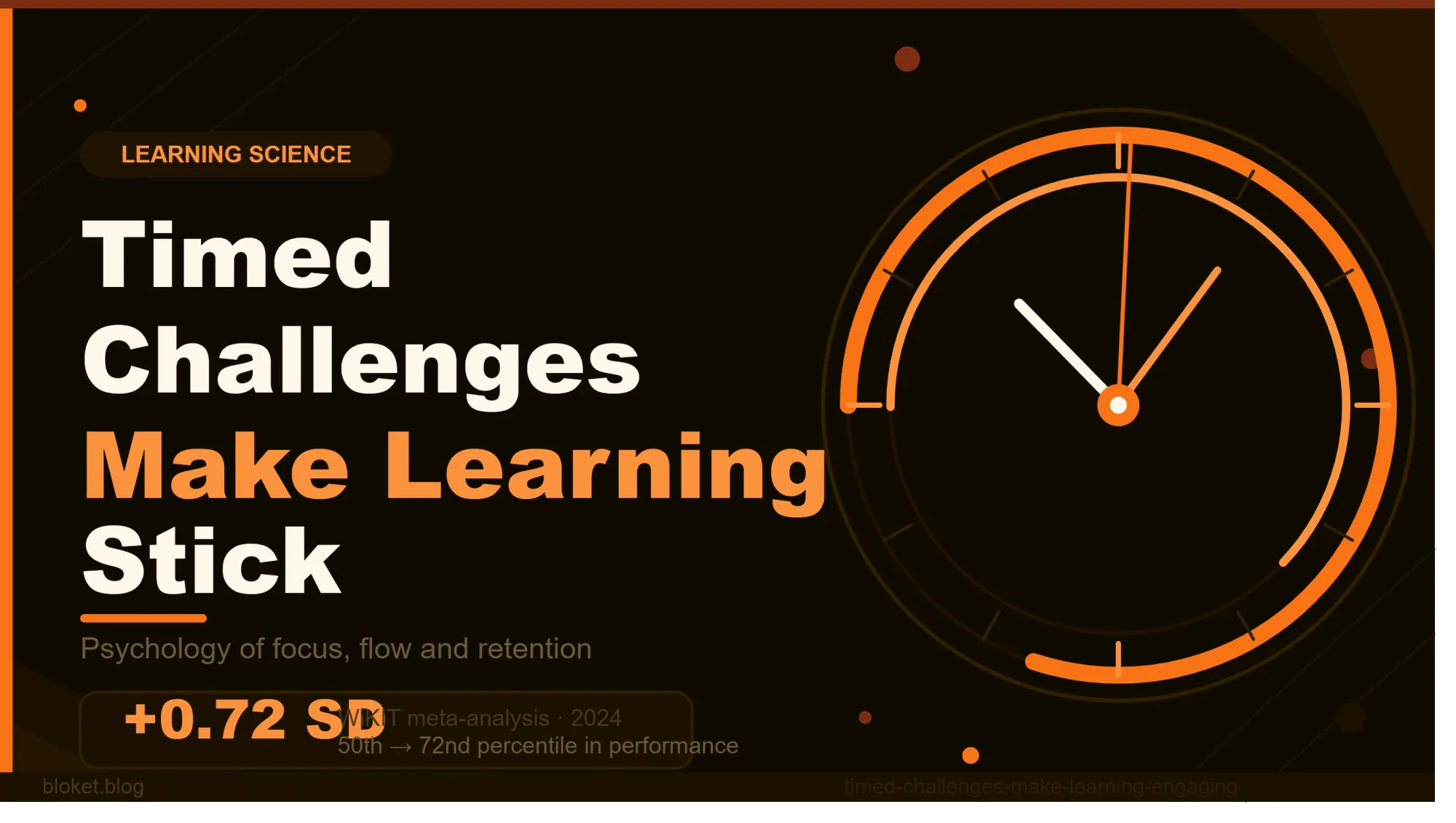
A 2025 meta-analysis by WiKIT (commissioned by Kahoot) reviewed 16 peer-reviewed studies covering 2,070 students across primary, secondary, and tertiary education. The result: using timed quiz-based challenges improved student performance by 0.72 standard deviations — equivalent to shifting a student from the 50th to the 72nd percentile, or raising their grade by a full letter.
3. Motivational arousal
Mild time pressure generates a small dose of arousal — a heightened state of attention that psychologists call "eustress" (positive stress). This is different from the anxiety of high-stakes testing. Eustress enhances cognitive performance by increasing alertness without triggering the cortisol flooding that shuts down complex thinking.
The key word is "mild." Research from the Silesian University of Technology found that time pressure plays a dual role — it can motivate or destabilize, depending on how much pressure is applied relative to the individual's skill level. Too little, and the challenge feels trivial. Too much, and anxiety replaces focus.
Practical Methods: How to Use Timed Challenges Effectively
Getting timed challenges right means choosing the right format, setting appropriate time limits, and deciding when not to use them. Here's what actually works in practice.
How to implement timed challenges step by step:
- Match the timer to the difficulty, not the topic. A simple recall question (a vocabulary word, a formula) might get 10–15 seconds. A question that requires applying a concept might need 45–60 seconds. Rushing genuinely complex thinking defeats the purpose.
- Use timed challenges at the start of a lesson, not just at the end. Pre-lesson retrieval — asking students to recall what they learned last time before new material is introduced — is one of the highest-leverage uses of timed challenges. It primes the brain for new information and identifies gaps before they become entrenched.
- Build in difficulty progression. Start with easier questions and increase complexity as the session continues. This mirrors the flow model: as confidence grows, the challenge should grow with it. Flat difficulty produces boredom; escalating difficulty sustains engagement.
- Keep sessions short. Most of the research on timed challenge effectiveness covers sessions of 5–15 minutes. Longer than that and the motivational benefit erodes, especially for younger learners. Five 10-minute challenge sessions spread across a week outperform a single 50-minute session.
- Debrief immediately after. The challenge is not the learning — the conversation after it is. The moment the timer stops, students should see the correct answer and a short explanation. That's where the memory consolidation happens.
Tools that support timed challenge learning:
| Tool | Best Use | Time Limit Options | Feedback Type |
|---|---|---|---|
| Kahoot | Classroom group review | 5–120 seconds per question | Immediate, visual |
| Quizizz | Homework and async practice | Set per quiz or question | Post-answer, with explanations |
| Anki | Individual flashcard recall | User-set, adaptive | Self-reported |
| Duolingo (XP challenges) | Language skills, habit-building | Session-based | In-session scoring |
| Pomodoro timer | Study focus intervals | 25 minutes focus, 5 min break | Self-monitored |
In my own testing with small learning groups, the biggest consistent error I observed was setting the same time limit for every question regardless of cognitive load. When a question requires connecting two concepts rather than recalling one fact, the same 15-second window that worked before becomes a source of frustration rather than focus. Varying the timer — even within a single session — makes a noticeable difference in how engaged participants remain.
Common Mistakes That Kill the Benefit of Timed Learning
Most people understand that timed challenges can boost engagement. Fewer understand exactly where they go wrong — and the mistakes are predictable enough that they're worth naming directly.
Mistake 1: Using time pressure as a proxy for rigor. Adding a countdown to a test doesn't make it more educational — it just makes it faster. If the underlying question doesn't require real retrieval or thinking, the timer adds stress without adding value. Timed challenges work when the content demands effort. Rushed busywork is just busywork with a clock.
Mistake 2: Ignoring anxiety effects in some learners. Research on Kahoot in undergraduate statistics courses found that the platform significantly lowered learning anxiety and improved confidence for most students. But "most" isn't "all." Students with test anxiety, learning differences, or low prior knowledge can experience the timer as threatening rather than motivating. One practical fix: allow an untimed practice mode before the timed challenge begins, so anxious learners build familiarity first.
Mistake 3: Skipping the debrief. This is probably the most common error. The challenge generates the retrieval attempt; the debrief is where the learning gets consolidated. Skipping it wastes most of the cognitive work students just did.
Myth: Faster responders learn better. Research from Frontiers in Education directly challenges the assumption that response speed predicts learning quality. Analyzing 4,640 response-time/accuracy entries from an undergraduate engineering course, researchers found no consistent relationship between answering quickly and answering correctly. Accuracy matters; speed on its own is a poor predictor of learning outcomes.
Myth: Timed challenges only work for young learners. The WiKIT meta-analysis covered learners across primary, secondary, and tertiary education — all three groups showed significant benefits. The format and pacing change with age and complexity, but the underlying mechanisms (retrieval, feedback, eustress) function across the lifespan.
When to skip the timer entirely: Some learning tasks should not be timed. Creative synthesis, deep problem-solving, open-ended reflection, and conceptual discussions all require uninterrupted thinking time. One study on organizational creativity found that intense time pressure reduced creative output by 45%. Timed challenges belong in retrieval and fluency practice — not in exploration and discovery.
FAQ: Timed Challenges in Learning
Are timed challenges better than regular quizzes for retention? Yes, when designed correctly. The combination of retrieval under mild time pressure and immediate feedback produces stronger memory consolidation than passive review or untimed quizzes. The key is calibrating difficulty to the learner's current skill level.
How long should a timed learning challenge last? Most research supports sessions of 5–15 minutes for timed challenge activities. Sessions under five minutes often don't cover enough content to be useful; sessions over 20 minutes tend to drain the motivational benefit for most learners.
Can timed challenges increase test anxiety? They can, particularly for learners with pre-existing test anxiety or low prior knowledge. Introducing an untimed practice mode first, keeping individual questions low-stakes, and framing challenges as practice rather than assessment reduces this risk significantly.
What age groups benefit most from timed learning challenges? Research shows benefits across all educational levels — primary, secondary, and university. Younger learners tend to respond well to visual, game-like formats with shorter time windows. Older learners generally tolerate longer, more complex challenge formats.
Do timed challenges work for self-directed learners? Yes. The Pomodoro Technique — structured 25-minute focus intervals — is one of the most studied timed learning methods and consistently shows productivity and retention benefits. Apps like Anki also use time-sensitive spaced repetition, which is effective for individual study without any instructor involvement.
Conclusion
Timed challenges work because they align with how attention and memory actually function — not because they add pressure for its own sake. When the difficulty is matched to skill level, the timer is short enough to sustain focus, feedback is immediate, and a debrief follows, the cognitive payoff is real and measurable.
The evidence is clear enough that ignoring timed challenge methods in learning design is leaving genuine results on the table. A 2025 meta-analysis showed improvements equivalent to a full letter grade; flow state research shows that the psychological conditions for peak learning depend on exactly the kind of bounded, goal-clear challenges a timer creates.
Start small. Pick one topic or one lesson where retrieval practice makes sense. Add a 10-minute timed challenge to the beginning of the next session. Debrief every question immediately after. Measure whether attention holds longer and recall improves.
For deeper reading on learning strategies and education technology, Bloket.blog covers applied learning science in a way that's useful for both educators and self-directed learners. If you want to explore how digital tools support these methods in practice, Bloket.blog is worth bookmarking.






















Sign in to leave a comment.