
When building photovoltaic storage systems, home backup power systems, or commercial distribution setups, most buyers struggle to decide among 2-pole, 3-pole, and 4-pole automatic transfer switches (ATS). ATS with different pole counts differ drastically in circuit isolation, voltage compatibility, safety performance, and overall cost. A mismatched ATS will lead to frequent tripping and unstable power output; in serious cases, it can permanently damage costly inverters and energy storage batteries. This guide combines residential single-phase and industrial three-phase power needs, merges basic definitions with pros and cons, clarifies core differences, and delivers actionable selection advice.
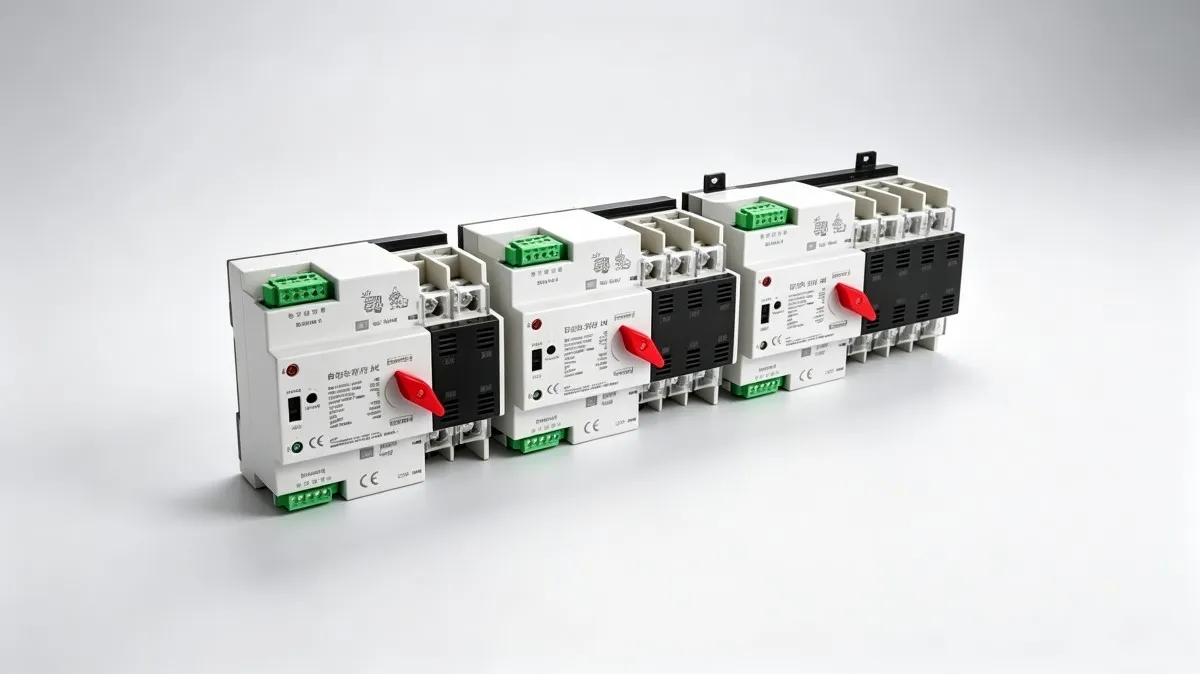
Core Differences Between 2P, 3P and 4P ATS
The pole number of automatic transfer switch (ATS) refers to the number of circuit lines the switch can connect and disconnect synchronously. Standard power circuits consist of a live wire (L), a neutral wire (N), and a protective earth wire (PE). The earth wire is exclusively used for safety grounding and will never be disconnected by ATS devices. The core differences between 2P, 3P and 4P ATS lie in their control over live wires and neutral wires.
2P ATS: Single-Phase Household Transfer Switch
A 2P ATS cuts off one live wire and one neutral wire simultaneously, and it is specially designed for single-phase 220V AC household power supply. It features a compact structure, straightforward wiring, low space occupation, and a cost-effective price, paired with stable and fast transfer speed. Models rated from 16A to 63A are mature and reliable enough for small single-phase loads. Its biggest drawback is that it only supports single-phase power and cannot drive three-phase mechanical equipment. In addition, its compact internal structure restricts heat dissipation, so it cannot work continuously under current exceeding 63A.
3P ATS: Three-Phase Industrial Transfer Switch
A 3P ATS cuts three live wires synchronously, designed for three-phase 380V three-wire power systems without neutral wire switching. Favored in heavy industrial applications, it boasts a robust build, steady load capacity and responsive overload protection. A full range of high-current variants from 100A up delivers low failure rates during long factory runtime. Its biggest flaw is an always-connected neutral line. In aging power grids and off-grid PV systems, this easily creates neutral potential shift and leakage risks, which threaten delicate devices like inverters and storage batteries.
4P ATS: Fully Isolated Dual Power Switch
A 4P ATS disconnects three live lines plus one neutral line, providing the most complete electrical isolation among all three ATS types. Synchronous live and neutral disconnection eliminates leakage, voltage drift and harmonic interference, offering top-tier protection for precision electrical gear. It is a must-have for energy storage stations, server rooms and medical equipment facilities. On the downside, it comes with a larger footprint, higher manufacturing cost and more complex wiring steps. Installing a 4P ATS on small single-phase household circuits results in over-specification and unnecessary extra spending.
ATS Pole Selection for Different Application Scenarios
- Residential & Homestay Single-Phase Power: Nearly all household incoming power uses single-phase 220V, so the 2P ATS is the top pick for home use. Home appliances, lighting and small residential solar storage units are single-phase loads. 16A–63A 2P ATS covers all blackout auto-switch demands with easy installation and great value for money.
Shops, Factories & Temporary Construction Power: Water pumps, regular machine tools and other three-phase equipment do not require neutral wire isolation, making the 3P ATS the top choice for such scenarios. It delivers stable load performance at moderate cost, with complete high-current options from 100A to 3200A for long-term heavy industrial use.
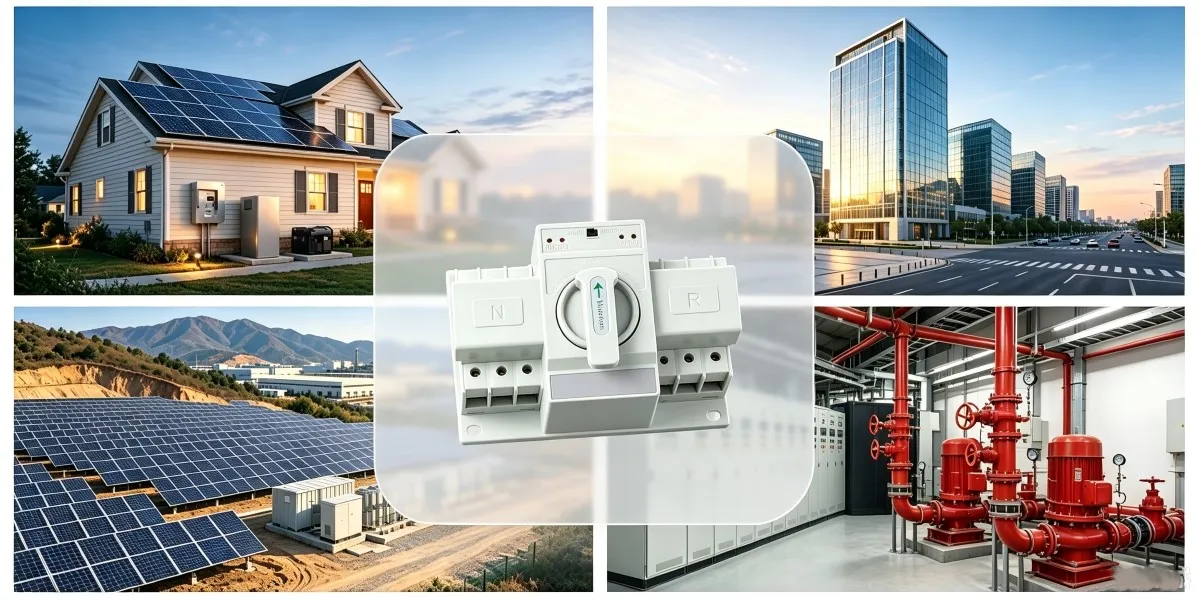
- Server Rooms, Storage Stations & Medical Facilities: Servers, storage batteries and inverters demand ultra-stable voltage supply, so the 4P ATS is the ideal top pick here. A permanently connected neutral line causes potential offset and harmonics that burn circuit boards, while the 4P ATS achieves full circuit isolation and cannot be replaced for these sensitive load environments.
- Off-Grid Solar Energy Storage Systems: Small household off-grid storage systems use 2P ATS; large commercial PV power plants and energy storage cabinets adopt 4P ATS.
Practical ATS Buying Tips You Cannot Miss
Avoid overbuying oversized ATS units. 2P models fully satisfy household loads under 63A. For industrial machinery, select an ATS with rated current 1.2 times the equipment’s normal running current to leave overload buffer and prevent burnout under long full-load operation.
CB-class ATS integrates built-in short-circuit and overload protection, ideal for home power and solar storage projects. PC-class ATS provides faster transfer speed and superior stability, tailored for server rooms requiring zero power interruption.
Quick Reference for ATS Pole Selection
- Single-phase low-power home loads: Choose 2P ATS for simplicity and cost savings.
- Standard three-phase industrial machinery: Choose 3P ATS for stable long-term operation.
- Energy storage stations and precision equipment rooms: Choose 4P ATS for full circuit safety isolation.
After figuring out the suitable pole number, many users will further compare detailed parameters, wiring schematics and current specifications before final purchase. If you want to check complete ATS specifications, intuitive wiring diagrams and systematic comparison tables of 2P, 3P and 4P models, you can browse detailed resources and product introductions here: https://www.powerhome.com/automatic-transfer-switch


















Sign in to leave a comment.