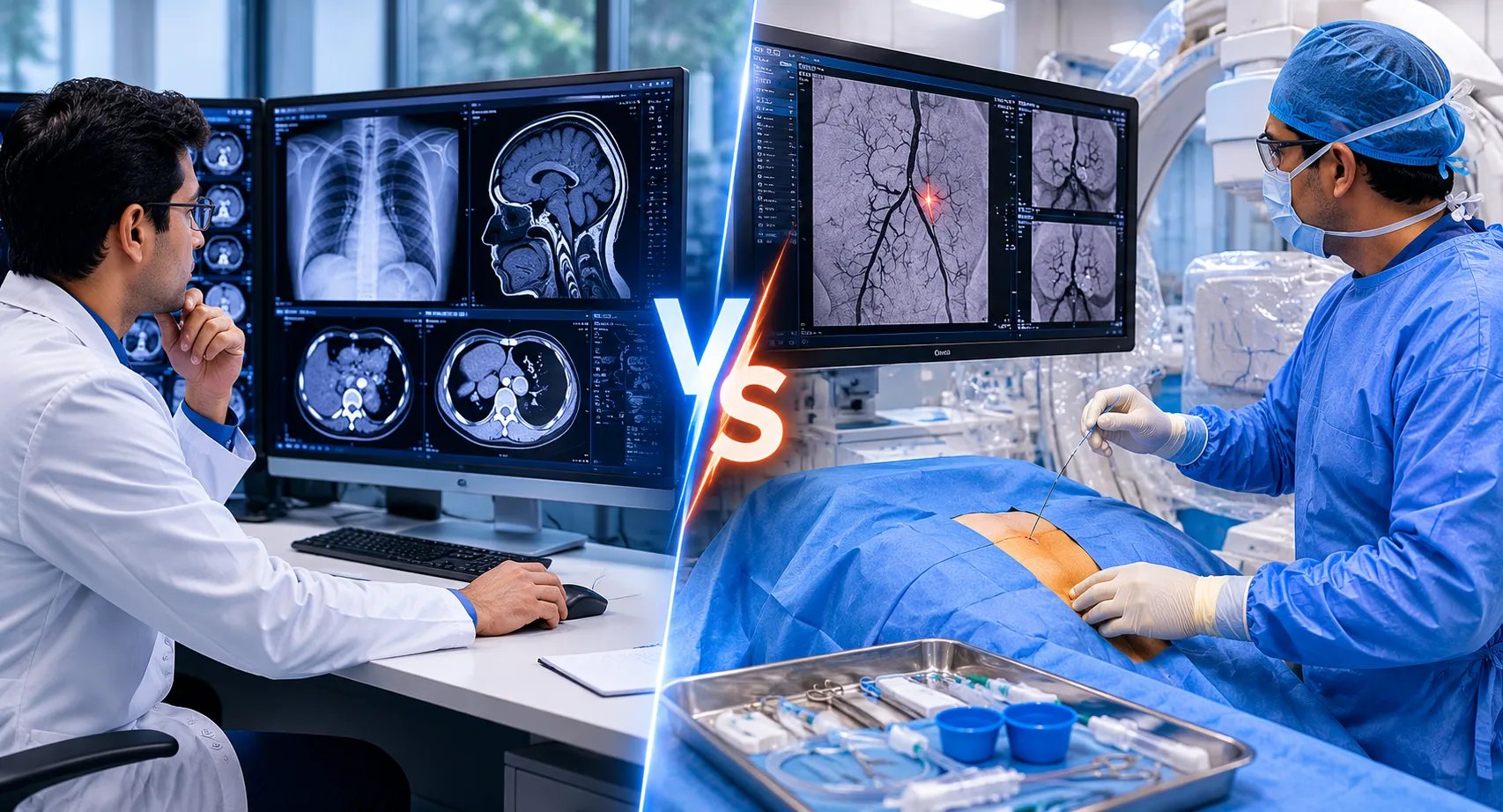

My mother-in-law called me in a panic three years ago.
Her GP had referred her for a "radiologist consultation." She assumed someone was going to treat her varicose veins that day. She got dressed, took an auto to the hospital, waited an hour, and came home with a printed scan report and no treatment.
She called me confused. "The doctor never even came into the room. A machine took pictures, and they posted a paper under the door."
She had seen a diagnostic radiologist. She needed an interventional radiologist.
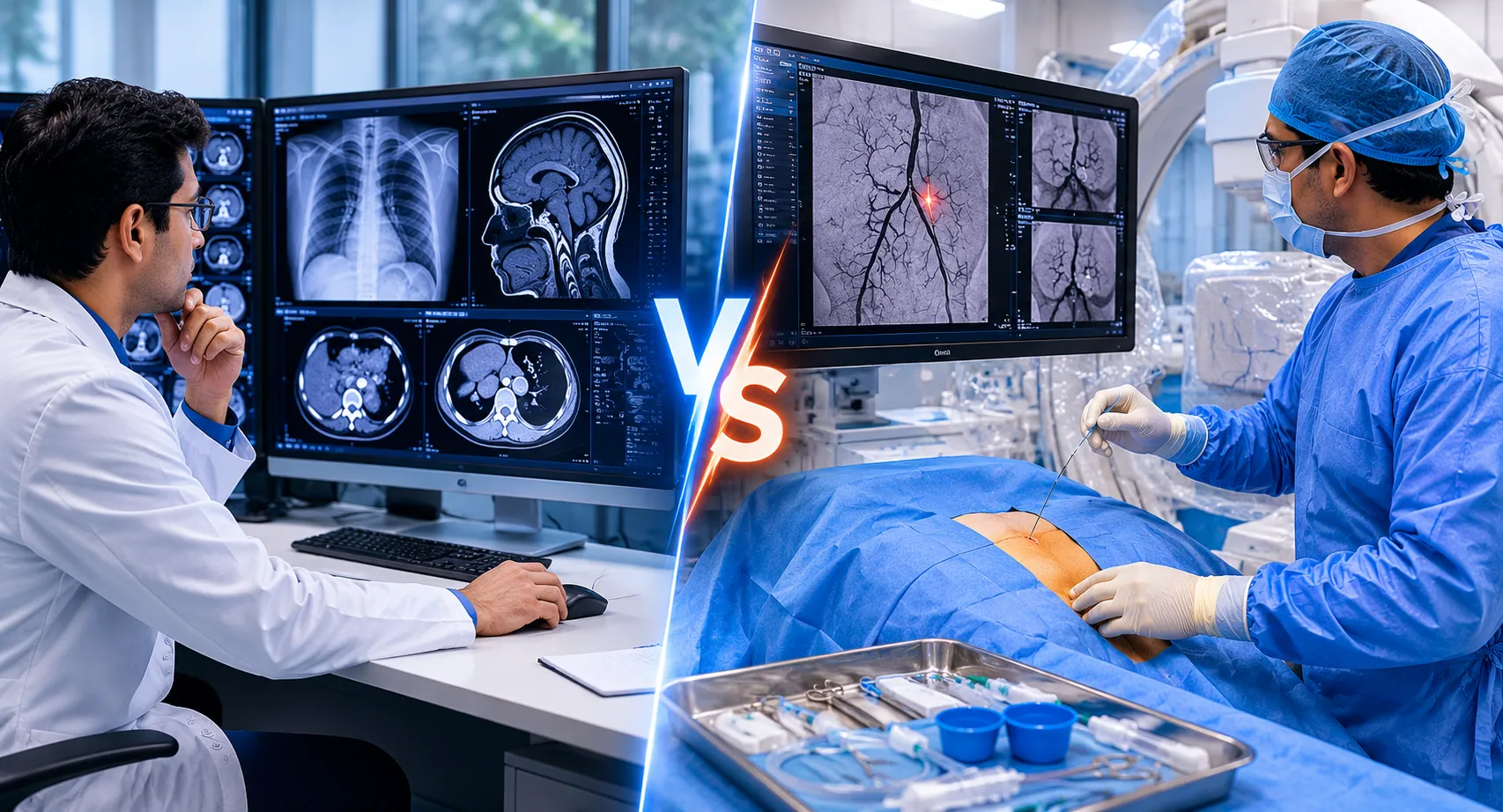
These are two completely different doctors. They share a name. They both use imaging. But one reads scans and writes reports. The other uses those same imaging tools to treat disease inside your body through a needle puncture, while you're awake, and sends you home the same day.
This confusion happens every week in Chennai. And it matters because patients going to the wrong specialist waste months, and sometimes agree to surgery they didn't need, simply because they never found the right doctor.
Quick definition: A diagnostic radiologist interprets medical images and produces reports. An interventional radiologist uses live imaging to guide instruments inside the body and perform treatment procedures. Same imaging technology. Completely different purpose.
Diagnostic Radiologist vs Interventional Radiologist: The Clear Breakdown
Here is the confusion explained simply.
When your doctor says "go for an MRI" or "get a CT scan done", the doctor who reads those images and writes the report is a diagnostic radiologist. You rarely meet them. They sit in a reading room. They look at your scan. They write findings on paper. Their job is to tell your treating doctor what they see.
They are essential. A missed finding on a scan can delay a diagnosis by months. Good diagnostic radiologists save lives through careful image interpretation.
But they do not treat you. They describe what is wrong. Your treating specialist then decides what to do about it.
An interventional radiologist is entirely different.
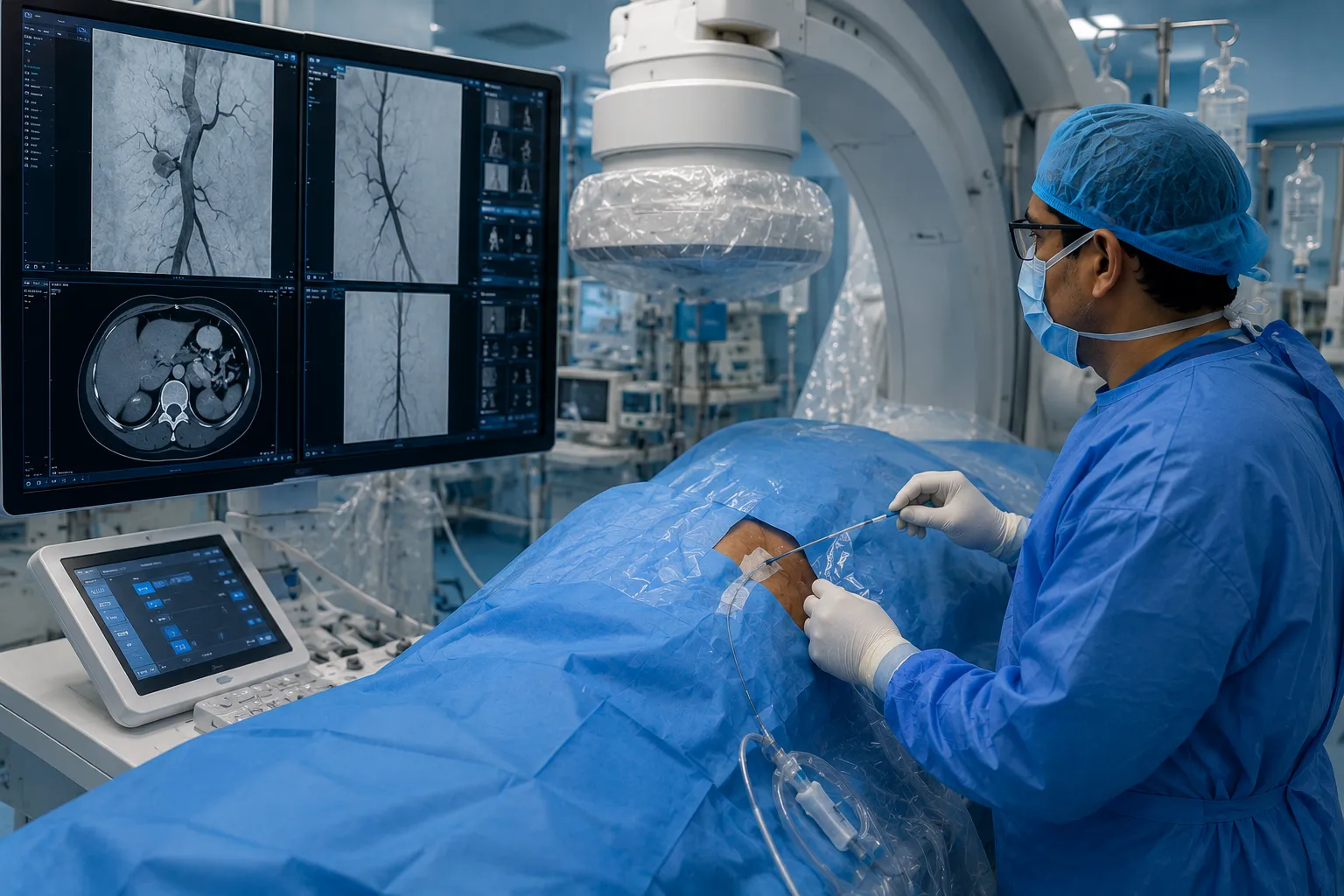
They trained in radiology, so they understand imaging at a deep, technical level. But then they took additional fellowship training in using that imaging to guide instruments inside the body. Catheters. Laser fibres. Embolic particles. Stents. Balloon catheters. All navigated through a 2mm skin puncture while watching a live imaging screen.
They see you in a clinic. They review your history. They explain a procedure. They perform it. They follow you up afterwards.
Quick-glance comparison:
| Feature | Diagnostic Radiologist | Interventional Radiologist |
| Primary role | Diagnoses by reading scans | Treats disease using image-guided tools |
| Patient contact | Rarely meets the patient directly | Consults, treats, and follows up |
| Tools used | MRI, CT, X-ray, and ultrasound equipment | Catheters, lasers, stents, micro-needles |
| Treatment style | Non-invasive - interpretation only | Minimally invasive - active treatment |
| Where they work | Reading room, reporting centre | Procedure suite, clinic, follow-up |
| Referral pathway | Your GP sends scans to them | You see them like any other specialist |
| When you need them | Every time you get an imaging test | When an IR-treatable condition is diagnosed |
The simplest way I explain it to patients:
A diagnostic radiologist reads the map. An interventional radiologist drives the route.
Both matter. But they are not interchangeable, and knowing the difference determines whether you end up with a report or a treatment.
Pro Tip: When your doctor refers you to a "radiologist," ask specifically which type. "Is this for a scan report, or for a consultation about a procedure?" That one question tells you what to expect and whether you are going to the right specialist for what you actually need.
Key Takeaway: These are two separate specialties that share a name. Diagnostic radiologists interpret images. Interventional radiologists treat conditions through those same imaging tools. If you have fibroids, varicose veins, knee pain, or any IR-treatable condition, you need the second type.
When Do You Actually Need to See an Interventional Radiologist?
You need a diagnostic radiologist every time you have a scan. You might not even know their name.
You need an interventional radiologist when you have a condition that can be treated through imaging-guided techniques, and you want to understand whether that treatment is right for you before agreeing to surgery.
Let me be specific about when that is.
You need an IR consultation when:
You've been told you have uterine fibroids and surgery has been recommended. Before agreeing to a hysterectomy or myomectomy, an IR specialist can tell you whether UFE, a same-day, uterus-preserving procedure, is appropriate for your fibroid anatomy.
You've been living with varicose veins and compression stockings and have been told to "wait and see." An IR specialist performs endovenous laser treatment, a 45-minute walk-out procedure that closes faulty veins permanently. You do not need to wait until it becomes an ulcer.
You've been diagnosed with an enlarged prostate and offered TURP surgery. Before accepting the surgical option and its associated side effects, retrograde ejaculation in up to 90% of men an IR specialist can assess whether Prostate Artery Embolization achieves the same outcome without those consequences.
You have a varicocele and have been referred for surgical repair. An IR specialist performs embolization local anaesthesia, no hospital stay, and back to work in two days. The surgical alternative requires general anaesthesia and four to six weeks of recovery.
You have moderate knee osteoarthritis, and steroid injections have stopped working. Before accepting a knee replacement conversation, an IR specialist can assess you for Genicular Artery Embolization a procedure that targets the vascular inflammation driving your pain without altering the joint structure.
You've been told a liver tumour is inoperable. An IR specialist performs TACE, delivering chemotherapy directly into the tumour's blood supply. Inoperable does not mean untreatable. For intermediate-stage liver cancer, TACE is the international first-line recommendation. It is performed exclusively by IR specialists.
You have a wound on your foot that has been open for weeks or months. An IR specialist restores blood flow to the affected area through angioplasty. Without that blood supply restored, no wound dressing in the world will close a vascular wound permanently.
You also need an IR specialist for image-guided biopsies when tissue needs to be sampled from a deep location like the liver, kidney, or lung, and doing so through open surgery would be unnecessarily risky. IR performs these through a needle under CT or ultrasound guidance, as an outpatient procedure.
You do not need an IR consultation for:
Getting an MRI result explained. That is your treating specialist or GP.
Routine scan reports. Those come from diagnostic radiology.
Emergency trauma, fractures, or structural surgical emergencies. Those go to the operating theatre.
Pro Tip: Think of an IR consultation the same way you'd think of a second surgical opinion. It costs one appointment. You bring your existing imaging. You leave knowing whether a minimally invasive option exists for your condition and whether you're a candidate. For most people with IR-treatable conditions, that consultation is the most useful medical appointment they have had in years.
Key Takeaway: See a diagnostic radiologist for image interpretation. See an interventional radiologist when you have a condition on the IR-treatable list and want to understand your non-surgical options before any decision is made. The two roles do not overlap, and confusing them means patients either show up expecting treatment and get a report, or show up for a scan when they need a procedure consultation entirely.
What an IR Consultation Actually Looks Like in Chennai
People imagine interventional radiologists as distant, technical figures sitting in dark rooms full of screens.
That is the diagnostic radiologist.
An IR specialist runs a clinic like any other treating doctor. You walk in. You sit down. You talk about your symptoms, your history, and your concerns. They review your imaging not to write a report, but to assess whether a procedure is appropriate and technically feasible for your specific anatomy.
Then they explain exactly what the procedure involves. How it is done. What you will feel. What the recovery looks like. What happens if the result is incomplete? What the alternative is if surgery turns out to be the better answer?
And if surgery is the better answer, they tell you that directly and refer you without hesitation.
Specialists like Dr Ravindran, an Endovascular and Interventional Radiologist at irdoctor, run consultations on exactly this model. Every patient assessment begins with an imaging review. Every recommendation is anatomy-specific, not a default pathway. And when a patient is not a candidate for IR, they leave knowing clearly why and where to go next.
That is what a proper IR consultation looks like. Not a scan. Not a report. A conversation, a clinical assessment, and a treatment plan.
Pro Tip: Before your IR consultation, write down three things: your main symptom and how long you've had it, every specialist you've already seen and what they recommended, and any imaging you've had done. Bring those scans physically if possible, not just the report. An IR specialist reading your actual images, not just a summary, gives you a far more specific and useful assessment.
Key Takeaway: An IR consultation is a clinical appointment with a treating specialist, not a radiology appointment for a scan. If you are going with imaging in hand to discuss a treatment option, you are going to the right place. If you are going to get a scan read, that is diagnostic radiology, a different department entirely.
The Conditions That Fall Between These Two Specialists
There is a category of patients who falls into a gap.
They've had their imaging done. The diagnostic radiologist has found something: fibroids, a varicocele, varicose reflux, a liver lesion, and abnormal prostate vasculature. The report is clear.
Their GP or surgeon sees the report and recommends the standard treatment pathway, usually surgical.
Nobody sends them to an IR specialist because IR is not in the standard referral chain for most of these conditions.
So the patient with a diagnostic report in hand and a surgical appointment booked goes ahead. They never knew another specialist existed. They never asked. Nobody told them.
This is the gap that costs patients the most. Not lack of access. Not a lack of technology. Just a lack of a referral that should have happened, but didn't.
Conditions most commonly falling into this gap:
- Uterine fibroids diagnosed on ultrasound - referred to gynaecology - surgery recommended - IR never mentioned
- Varicose veins confirmed on Doppler - referred to vascular surgery - stripping offered - laser ablation never mentioned
- Varicocele found on scrotal ultrasound - referred to urology - surgery recommended - embolization never mentioned
- BPH confirmed on prostate ultrasound - referred to urology - TURP discussed - PAE never mentioned
Liver lesion found on CT - referred to hepatology - inoperable declared - TACE never mentioned
In every single one of these cases, a diagnostic report existed. A surgical recommendation followed. An IR option was available. The referral never happened.
Pro Tip: If you have a diagnostic radiology report showing any of the conditions above, take that report to an IR consultation before your surgical appointment, not after. The report already contains the information an IR specialist needs to assess candidacy. You don't need new imaging. You need a different specialist to look at what you already have.
Key Takeaway: The gap between diagnostic imaging and IR treatment exists because the referral pathway doesn't connect them by default. Patients who close that gap themselves by booking an IR consultation with their existing scan consistently get better information and more complete options than those who don't.
FAQ People Also Ask
What is the difference between a radiologist and an interventional radiologist?
A diagnostic radiologist reads medical images and produces written reports for other doctors. An interventional radiologist uses those same imaging tools to guide instruments inside the body and perform treatment procedures through a 2mm skin puncture, under local anaesthesia. One describes what is wrong. The other treats it. Both are doctors. Their roles do not overlap.
How do I know if I need an interventional radiologist or a regular radiologist?
If you need a scan, MRI, CT, or ultrasound, you are going to a diagnostic radiologist. If you have a condition like fibroids, varicose veins, varicocele, enlarged prostate, knee osteoarthritis, or liver cancer and want to understand non-surgical treatment options, you need an interventional radiologist. They run clinics, see patients, and perform procedures. They are a treating specialist, not a reporting service.
Why do patients in Chennai confuse diagnostic and interventional radiologists?
Both use the word "radiologist", and both work with imaging equipment. Most patients have only ever interacted with diagnostic radiology, getting scans done, so they assume all radiologists work the same way. Interventional radiologists are less visible in standard referral pathways, which compounds the confusion. The distinction matters enormously when you need treatment, not just a report.
When should I ask for an interventional radiology referral specifically?
Ask for an IR referral whenever you receive a surgical recommendation for fibroids, varicose veins, enlarged prostate, varicocele, knee osteoarthritis pain, intermediate-stage liver cancer, non-healing foot wounds, or Grade 2–3 haemorrhoids. These conditions have evidence-backed IR-based alternatives to surgery. One IR consultation before agreeing to an operation gives you the full picture of your options.
Which hospitals in Chennai have interventional radiology departments?
Several private hospitals and specialist clinics in Chennai have dedicated IR departments with fluoroscopy suites and imaging guidance equipment. When searching, look specifically for "interventional radiology Chennai" or the specific procedure name "UFE Chennai" or "EVLT varicose veins Chennai." Not all radiology departments have IR capabilities. Confirm that the specialist you are seeing has fellowship training specifically in interventional radiology, not just general radiology.
Conclusion: Two Doctors. Same Name. Completely Different Jobs.
My mother-in-law eventually got her varicose veins treated. She came to my clinic, understood what EVLT involved, had the procedure on a Tuesday, and was back in her kitchen by Thursday.
She still tells the story of the appointment where she expected treatment and got a printed report slid under a door.
It is funny now. It wasn't at the time.
The difference between a diagnostic radiologist and an interventional radiologist is not a minor technicality. It determines whether you leave an appointment with a piece of paper or a treatment plan.
Here is the short version:
- Going for a scan result or imaging report -Diagnostic radiologist
- Have a condition and want to understand non-surgical treatment - Interventional radiologist
- Have a surgical recommendation and want a second opinion - IR consultation first
- Have existing scan reports and an untreated condition - Take those reports to an IR specialist this week























Sign in to leave a comment.