
A patient came to me recently, a 38-year-old software engineer from Perumbakkam.
He had been diagnosed with a varicocele. His urologist recommended surgery. He was ready to book the operation when his colleague mentioned something called "embolization." He had never heard of it. Neither had his wife. Neither had his GP.
He spent three evenings searching online and found almost nothing that explained it plainly.
That gap between what interventional radiology can do and what patients actually know about it is why I'm writing this.
Interventional radiology is not a new speciality. It is not experimental. It has been quietly replacing open surgery for dozens of conditions since the 1970s. And in Chennai, it is available right now for fibroids, varicose veins, prostate problems, knee pain, liver tumours, and more.
What follows is a plain, honest explanation of what it is, what procedures it involves, and why it changes the conversation around treatment for so many conditions.
What is interventional radiology?
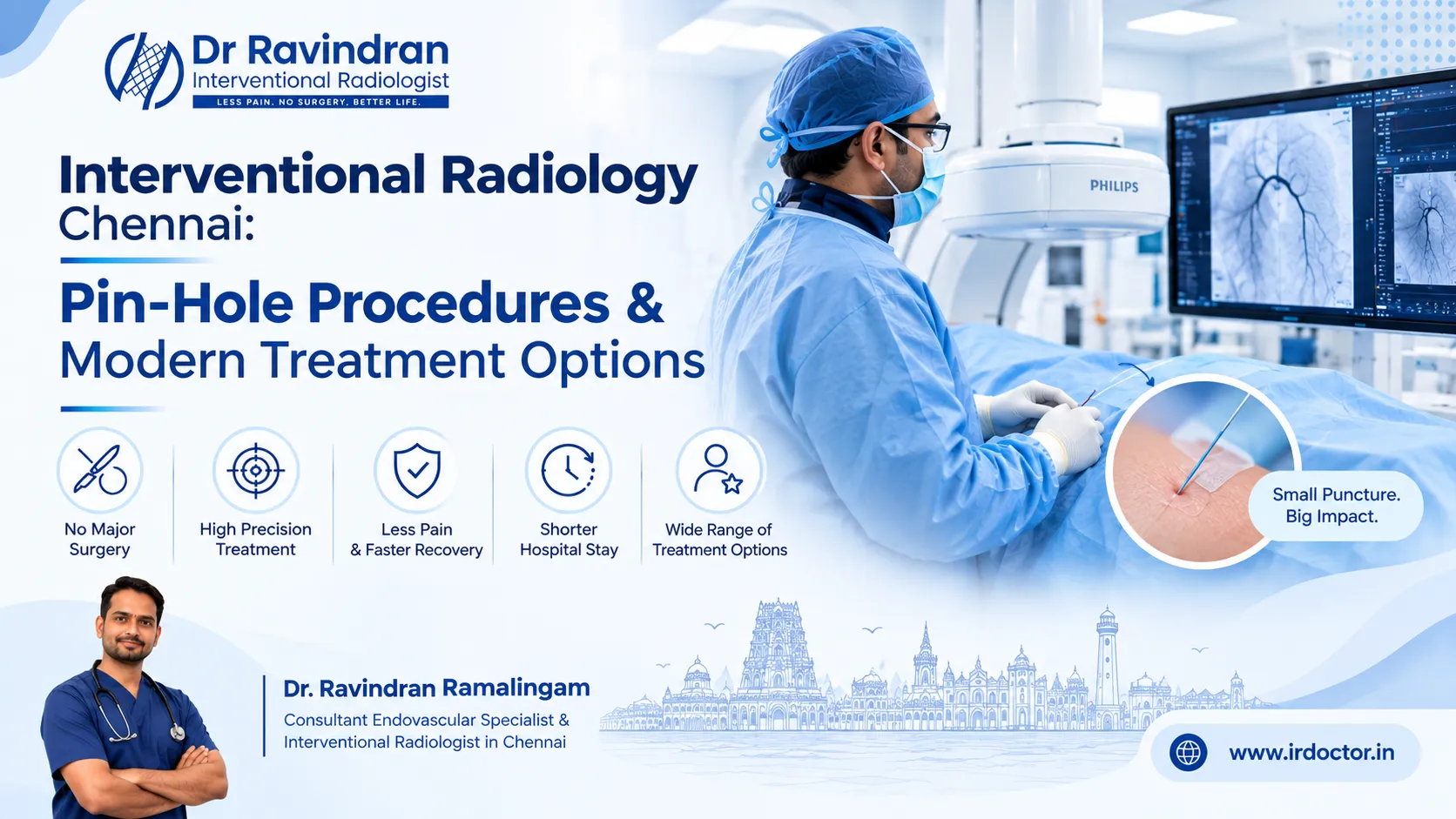
Interventional radiology (IR) is a speciality where doctors use live imaging - X-ray, ultrasound, or CT scan to guide instruments through a skin puncture roughly 2mm wide and treat disease inside the body. No large incisions. No general anaesthesia in most cases. Results comparable to surgery with a fraction of the recovery.
What Exactly Happens During an Interventional Radiology Procedure?
Most patients picture something dramatic when they hear the word "procedure." A theatre. Surgical gowns. Being put to sleep.
IR is nothing like that.
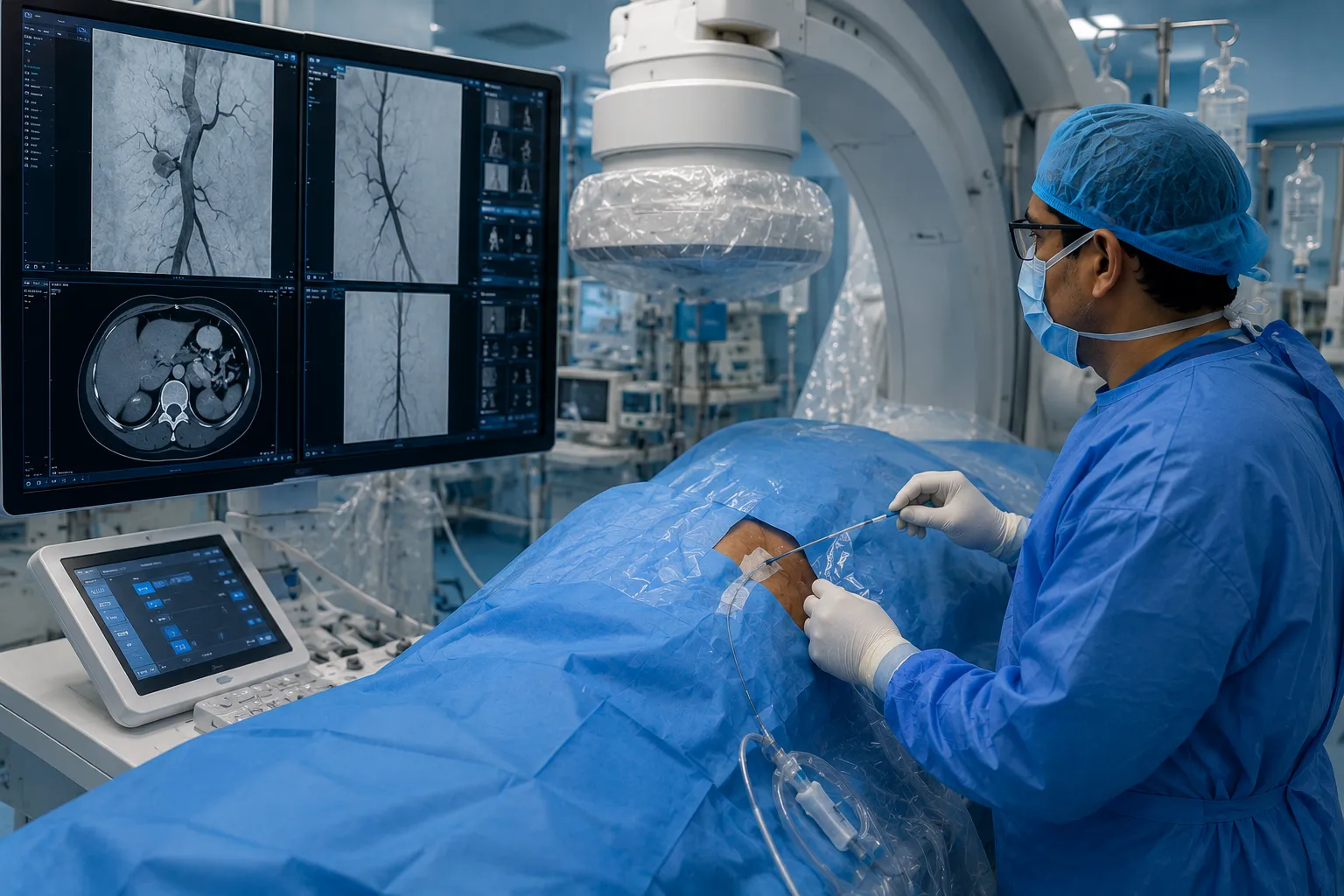
You walk into a procedure room. You lie on a table. A small area of skin, usually at the wrist or groin, is cleaned and numbed with local anaesthetic. That's the only injection you feel.
From that point, a catheter, a thin, flexible tube about the width of a strand of spaghetti, is guided into a blood vessel through a 2mm puncture. No cutting. No stitching. Just a needle entry point that barely needs a plaster afterwards.
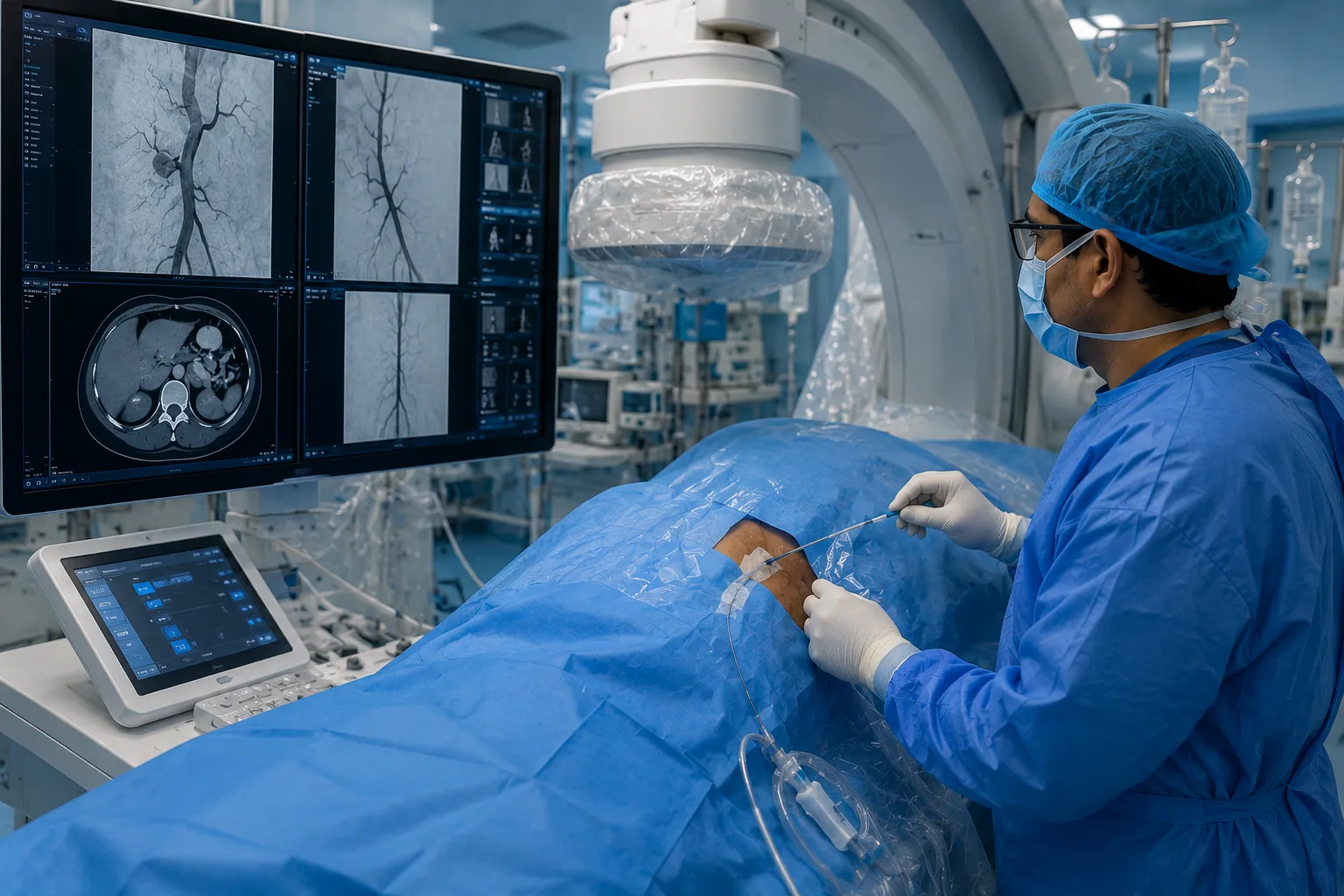
From there, the interventional radiologist watches everything on a live imaging screen. Depending on the procedure, this might be fluoroscopy (live X-ray), ultrasound, or CT. Every movement of the catheter is visible in real time. Treatment is delivered precisely - at the exact site of the problem.
The steps in a typical IR procedure:
- Patient arrives - no overnight fast required for most procedures
- Local anaesthetic is applied at the puncture site
- Catheter inserted through a 2mm skin puncture
- Live imaging guides the catheter to the target site
- Treatment delivered - particles, laser energy, coils, medication, or balloon
- Catheter removed - no stitches needed
- Small dressing applied
- Patient monitored for 1–3 hours
- Patient goes home the same day
The whole process from entry to discharge takes between 45 minutes and a few hours, depending on the condition being treated.
Most patients describe it as far less dramatic than they expected. The most common thing I hear afterwards is: "That was it?"
Yes. That was it.
Pro Tip: You can eat a light meal before most IR procedures. You do not need to fast overnight the way you would before surgery under general anaesthesia. Confirm the specific instructions with your IR clinic when you book, but for the majority of outpatient IR procedures, your day starts normally.
Key Takeaway: An IR procedure feels nothing like surgery. Local anaesthetic, a needle puncture, live imaging, and same-day discharge. Most patients are surprised by how straightforward it actually is.
Common IR Procedures Performed in Chennai
IR covers a wide range of conditions. What connects them all is the same approach - imaging guidance, catheter access, and minimal invasion.
Here are the procedures performed most regularly at IR clinics in Chennai.
Endovenous Laser Treatment (EVLT) for Varicose Veins. A laser fibre enters through a needle puncture in the leg. Tumescent local anaesthetic is injected around the faulty vein. As the fibre is slowly withdrawn, it delivers laser energy that seals the vein wall from inside. The vein closes. Blood flow shifts immediately to healthy veins nearby.
Walk-out procedure. 45 minutes. Back to normal in three to five days. No surgical scars.
Uterine Artery Embolization (UAE / UFE) for Fibroids. The catheter navigates to the uterine arteries supplying the fibroids. Tiny embolic particles - smaller than a grain of sand block blood flow to the fibroid tissue. Without blood, fibroids shrink over three to six months. Symptoms, such as heavy bleeding, pelvic pressure, and pain, have reduced significantly.
The uterus is completely preserved. Recovery is one to two weeks. Success rate is 85–90%.
Prostate Artery Embolization (PAE) for Enlarged Prostate. For men with BPH - benign prostatic hyperplasia - Prostate Artery Embolization ( PAE ) reduces the blood supply to the overgrown prostate tissue. The prostate shrinks. Urinary symptoms improve. No surgical incision. No retrograde ejaculation, which is a significant side effect of surgical TURP affecting up to 90% of men. Same-day discharge.
Varicocele Embolization The abnormal veins in the scrotum are blocked from inside using coils or a sclerosant agent. Both sides can be treated in one session a significant advantage over surgery, which requires two separate incisions for bilateral varicocele. Local anaesthesia. Back to desk work in one to two days.
Genicular Artery Embolization (GAE) for Knee Pain. For patients with moderate knee osteoarthritis who have tried physiotherapy and steroid injections without lasting relief, and aren't ready for knee replacement. GAE targets the abnormal blood vessels feeding inflammation in the knee joint lining. Pain improves over two to four weeks. No joint is altered.
Transarterial Chemoembolization (TACE) for Liver Cancer. When liver tumours cannot be surgically removed, TACE delivers chemotherapy directly into the artery feeding the tumour. Embolic particles then seal that artery, trapping the drug at the tumour and cutting off its blood supply simultaneously. The surrounding liver tissue receives minimal drug exposure.
This is the international first-line recommendation for intermediate-stage liver cancer, per EASL guidelines.
Angioplasty for Non-Healing Wounds. A foot wound that won't close is almost always a blood supply problem. A balloon catheter opens the blocked artery. Circulation is restored. Wounds that have been open for months begin closing within weeks once blood flow returns.
Haemorrhoidal Artery Embolization (HAE) for Piles Grade 2–3 haemorrhoids treated by reducing blood flow to the swollen tissue. 30–45 minutes under local anaesthesia. Home the same evening. Back to normal in two to three days.
Specialists like Dr Ravindran, an Endovascular and Interventional Radiologist at irdoctor, assess every patient using pre-procedure imaging, such as Doppler ultrasound, MRI, or CT, before any procedure recommendation is made. The treatment plan is always built around the patient's specific anatomy and clinical findings. And when surgery is genuinely the better answer, that is what patients are told clearly, directly, and with a referral to the right surgeon.
Pro Tip: When researching IR procedures in Chennai, search the specific procedure name, not just "interventional radiologist." Searching "UFE Chennai" or "EVLT varicose veins Chennai" or "PAE prostate Chennai" will surface the right specialist far more directly than a general search.
Key Takeaway: IR covers fibroids, varicose veins, prostate, varicocele, knee pain, liver cancer, wounds, and haemorrhoids all through the same core approach. One needle entry. Live imaging. Same-day discharge.
Is Interventional Radiology Considered Major Surgery?
No. And the distinction matters more than most patients realise.
"Major surgery" typically means general anaesthesia, a surgical incision, an operating theatre team, a hospital stay of one to several nights, and a recovery period measured in weeks to months.
IR procedures involve none of these in most cases.
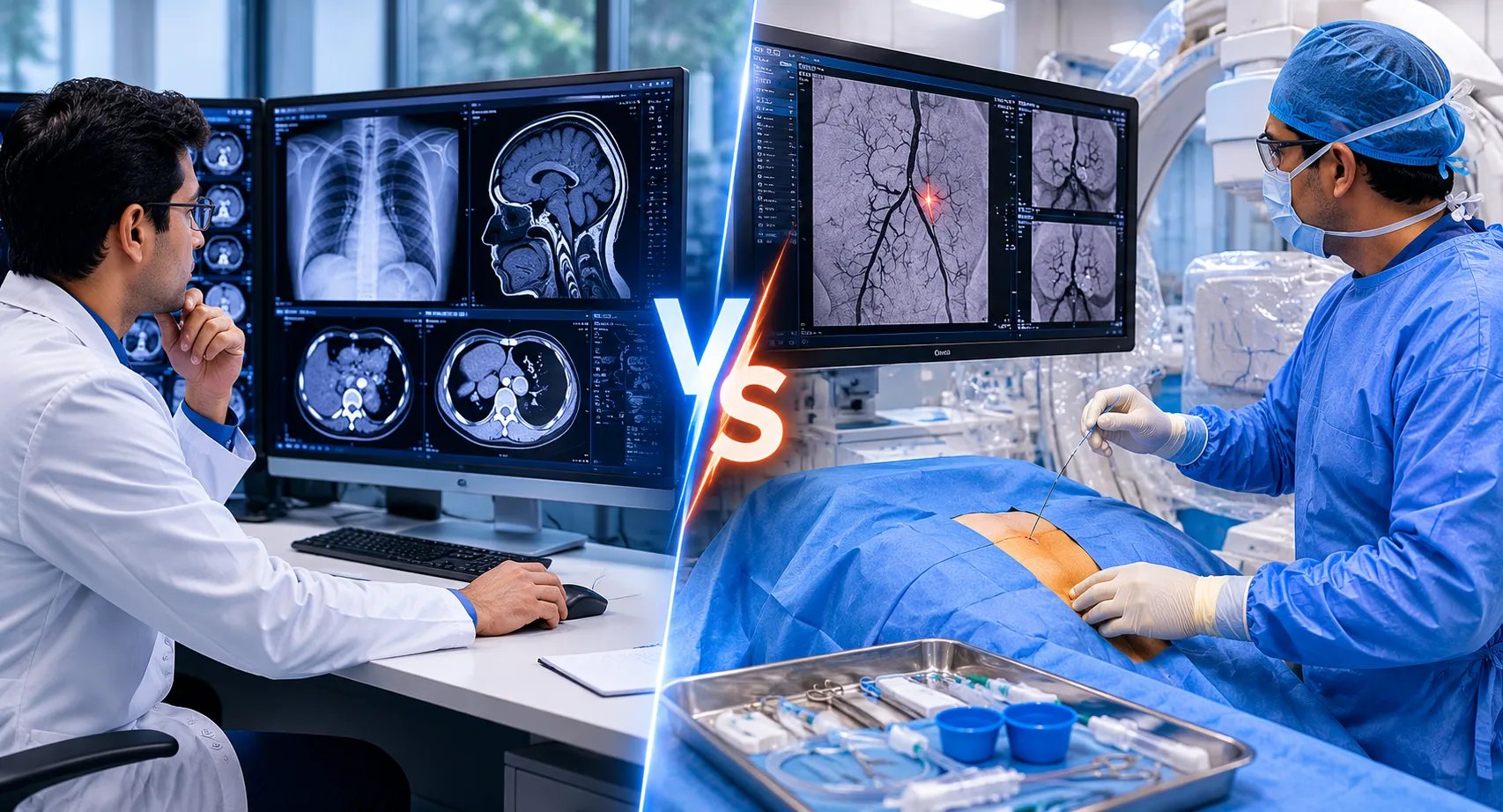
Here is the comparison that makes it concrete:
| Feature | Major Surgery | IR Procedure |
|---|---|---|
| Anaesthesia | General or spinal | Local only |
| Entry point | Surgical incision | 2mm needle puncture |
| Stitches required | Yes | No |
| Hospital stay | 1 night to several days | Same day for most |
| Recovery | Weeks to months | Days to 2 weeks |
| Theatre team | Full surgical team | IR specialist + imaging staff |
| Scarring | Surgical scar | None visible |
The 2mm puncture site closes on its own. It requires nothing more than a small plaster. By the next morning, it is barely visible.
Patients are awake throughout most IR procedures. They can talk. They can ask questions. They can tell me if something feels uncomfortable. There is no post-anaesthesia grogginess, no nausea, no recovery room wait measured in hours.
This is not minor in the sense of unimportant. The conditions IR treats are serious. The results are clinically significant. But the way the procedure is performed is genuinely minimally invasive in the literal meaning of those words.
Common mistake: Patients sometimes assume that because IR sounds medical and complex, the recovery must be similar to surgery. It isn't. A patient who has UFE on Thursday can realistically be walking around comfortably by the weekend. Someone who has a hysterectomy on Thursday is in the hospital until at least Saturday and off work for six weeks.
That difference is real. And for working patients, parents, and anyone with responsibilities they can't put on hold for six weeks, it changes the decision entirely.
Pro Tip: Ask your IR specialist specifically: "What will I be able to do on day one, day three, and day seven after this procedure?" That question gives you a concrete, realistic recovery picture, not a generic estimate. For most IR procedures, the answer is more encouraging than patients expect.
Key Takeaway: IR is not a major surgery. It is minimally invasive in the truest sense: local anaesthesia, a needle puncture, no stitches, same-day discharge, and recovery that takes days, not months.
Why More Chennai Patients Are Choosing IR Over Surgery
The shift is gradual. But it is happening.
Patients are arriving at IR consultations better informed than they were five years ago. More of them have done their research. More of them are asking their surgeons: "Is there a non-surgical option for this?"
And when the answer is yes, when they understand that UFE preserves the uterus, that EVLT requires no hospital stay, that PAE avoids the side effects of TURP, most of them choose IR without hesitation.
The patients who come to me and say "I wish I'd known about this sooner" are not edge cases. They are the majority.
The good news is that awareness is growing. More GPs in Chennai are making IR referrals. More patients are finding IR specialists through targeted online searches. More families facing liver cancer diagnoses are asking about TACE before assuming inoperable means untreatable.
That shift matters. It means fewer unnecessary operations. Shorter recoveries. Preserved organs. Patients back at work, back with their families, back in their lives weeks earlier than surgical pathways would have allowed.
Pro Tip: If you have been given a surgical recommendation for any condition on the IR-treatable list, get one IR consultation before booking the operation. It costs one appointment. It gives you complete information. And if surgery really is the better answer for your specific case, a good IR specialist will tell you so directly, and you'll make that decision with confidence rather than doubt.
Key Takeaway: The shift toward IR is driven by patient experience, faster recovery, preserved anatomy, and results that hold up over time. The patients who discover it early make better-informed decisions. The ones who discover it late wish they'd asked sooner.
FAQ: People Also Ask About Interventional Radiology
How do I know if an IR procedure is right for my condition?
If your condition involves fibroids, varicose veins, enlarged prostate, varicocele, moderate knee osteoarthritis, intermediate-stage liver cancer, non-healing wounds, or Grade 2–3 haemorrhoids, and you've only had a surgical recommendation so far, one IR consultation will confirm whether a minimally invasive alternative is appropriate for your specific anatomy. Bring your most recent imaging.
What does an IR procedure feel like?
The puncture site is numbed with local anaesthetic before the catheter is inserted. Most patients feel nothing beyond that initial injection. During the procedure, some patients feel mild pressure or warmth at the treatment site both normal. Afterwards, mild soreness for one to two days is typical. Most patients describe the experience as far less uncomfortable than they anticipated.
Why is IR not offered by default for conditions like fibroids and varicose veins?
Because IR specialists sit outside the standard GP-to-surgeon referral pathway, gynaecologists treat fibroids surgically. Urologists treat prostate problems surgically. These are their tools. IR is a separate speciality with different tools, and most patients are never pointed toward it unless they specifically ask. Awareness, not availability, is the barrier.
When should I choose surgery over interventional radiology?
For conditions requiring structural repair - fractures, ligament tears, tumours needing clear surgical margins, Grade 4 haemorrhoids with permanent prolapse, or end-stage joint disease requiring replacement surgery is often the right answer. A good IR specialist tells patients this directly. The goal is always the best outcome, not the avoidance of surgery at any cost.
Which IR procedures are available in Chennai, and are they safe?
EVLT for varicose veins, UFE for fibroids, PAE for prostate, varicocele embolization, GAE for knee pain, TACE for liver cancer, angioplasty for peripheral artery disease, and HAE for haemorrhoids are all available at specialist IR centres in Chennai. These procedures are performed with live imaging guidance throughout, which provides both precision and real-time safety monitoring. Complication rates across well-performed IR procedures are low.
Conclusion: One Speciality. A Different Kind of Treatment.
Interventional radiology is not a replacement for surgery. It is an alternative path - for conditions where that path exists, works, and gets patients home faster.
A 2mm puncture. Local anaesthetic. Live imaging guidance. Same-day discharge. Recovery in days.
That is what IR offers. And for the conditions it treats - fibroids, varicose veins, prostate, varicocele, knee pain, liver cancer, wounds, haemorrhoids - it offers that consistently.
Here is what to do now:
- Check whether your condition is on the IR-treatable list
- Search the specific procedure name alongside "Chennai"
- Book one consultation before agreeing to any surgical recommendation
- Bring your imaging and ask the direct questions
You don't have to choose between living with the problem and going through major surgery. For many conditions, there is a third option.
It is worth one appointment to find out whether it applies to you.
























Sign in to leave a comment.