

Real estate businesses need accurate property information to identify opportunities, analyze markets, manage listings, and make informed decisions. However, collecting reliable data from multiple sources can be time consuming.
Property information is often scattered across county records, assessor databases, MLS platforms, property websites, and tax records. These sources may contain inconsistent formats, missing fields, or outdated information.
Real estate data collection companies help businesses gather, organize, validate, and maintain property information. Their offerings may include outsourced data collection, public records research, document processing, web scraping, and property intelligence.
This guide explores eight companies, their primary capabilities, and how to choose the right provider for your business.
For a broader understanding of the process, explore this real estate property data collection guide to learn more about collecting and organizing property information for business use.
What Do Real Estate Data Collection Companies Do?
These companies gather property information from relevant sources and prepare it for business use. Depending on the provider, the process may involve automated extraction, manual research, licensed datasets, or document processing.
Common data categories include:
- Property listings, prices, and property characteristics
- Ownership and transaction records
- Property tax and assessment information
- Deed and mortgage records
- Land parcels and zoning information
- Commercial property and rental data
- Property documents and valuation information
The right approach depends on the intended use. A real estate marketplace may need frequent listing updates, while a title company may prioritize recorded documents and ownership information.
Businesses can also explore real estate data collection public sources to understand where property information is available and which sources may be relevant to their data collection needs.
8 Best Real Estate Data Collection Companies
1. HabileData
HabileData provides real estate data collection services and data management support for businesses that need property information gathered and organized from multiple sources.
Its services are relevant to companies managing property listings, public records, ownership information, and other real estate datasets.
Key capabilities include:
- Property data collection and research
- MLS data collection, subject to access permissions
- Public property records research
- Property tax and transaction data gathering
- Data cleansing and database management
Why choose HabileData?
Businesses often need specific property fields that are not available in a single database. HabileData is worth evaluating for projects involving custom data collection, recurring research, and property information management.
Before engaging the company, confirm geographic coverage, supported sources, quality checks, and update schedules.
2. Hitech BPO
Hitech BPO supports real estate data processing, data entry, document processing, and structured information management.
These capabilities can help businesses convert property documents, spreadsheets, and records into organized datasets.
Key capabilities include:
- Property data collection and research
- Real estate data entry and database management
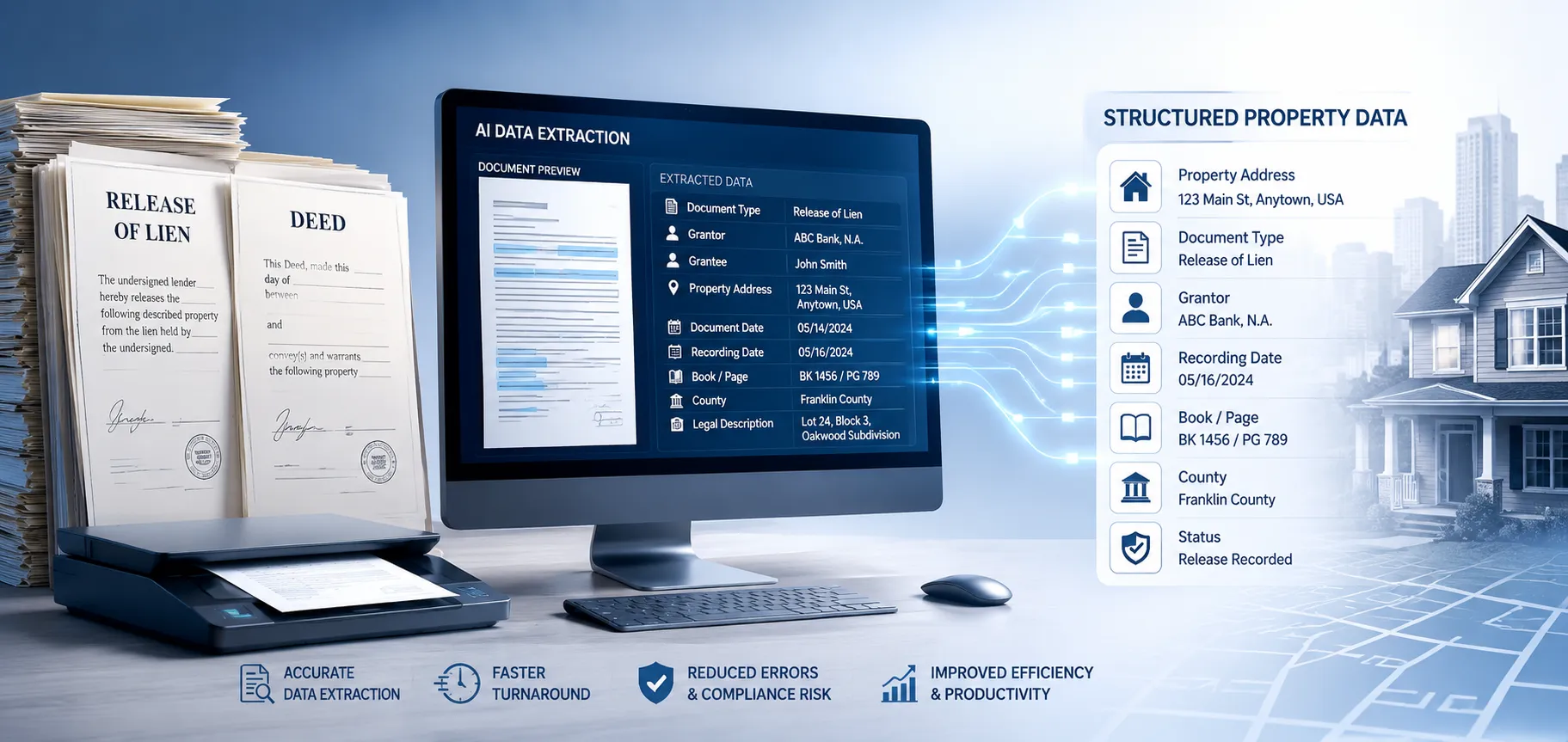
- Document processing and data extraction
- OCR assisted document digitization
- Data cleansing and validation
Why choose Hitech BPO?
Consider a property data aggregator that needs to extract information from county records, standardize addresses, identify duplicate entries, and prepare records for a central database.
Hitech BPO is worth evaluating for workflows combining research, document handling, and structured data processing.
3. Damco
Damco Solutions offers technology and business process solutions that organizations can evaluate for real estate related outsourcing requirements.
Potential areas to evaluate include:
- Property data collection and research
- Data entry and processing
- Property listing management
- Database updates and standardization
- Quality checks and operational support
Why choose Damco?
Damco may suit businesses seeking an outsourcing partner for broader data operations. Before selecting the company, confirm its current real estate capabilities, supported sources, and experience with similar projects.
4. Forage AI
Forage AI focuses on data collection and data operations. Businesses evaluating it for real estate projects should confirm support for their required property sources and fields.
Key capabilities to evaluate include:
- Data collection from relevant online sources
- Structured data extraction
- Record matching and deduplication
- Data classification and quality checks
- Custom dataset preparation
Why choose Forage AI?
A PropTech company may need to combine property information from multiple authorized sources to develop a more comprehensive dataset.
A suitable data partner should explain how it handles missing fields, duplicate records, source changes, and recurring updates.
5. Bright Data
Bright Data provides web data collection infrastructure and real estate scraping solutions for gathering information from supported websites.
Depending on the source, businesses may collect listing details, prices, property characteristics, and other available information.
Key capabilities include:
- Automated property listing extraction
- Structured data collection
- API based workflows
- Recurring collection processes
- Web data parsing and organization
Why choose Bright Data?
Bright Data is relevant when businesses need to collect information from supported websites at scale.
For example, a market research team may monitor asking prices across selected property websites to study market changes.
Businesses must confirm website terms, access permissions, privacy obligations, and applicable laws before collecting or redistributing information. MLS data may require separate authorization.
6. HouseCanary
HouseCanary provides residential property data, automated valuation models, rental valuations, market forecasts, and analytics.
Its offerings help businesses evaluate properties and incorporate property intelligence into investment and lending workflows.
Key capabilities include:
- Residential property data
- Automated valuation models
- Rental valuation estimates
- Comparable property analysis
- Property data APIs and bulk data products
Why choose HouseCanary?
HouseCanary is worth considering when property data needs to be combined with valuation insights. Investors may use these products to evaluate acquisitions, while lenders may incorporate property information into risk assessment workflows.
Automated valuations are estimates and do not automatically replace formal appraisals where required.
7. The Warren Group
The Warren Group provides real estate datasets covering property, transaction, mortgage, parcel, and related information.
These datasets can support property research, market analysis, and business intelligence.
Key data categories include:
- Property ownership and characteristics
- Deed and mortgage transaction records
- MLS related information
- Land parcel data
- Property tax and assessment records
- Foreclosure and building permit information
Why choose The Warren Group?
The company is worth evaluating when businesses need structured property and transaction datasets rather than a fully outsourced collection team.
Confirm geographic coverage, historical depth, available fields, update frequency, and licensing terms before purchasing.
8. Clear Capital
Clear Capital provides real estate valuation and property intelligence solutions for organizations involved in lending, servicing, investment, and collateral assessment.
Key areas to evaluate include:
- Property valuation solutions
- Automated valuation models, where available
- Property condition information
- Collateral risk assessment
- Valuation workflow support
- Property data and analytics integration
Why choose Clear Capital?
Clear Capital is relevant when property information supports valuation and lending decisions. For example, mortgage businesses may use valuation related insights to help assess collateral and manage portfolio risk.
Businesses requiring custom collection from county websites or extensive document extraction should confirm whether these specific needs are supported.
How to Choose a Real Estate Data Collection Service
Selecting a provider requires more than comparing prices. Businesses should evaluate data quality, source coverage, update schedules, and the intended use of the information.
1. Identify Your Data Sources
List the sources required for your project, such as county assessor websites, recorder offices, public records, MLS platforms, property portals, or scanned documents.
Confirm that the provider can access each source through an authorized method.
2. Define Required Fields
Specify the information needed, including property addresses, parcel identifiers, sale prices, assessment values, building characteristics, and source references.
A clear data structure reduces ambiguity and makes it easier to evaluate sample records.
3. Check Data Accuracy
Ask how the provider identifies missing fields, duplicate records, inconsistent addresses, and conflicting information.
Request a sample dataset and evaluate it against your quality requirements before starting a large project.
4. Confirm Geographic Coverage
Check whether the provider covers your target counties, states, and property categories. Also verify historical availability and update frequency.
5. Compare Total Costs
Pricing may depend on record volume, source complexity, refresh frequency, and quality assurance requirements.
Compare subscriptions, API usage, dataset licensing, and outsourced collection projects. Include the cost of data correction, integration, and ongoing maintenance.
6. Review Security and Licensing
Confirm how the provider handles confidential information and whether the intended collection and reuse of records comply with applicable laws, privacy obligations, source terms, and licensing conditions.
Benefits of Outsourcing Real Estate Data Collection
Outsourcing can help businesses manage repetitive data tasks without developing every capability internally.
Understanding the role of data collection in real estate highlights how structured, reliable property information can improve operational efficiency and support better business decisions.
Key benefits include:
- Reduced manual workload: Dedicated teams can manage repetitive research and data entry.
- Improved consistency: Standardized processes can help align property fields and formats.
- Scalable operations: Businesses can increase collection capacity as requirements grow.
- Better data maintenance: Recurring collection workflows can help keep records updated.
- More efficient analysis: Structured datasets are easier to use in reporting, analytics, and business applications.
The actual benefits depend on source availability, provider capabilities, and the quality standards agreed upon.
Conclusion
Reliable property information helps real estate businesses improve research, evaluate opportunities, and develop data driven products. Choosing the right provider starts with understanding the sources, fields, coverage, and quality standards your business requires.
HabileData and Hitech BPO are worth evaluating for outsourced property data collection and processing. Bright Data is relevant for automated web extraction, while HouseCanary, The Warren Group, and Clear Capital serve more specialized property intelligence and valuation needs.
Before making a decision, request sample records, confirm source permissions, and compare quality controls, delivery schedules, and total costs.
If your organization needs property data collection, document processing, or structured data extraction, explore Hitech BPO's real estate support services to assess whether its capabilities fit your requirements.
FAQ
What are the best real estate data collection companies?
HabileData and Hitech BPO are options to evaluate for outsourced collection, processing, and extraction. Damco and Forage AI address data operations, while Bright Data specializes in web collection technology. HouseCanary, The Warren Group, and Clear Capital focus on property intelligence, transaction data, and valuation related needs.
How do real estate data collection services work?
Providers gather information from authorized sources, extract required fields, validate records, standardize formats, and deliver the results in an agreed format.
How much do these services cost?
Pricing depends on data volume, source complexity, geographic coverage, update frequency, and quality requirements. Request quotes based on a defined project scope and sample dataset.
Can property data be collected automatically?
Yes. Automated tools can collect information from supported sources, subject to applicable laws, source terms, and access permissions.
What is the difference between a property data API and a collection service?
A property data API provides programmatic access to an existing dataset or product. A collection service can gather information from specified sources and prepare custom datasets according to business requirements.




















Sign in to leave a comment.