
Diamonds are one of the most valuable and meaningful gemstones you can own. Whether you inherited a ring, received a diamond as a gift, or are shopping for an engagement diamond ring, it is natural to wonder: How can you tell if a diamond is real?
With so many diamond alternatives available today, including cubic zirconia, moissanite, and lab-created diamonds, it can be difficult to know what you are actually looking at. Some traditional “at-home diamond tests” can offer clues, but they are not reliable enough to confirm a diamond’s identity.
The most dependable way to determine whether a diamond is genuine is to have it examined by a qualified jewelry professional or gemologist.
In this guide, we will explain how to tell if a diamond is real, which popular tests you should avoid, how natural diamonds differ from lab-created diamonds, and when professional diamond testing is the best choice.
What Does “Real Diamond” Mean?
Before testing a diamond, it helps to understand what the term “real” actually means.
A natural diamond forms deep inside the Earth under extreme heat and pressure over millions or even billions of years. A lab-created diamond, also called a laboratory-grown diamond, is made using advanced technology that replicates the conditions under which diamonds form.
Both natural and lab-created diamonds are diamonds. Their origins are different, but lab-created diamonds are not simply fake stones or imitations.
Diamond alternatives such as cubic zirconia and moissanite, however, are different gemstones. They can look similar to diamonds but do not have the same chemical and physical properties.
If you are trying to understand the difference between the two types of genuine diamonds, our guide to Natural Diamonds vs. Lab-Created Diamonds provides a more detailed comparison.
How Can You Tell If a Diamond Is Real?
There are several ways to evaluate a diamond. Some can be performed as preliminary checks, while others require professional equipment and expertise.
Here are some of the most important methods.
1. Check for a Diamond Grading Report
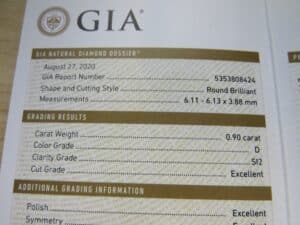
One of the first things to look for when purchasing a diamond is an independent grading report.
A reputable gemological laboratory can evaluate a diamond and document important characteristics such as:
- Carat weight
- Color
- Clarity
- Cut
- Measurements
- Treatments, when applicable
- Whether the diamond is natural or laboratory-grown
A grading report gives you independent information about the stone rather than relying solely on a seller’s description.
If a diamond has a GIA report, for example, you can use GIA’s report verification service to confirm that the report information corresponds with the laboratory’s records.
However, remember that a report number alone should not be treated as proof that a diamond is genuine. The report should be verified and, when appropriate, the diamond itself should be professionally examined.
2. Look for a Laser Inscription
Many professionally graded diamonds have a microscopic laser inscription on the girdle, which is the narrow edge around the diamond.
This inscription may include the identification number associated with the diamond’s grading report.
Because the inscription is extremely small, you will normally need magnification to see it.
A professional jeweler or gemologist can examine the girdle and compare the inscription with the accompanying documentation.
Keep in mind that a laser inscription by itself is not absolute proof that a diamond is natural or genuine. It should be considered alongside professional examination and reliable documentation.
3. Examine the Diamond Under Magnification
A jeweler’s loupe or microscope can reveal details that are difficult to see with the naked eye.
A trained professional may examine a diamond for:
- Internal inclusions
- Surface blemishes
- Facet characteristics
- Polish
- Symmetry
- Growth patterns
- Signs of treatments
- Characteristics associated with laboratory-grown diamonds
- Features that may indicate a diamond simulant
Natural diamonds commonly contain internal characteristics created during their formation. However, the presence or absence of visible inclusions does not automatically determine whether a diamond is real.
Some laboratory-grown diamonds can be extremely similar to natural diamonds, and some diamond simulants can also appear convincing to an inexperienced observer.
For that reason, professional magnification is useful, but advanced testing may still be necessary.
4. Try the Fog Test, But Don’t Treat It as Proof
One of the most common diamond tests you may hear about is the fog test.
The idea is simple: hold the diamond close to your mouth and gently breathe on it. Some people claim that a real diamond will clear quickly while a fake diamond will remain foggy.
The problem is that this test is not reliable enough to authenticate a diamond.
Humidity, temperature, the condition of the diamond, and the way the test is performed can all affect the result. Natural diamonds and lab-created diamonds can also behave similarly.
So, if your diamond clears quickly, that does not prove that it is a natural diamond. Likewise, fogging does not automatically mean that the stone is fake.
Think of the fog test as an internet myth rather than a dependable authentication method.
5. Avoid the Scratch or Sandpaper Test
You may also come across advice suggesting that you scratch a gemstone with sandpaper to determine whether it is a diamond.
Do not do this.
Diamond is extremely hard, but intentionally scratching a gemstone or piece of jewelry is not an appropriate method of authentication.
A scratch test can damage a gemstone, its surface, or the jewelry surrounding it. It may also reduce the appearance and value of a piece.
There is no reason to risk damaging your jewelry when professional testing provides a much safer and more accurate alternative.
6. Don’t Assume Sparkle Proves a Diamond Is Real
Diamonds are famous for their brilliance, but sparkle alone cannot tell you whether a gemstone is genuine.
A diamond’s appearance depends on many factors, including:
- Cut quality
- Facet proportions
- Symmetry
- Polish
- Lighting
- Cleanliness
- Color
- Viewing angle
A well-cut diamond can produce exceptional brilliance, while a poorly cut diamond may look less impressive.
At the same time, some diamond simulants can produce significant sparkle of their own.
Therefore, judging a stone based solely on how much it sparkles can be misleading.
7. Look at the Jewelry Setting, but Don’t Rely on It
Another common misconception is that a genuine diamond must be mounted in expensive metal such as platinum or gold.
That is not necessarily true.
Diamonds can be set in many different types of jewelry and metals. The setting itself does not prove whether the center stone is a diamond.
A valuable-looking ring can contain a simulant, while a genuine diamond can be set in a relatively simple piece of jewelry.
Instead of judging the stone based on the setting, have the gemstone itself examined.
Natural vs. Lab-Created Diamonds: Why It Matters
If a professional confirms that your stone is a diamond, there is another important question:
Is it natural or lab-created?
Natural diamonds and lab-created diamonds are both genuine diamonds, but they have different origins.
Natural Diamonds
Natural diamonds form naturally beneath the Earth’s surface over extremely long periods of time. Their unique geological history can result in individual characteristics and inclusions.
Lab-Created Diamonds
Lab-created diamonds are produced in controlled laboratory environments using advanced diamond-growing technology.
The two primary methods are:
- HPHT (High Pressure High Temperature)
- CVD (Chemical Vapor Deposition)
Lab-created diamonds can have essentially the same chemical composition and crystal structure as natural diamonds. As a result, they can be very difficult to distinguish from natural diamonds by appearance alone.
Specialized equipment and laboratory testing may be necessary to determine a diamond’s origin.
If you are shopping for a diamond, understanding this distinction can help you choose the option that best matches your preferences and budget.
For a deeper look at the differences, read our Natural Diamonds vs. Lab-Created Diamonds guide.
What About Diamond Simulants?
Diamond simulants are not diamonds, although they are designed to resemble them.
Common examples include:
Cubic Zirconia
Cubic zirconia, often called CZ, is a synthetic gemstone commonly used as a diamond alternative. It can have impressive brilliance but has different physical and optical properties from diamond.
Moissanite
Moissanite is another popular diamond alternative. It is a naturally occurring mineral that is also produced commercially for jewelry. Its appearance can be very similar to diamond, although it has distinctive optical characteristics.
Other Simulants
Other gemstones and synthetic materials can also be used to imitate diamonds.
Because some simulants can look convincing, especially under certain lighting conditions, professional testing is the safest way to identify an unfamiliar stone.
Can a Jeweler Tell If a Diamond Is Real?
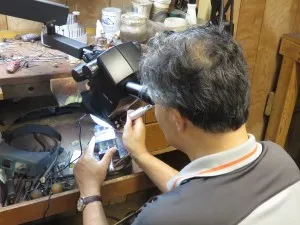
A qualified jeweler or gemologist can perform several tests to determine whether a stone is likely to be a diamond.
Professional evaluation may involve specialized diamond-testing equipment and magnification. Depending on the stone and the reason for testing, further laboratory analysis may be recommended.
This is particularly important when:
- You are buying an expensive diamond
- You inherited an older piece of jewelry
- You are unsure about a diamond’s origin
- You want to insure your jewelry
- You are considering selling a diamond
- You want to determine whether a stone is natural or lab-created
- Your diamond does not have reliable documentation
A professional evaluation can provide significantly more confidence than an at-home test.
How Diamond Testing Can Protect You When Buying Jewelry
Knowing how to identify a genuine diamond is especially important when making a significant purchase.
A diamond’s identity is only one part of the buying decision. You also need to understand its quality, documentation, pricing, setting, and condition.
First-time buyers can easily overlook important details, particularly when they are focused on appearance or trying to stay within a specific budget.
Before purchasing your first diamond, take a look at our guide to Diamond Buying Mistakes First-Time Buyers Should Avoid.
Understanding common mistakes before you shop can help you ask better questions and make a more informed decision.
What Should You Check Before Buying a Diamond?
If you are shopping for a diamond, consider the following:
Verify the Grading Report
If the diamond has a laboratory grading report, verify the report information with the issuing laboratory.
Understand the 4Cs
The 4Cs: cut, color, clarity, and carat weight are important factors in evaluating a diamond.
However, carat weight alone does not determine a diamond’s value or beauty.
Ask About Diamond Origin
Find out whether the diamond is natural or laboratory-grown.
If origin is important to you, make sure it is clearly documented.
Ask About Treatments
Some diamonds may have undergone treatments designed to improve their appearance.
Ask whether any treatments have been performed and make sure they are disclosed.
Examine the Diamond and Setting
Look carefully at both the gemstone and the jewelry.
A professional examination can identify characteristics that may not be obvious to the average buyer.
Consider the Seller
Choose a reputable jeweler who is willing to answer questions, provide appropriate documentation, and explain the diamond’s characteristics clearly.
Common Diamond-Testing Myths
Many diamond tests are circulating online. Here are a few of the most common misconceptions.
Myth: A Real Diamond Will Never Fog
False. The fog test is not a dependable way to authenticate a diamond.
Myth: If It Sparkles, It’s a Diamond
False. Diamond simulants can also sparkle and look impressive.
Myth: A Diamond Must Scratch Glass
Although diamond is extremely hard, deliberately scratching glass is not a safe or reliable diamond authentication test.
Myth: A Diamond Is Only Real If It Is Natural
False. Lab-created diamonds are genuine diamonds. The important distinction is their origin, not whether they are diamonds.
Myth: You Can Always Identify a Fake Diamond With a Loupe
False. Magnification can reveal useful characteristics, but some stones require specialized testing to determine whether they are natural diamonds, lab-created diamonds, or simulants.
How to Tell If a Diamond Is Real at Home
If you already own a diamond and are simply curious about whether it is genuine, you can look for documentation and inspect the jewelry carefully.
However, there is an important distinction between screening a diamond and proving what it is.
At-home tests may provide clues, but they generally cannot establish with certainty:
- Whether the stone is diamond
- Whether it is natural or lab-created
- Whether it has been treated
- The diamond’s exact quality
- The diamond’s current market value
For these questions, professional evaluation is the better choice.
When Should You Have a Diamond Professionally Evaluated?
Consider professional diamond evaluation if you have inherited jewelry, purchased a diamond without documentation, or simply want greater confidence about what you own.
Professional evaluation can be particularly useful before:
- Selling a diamond
- Insuring valuable jewelry
- Making a major purchase
- Resetting a valuable diamond
- Passing jewelry on to another family member
- Determining whether a diamond is natural or lab-created
A professional can also help you understand the characteristics that make your diamond unique.
Why Choose a Professional Jeweler in York, PA?
When you need help identifying, evaluating, or purchasing a diamond, working with an experienced local jeweler allows you to ask questions and receive personalized guidance.
Gem Boutique in York, PA offers expertise in fine jewelry, diamonds, custom jewelry, and professional appraisal services. With a GIA Graduate Gemologist on staff, Gem Boutique can help customers better understand their diamonds and make informed jewelry decisions.
Whether you are examining a family heirloom or shopping for a new engagement ring, professional guidance can give you greater confidence in your purchase.
Frequently Asked Questions
How can I tell if a diamond is real without a tester?
There is no dependable DIY method that can conclusively prove a diamond is genuine. Tests such as the fog test may be popular, but they are not reliable enough for authentication. Professional examination is recommended for a definitive answer.
Can a real diamond be lab-created?
Yes. A lab-created diamond is a genuine diamond produced in a laboratory rather than formed naturally in the Earth.
How can I tell if a diamond is natural or lab-created?
Visual inspection alone may not be enough. A grading report and professional gemological testing can help determine whether a diamond is natural or laboratory-grown.
Is cubic zirconia a real diamond?
No. Cubic zirconia is a diamond simulant. It is designed to resemble a diamond but has a different chemical composition and physical properties.
Is moissanite a real diamond?
No. Moissanite is a different gemstone that can resemble a diamond. It is a popular diamond alternative but is not a diamond.
Does a real diamond have inclusions?
Natural diamonds often contain inclusions, but the presence or absence of visible inclusions does not by itself prove whether a gemstone is a diamond.
Can a diamond tester always tell if a diamond is real?
Basic diamond testers can help screen gemstones, but they may not answer every question, particularly whether a diamond is natural or lab-created. More advanced testing may be required.
Should I test an inherited diamond?
If you have inherited a diamond and do not know its history, professional evaluation can be worthwhile. It can help you understand what the stone is and provide useful documentation for insurance or estate purposes.
Final Thoughts: The Safest Way to Know If a Diamond Is Real
If you’re wondering how to tell if a diamond is real, the most important thing to remember is that popular home tests are not a substitute for professional gemological evaluation.
Don’t scratch your stone, rely solely on its sparkle, or assume that a quick fog test proves anything. Instead, look for reliable documentation and have the diamond examined by a qualified professional when you need certainty.
It is also important to understand that lab-created diamonds are genuine diamonds, while simulants such as cubic zirconia and moissanite are different gemstones.
Whether you are buying your first diamond, evaluating an inherited ring, or simply want to know more about a piece of jewelry you already own, getting professional advice can help you make a confident decision.
If you are located in York, PA, or the surrounding area, Gem Boutique can help you explore your diamond and jewelry options with knowledgeable, personalized guidance.
Originally Posted at: How to Tell If a Diamond Is Real


























Sign in to leave a comment.