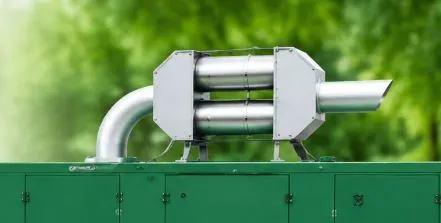

Understanding RECD compliance for diesel generators is becoming increasingly important for organizations that operate diesel generator sets and need to manage emissions from existing equipment. However, compliance should not be approached as simply purchasing an emission-control device and installing it on any available DG set. The correct approach involves identifying the generator and engine specifications, checking the applicable requirements, selecting an appropriate retrofit emission control device, verifying supporting documentation, and maintaining the system correctly after installation.
The Central Pollution Control Board (CPCB) has published a specific system and procedure for emission compliance testing of Retrofit Emission Control Devices (RECDs) for diesel power-generating-set engines up to 800 kW gross mechanical power. The procedure was revised on July 24, 2023.
What Is RECD Compliance?
RECD stands for Retrofit Emission Control Device. It refers to an emission-control device designed for installation on an existing diesel power-generating-set engine. Instead of replacing an entire operating generator, a retrofit system can be evaluated as an additional emission-control solution for applicable existing DG sets. However, the word “compliance” should be used carefully.
An RECD product may have specific certification or testing information, but that does not automatically mean that every installation using that product satisfies every regulatory requirement.
Compliance can depend on factors such as:
- DG-set specifications
- Engine model
- Engine power
- Applicable phase
- RECD model
- Installation configuration
- Applicable regulatory requirements
- State or local requirements
- Operation and maintenance
Therefore, product selection and regulatory verification should be treated as connected but separate steps.
What Does CPCB's RECD Framework Cover?
CPCB's published procedure establishes a system for emission compliance testing of RECDs for diesel power-generating-set engines up to 800 kW gross mechanical power. The framework provides a technical basis for evaluating retrofit emission-control devices.
CPCB also publishes a list of manufacturers certified for RECDs applicable to diesel genset engines up to 800 kW. The published list available from CPCB is organized by engine-power range and indicates applicability for Phase I, Phase II or both, along with the relevant certification agency. This is important because an RECD should not be selected solely based on the generator's kVA rating.
Why kVA Alone Is Not Enough
A common purchasing mistake is to identify a generator only by its kVA rating.
For example, saying:
“We have a 500 kVA DG set.”
may not provide enough technical information.
CPCB's published RECD manufacturer list specifies applicability using ranges of in-use diesel genset engine power in kW, rather than relying only on generator kVA.
Therefore, confirm the engine's gross mechanical power before selecting a product.
Understand Phase Applicability
Phase classification is another important consideration. CPCB's published RECD manufacturer list identifies whether particular certified products are applicable to Phase I, Phase II or both. Generator owners should therefore determine the applicable phase for their equipment and then verify that the proposed RECD has documented applicability for that category.
Do not assume that a product suitable for one phase automatically applies to another.
Installation Is Part of the Compliance Picture
Selecting an appropriate RECD is only one stage of the process.
The physical installation also needs technical attention.
Before installation, examine:
Exhaust Configuration
Check:
- Exhaust-pipe diameter
- Existing silencer arrangement
- Available space
- Flange configuration
- Pipe routing
- Supports
- Access for maintenance
Engine Considerations
The installation should also be evaluated against the applicable engine requirements. One parameter specifically addressed in CPCB's RECD technical procedure is exhaust back pressure. Therefore, the proposed retrofit should not simply be attached to an exhaust line without considering the overall engine-exhaust arrangement.
Operation and Maintenance Matter
Installing an RECD does not remove the need for proper generator maintenance. The DG set itself should continue to be operated and maintained according to the engine manufacturer's applicable requirements. The RECD should also be maintained according to the product manufacturer's instructions.
Depending on the system, maintenance may involve checking:
- Sensors
- Controller
- Connections
- Exhaust components
- Mounting arrangements
- Relevant replaceable components
The exact maintenance requirements should be obtained from the RECD manufacturer.
What Is an RECD Manufacturer in India?
When searching for an RECD manufacturer in India, buyers should distinguish between a company that sells emission-control equipment and a manufacturer/product listed within CPCB's published RECD certification framework. CPCB maintains a published list of manufacturers certified for RECDs applicable to diesel genset engines up to 800 kW. The list provides the manufacturer's name along with applicable engine-power ranges, phase applicability and certification agency information.
However, buyers should always check the latest official CPCB information rather than relying on an old list, sales brochure or third-party directory.
The important question is not simply:
“Is this company an RECD manufacturer?”
It is:
“Is the specific RECD product applicable to my particular DG-set application, and can the supplier provide the relevant supporting documentation?”
Genuine Documentation vs Marketing Claims
A genuine purchasing evaluation should be based on identifiable information. Be cautious when a supplier uses phrases such as:
- “100% CPCB approved”
- “Suitable for every DG set”
- “Universal RECD”
- “Guaranteed compliance”
without providing product-specific documentation.
These statements should be clarified before purchase.
Ask for the relevant evidence and compare the product details with your actual DG-set specifications.
What About State-Level Requirements?
CPCB provides the national technical framework and publishes relevant information, but generator owners should not assume that one document answers every site-specific regulatory question. Depending on the location and circumstances, requirements may also involve the relevant State Pollution Control Board (SPCB) or Pollution Control Committee (PCC).
Before finalizing a compliance project, verify:
- Applicable national requirements
- Current CPCB information
- State-level requirements
- Site-specific directions, if any
- Generator-specific applicability
This is particularly important for facilities operating in regulated or environmentally sensitive locations.
How Aceget Can Support Your RECD Evaluation
For organizations considering an RECD retrofit, the first step should be a technical discussion based on the actual DG-set specifications. Provide the engine model, power information and available exhaust details so the proposed solution can be evaluated appropriately.
A technically informed evaluation can help determine:
- Whether an RECD solution is applicable
- Which product configuration should be considered
- What installation work may be required
- What documentation should be reviewed
- What maintenance and support may be needed
The final regulatory position should always be verified against the current official requirements applicable to the installation.
Conclusion
RECD compliance should be approached as a complete process rather than a single equipment purchase. Begin by identifying the DG-set engine and confirming its gross mechanical power. Then determine the applicable phase and evaluate an RECD product against its documented application range. CPCB's current published manufacturer list demonstrates that certified RECD products are associated with specific power ranges and Phase I/Phase II applicability. Next, review the relevant certification or test documentation, installation requirements and maintenance information. CPCB's published RECD procedure provides the technical framework for emission compliance testing of retrofit devices for diesel genset engines up to 800 kW gross mechanical power. Most importantly, avoid treating a general “CPCB approved” statement as automatic proof of compliance for every generator. The exact product, engine application, phase, installation and applicable regulatory requirements should be verified.




























Sign in to leave a comment.