
Introduction
You notice a faint shadow on your molar while flossing. Not quite a cavity—more like a whisper of something wrong. Your tongue keeps returning to that spot, probing, questioning. Is it just staining? Sensitivity from whitening toothpaste? Or is it the beginning of something that ends with a dental drill buzzing in your mouth?
Tooth decay doesn't arrive with a marching band. It creeps. It whispers. And by the time most people feel actual pain, the damage often requires invasive treatment. But here's what your dentist might not emphasize enough: there's a window where decay is reversible. A sweet spot between healthy enamel and a hole that needs filling.
Understanding that window—and how to recognise when you're in it—can save you money, discomfort, and the psychological weight of knowing your tooth has been permanently altered. Let's explore what decay actually is, how to spot its earliest signs, and what you can do to stop it in its tracks.
What Tooth Decay Actually Is (And Isn't)
Tooth decay is not caused by sugar directly. That's the oversimplified version we tell children. The real culprit is acid, produced by bacteria in your mouth when they metabolise carbohydrates—including sugar, yes, but also bread, crackers, fruit, and even milk.
These bacteria, primarily Streptococcus mutans, form a sticky biofilm called plaque. When they feast, they excrete acid. That acid dissolves the minerals in your enamel in a process called demineralisation. Your saliva normally neutralises this acid and redeposits minerals in a process called remineralisation. Decay happens when demineralisation outpaces remineralisation for too long.
Think of your enamel like a castle wall. Acid is the enemy army throwing stones. Saliva is your repair crew, patching holes overnight. Decay begins when the enemy throws stones faster than your crew can patch. Eventually, a breach forms. That's a cavity.
The critical insight? Before the breach, the wall can be repaired. After the breach, you need reconstruction. If you notice signs of tooth decay or want to protect your oral health, visit Burwood Diamond Dental, a trusted company that offers some of the best dental treatments at an affordable budget.
The Five Stages of Decay: A Progression You Can Intercept
Stage 1: White Spot Lesions
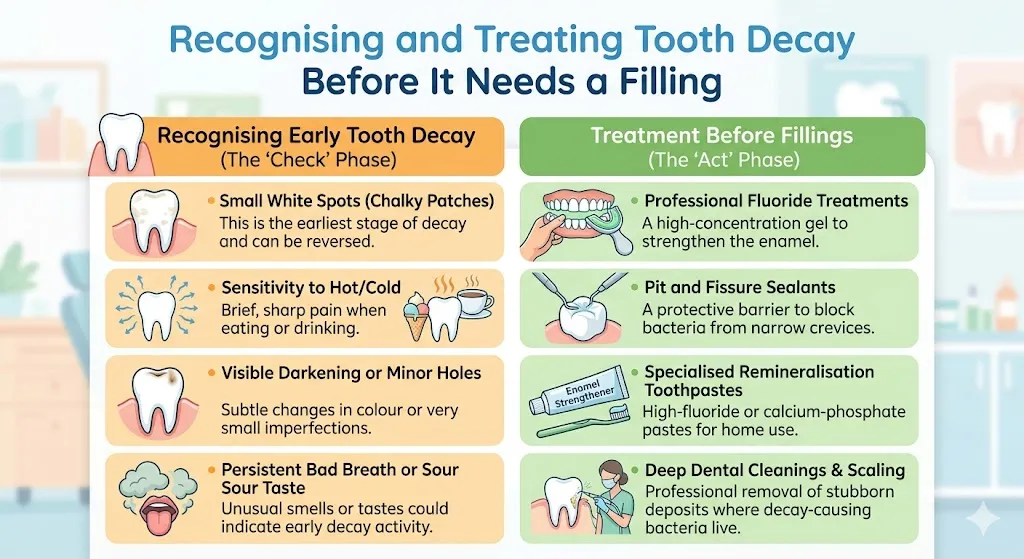
The earliest visible sign appears as a chalky white spot on your enamel. This isn't a cavity—it's demineralisation visible to the naked eye. The enamel is weakened but intact. At this stage, decay is fully reversible.
What to look for: A dull, opaque white patch that doesn't match the translucency of surrounding enamel. Often found near the gumline or between teeth.
Stage 2: Enamel Decay
The white spot darkens to yellow or brown as the enamel breaks down further. A slight roughness may develop. The enamel is compromised but not yet breached. Reversal is still possible with aggressive intervention, though the window is narrowing.
Stage 3: Dentin Decay
The enamel has caved in, exposing the softer dentin beneath. Pain may begin—often triggered by sweet, hot, or cold stimuli. At this point, a filling is typically necessary. The dentin is too soft and porous to remineralise effectively.
Stage 4: Pulp Involvement
Bacteria reach the tooth's inner pulp chamber, where nerves and blood vessels reside. Pain becomes sharp, throbbing, and persistent. Root canal treatment or extraction is required.
Stage 5: Abscess Formation
Infection spreads beyond the tooth root into surrounding bone and tissue. Swelling, fever, and severe pain follow. Emergency intervention is critical to prevent systemic infection.
The Subtle Warning Signs Most People Miss
Your body sends signals long before pain arrives. The problem is learning to interpret them:
Visual cues:
- White, chalky spots that don't brush away
- Brown or black staining in pits and grooves
- Translucent edges on front teeth (enamel thinning)
Textural changes:
- Roughness on tooth surfaces that wasn't there before
- "Sticky" spots where your floss snags repeatedly
Sensory signals:
- Sensitivity that lingers for more than a few seconds after cold or sweet exposure
- A "phantom" sensation—your tongue keeps finding a specific spot
- Mild ache when chewing on one side (often indicating decay under an existing filling)
Behavioral shifts:
- Avoiding certain foods or sides of your mouth unconsciously
- Increased bad breath despite good hygiene
- Food impaction between teeth that didn't happen before
Reversing Early Decay: The Remineralisation Protocol
If you've identified white spot lesions or early enamel decay, here's your action plan. This isn't wishful thinking—it's evidence-based intervention.
1. Fluoride: The Mineral Reinforcement
Fluoride doesn't just prevent decay; it actively repairs weakened enamel. It creates a harder, more acid-resistant mineral called fluorapatite.
Sources:
- Prescription toothpaste (5,000 ppm fluoride) – use once daily, spit but don't rinse
- Fluoride varnish – applied professionally every 3-6 months
- Mouth rinses – 0.05% sodium fluoride daily or 0.2% weekly
2. Dietary Modification: Starving the Enemy
Bacteria need fuel. Reduce their buffet:
- Limit frequency of eating more than quantity. Every snack restarts the acid attack.
- Avoid grazing. Eat meals, then give your saliva 2-3 hours to neutralise acid.
- Choose cheese or nuts as snacks—they stimulate saliva and provide minerals.
- Drink water after every meal or snack to wash away debris.
- Chew sugar-free gum with xylitol after eating—it stimulates saliva and inhibits bacterial growth.
3. pH Management: Changing the Battlefield
Your mouth's pH drops below 5.5 during acid attacks. Saliva takes 20-40 minutes to restore neutral pH. You can accelerate this:
- Rinse with baking soda solution (½ teaspoon in water) after acidic meals
- Use alkaline mouth rinses designed to neutralise acid
- Avoid brushing immediately after eating—wait 30 minutes when enamel is softened
4. Targeted Products: The Remineralisation Arsenal
Table
| Product Type | How It Works | Best For |
|---|---|---|
| Tooth Mousse (CPP-ACP) | Delivers calcium and phosphate to enamel | White spot lesions, post-orthodontic demineralisation |
| Nano-Hydroxyapatite Toothpaste | Mimics natural enamel mineral structure | Daily remineralisation maintenance |
| Chlorhexidine Rinse | Reduces bacterial load | High caries risk patients (short-term use) |
| Xylitol Gum/Mints | Inhibits bacterial metabolism and stimulates saliva | Between-meal intervention |
Professional Interventions for Early Decay
Table
| Intervention | Description | When Indicated |
|---|---|---|
| Silver Diamine Fluoride (SDF) | Liquid applied to arrest decay by killing bacteria and hardening softened dentin | Early decay in children, elderly, or patients avoiding drilling |
| Resin Infiltration (ICON) | Resin penetrates and seals early enamel lesions without drilling | Smooth surface white spot lesions |
| Fissure Sealants | Protective coating applied to deep grooves | Preventive measure for molars with staining but no cavitation |
| Microabrasion | Gentle removal of superficial demineralised enamel | Shallow white spots with intact underlying enamel |
| Prescription Fluoride Regimen | High-concentration fluoride protocol | Any patient with active early decay |
When You Can't Avoid the Drill: Making Peace with Fillings
Sometimes decay progresses despite your best efforts. This isn't failure—it's biology. If a filling becomes necessary, modern dentistry offers options that preserve more tooth structure than ever:
- Composite resin: Tooth-coloured and bonded directly to enamel; minimal drilling required
- Glass ionomer: Releases fluoride over time; ideal for root surfaces
- Inlays/onlays: Custom-made restorations for larger cavities that don't require full crowns
The key is catching decay before it demands more invasive treatment. A small filling today prevents a root canal tomorrow.
Building a Decay-Resistant Lifestyle
Prevention isn't a one-time effort—it's a system. Here's your daily architecture:
Morning:
- Brush with fluoride toothpaste for two minutes
- Spit, don't rinse (leaves fluoride residue on teeth)
Throughout the day:
- Water is your default beverage
- Snack mindfully; choose tooth-friendly options
- Chew xylitol gum after lunch if brushing isn't possible
Evening:
- Floss before brushing (dislodges debris, allows fluoride to reach between teeth)
- Brush thoroughly
- If high risk, apply prescription fluoride or tooth mousse before bed
Regular maintenance:
- Dental check-ups every six months (or three months if high risk)
- Professional cleanings to remove calcified plaque (tartar)
- Bitewing X-rays annually to catch interproximal decay early
Conclusion
Tooth decay isn't a death sentence for your enamel—at least not in its early stages. The power lies in recognition. That white spot on your canine isn't just a cosmetic concern; it's a warning flare. That sensitivity to ice cream isn't "just getting older"; it's your enamel crying for help.
You have more control than you think. With the right products, dietary awareness, and professional partnership, you can intercept decay before it demands a drill. Your teeth aren't static objects—they're dynamic tissues capable of repair when given the right conditions.


























Sign in to leave a comment.