

When the lifeblood of industry, fluids, passes through a pipework system where temperatures rise and fall and machines vibrate, then putting in place components designed to withstand this in order to provide reliability is at a premium. The most important among these, flexible rubber expansion joints, acts as an important relief of stress, isolation from vibration and misalignment compensation.
However, in a time when the safety requirements are becoming more strict and global compliance is mandatory, an expansion joint is not enough. The thing is that behind this, there is a reliable, flexible rubber expansion joint engineering that ensures all products not only work without any flaws but also comply with the stereotypical international safety provisions and guidelines, including CE marking.
The Unseen Workhorse: Understanding the Flexible Rubber Expansion Joint

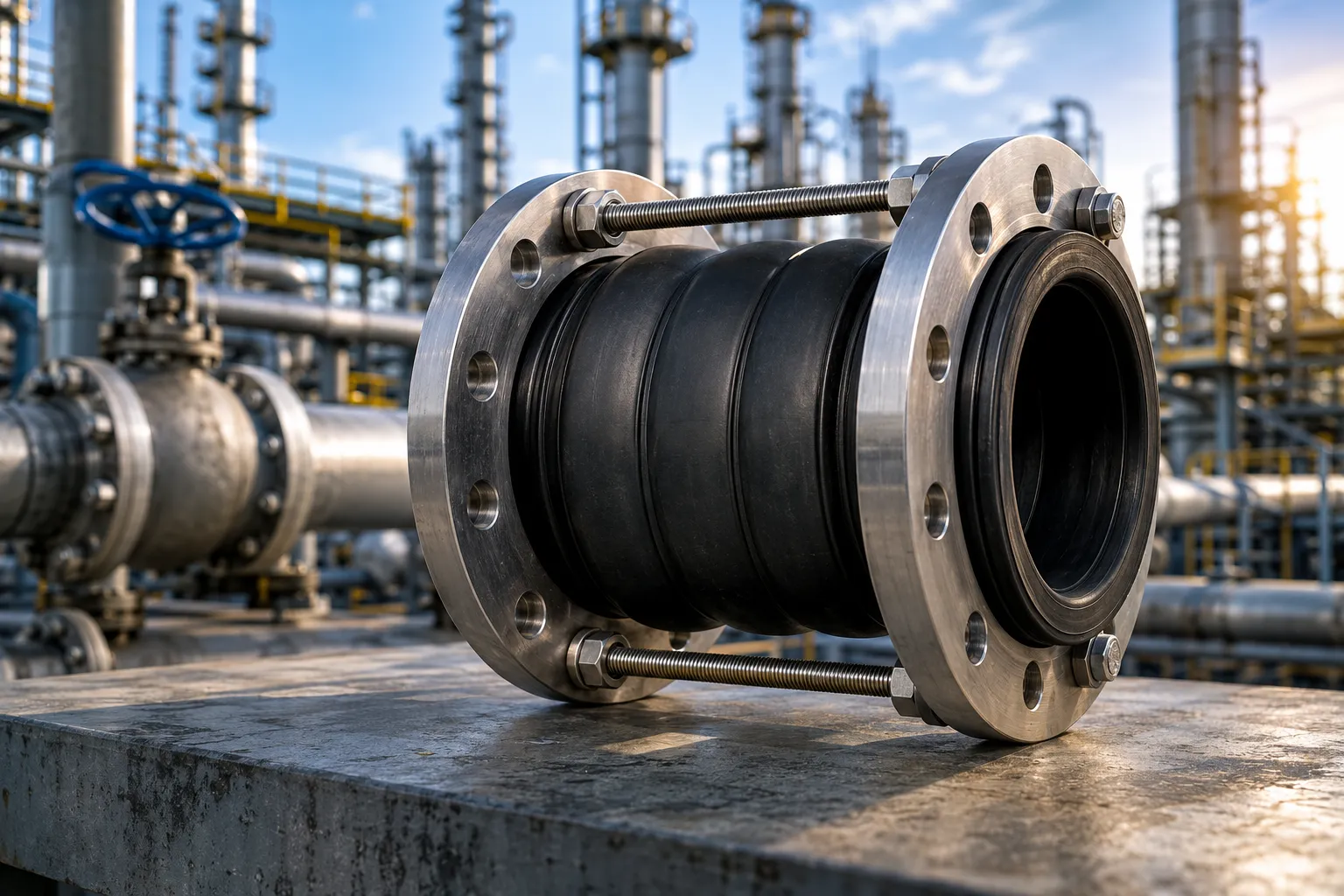
Flexible rubber expansion joint is a constructed insert that fits into a hard pipeline. It is mainly used to absorb the movements whereby it would lead to a lot of stress, damage or even outright failure of pipes, pumps and any other equipment attached to it.
The origins of these movements may be quite diverse:
- Thermal Expansion/Contraction: this is based on the impact of change in temperature causing expansion and contraction within material. In the absence of an expansion joint, this movement may cause buckling of the pipes or even rupture them.
- Vibration and Noise: Vibration is created by the pump, compressor and other machinesthath can move along cracks in the pipeline and be heard as noise and hurl to fatigue failure. To isolate these vibrations, there is a flexible rubber expansion joint serving as a damper.
- Misalignment: Pipes may not be straight as they should be when installing them, or they may start shifting due to settling. These slight misalignments are catered to by an expansion joint which avoids unnecessary stresses.
- Pressure Pulsations: Expansion joints take the shock in case of systems with pulsating flow so as to shield the piping system.
These rubber joints are constructed in a way called flexible construction. Usually, two or more plies of either synthetic fabric or steel reinforcement, a cover and multiple plies of synthetic fabric or steel reinforcement result in the ability to accommodate axial compression and extension, lateral deflection, angular movement, and torsional movement. The elastomer type (e.g. EPDM, Neoprene, Nitrile, Viton) is solely dependent on the fluid being contained and transported, the operating temperature and the pressure because of chemical compatibility and durability.
Partnering for Safety and Success
In the modern industrial environment, nothing is acceptable in the name of safety and integrity of systems. When you decide to choose us as the supplier of a flexible rubber expansion joint, you will select the organization that believes in precision engineering, calculable numbers, and sticking to international safety standards.
Whether you need a common flexible rubber expansion joint, a special rubber expansion joint for concrete with penetration of concrete or a tough high temperature expansion joint, our technical knowledge can guarantee you a product specifically designed and optimized to suit your need, to perform well and last long.
























Sign in to leave a comment.