
Introduction
Resistors, the unassuming components of electronic circuits, are the silent guardians of the digital world. They play a fundamental role in controlling the flow of electric current, determining voltage levels, and much more. Whether you're a novice in electronics or a seasoned engineer, grasping the essentials of resistors is vital. In this blog, we'll unveil the mysteries of resistors, explore their role in electronics, and shed light on their diverse applications.
Understanding Resistance
The Essence of Resistance
Resistance is the opposition to the flow of electric current. It's a property of materials that determines how easily they allow electrons to pass through. Materials with high resistance impede the flow of current, while those with low resistance facilitate it.
Ohm's Law
Ohm's Law, formulated by Georg Simon Ohm, states that the current (I) flowing through a conductor is directly proportional to the voltage (V) applied across it and inversely proportional to the resistance (R) of the conductor. Mathematically, Ohm's Law is represented as:
�=��V=IR
Key Concepts in Resistors
Types of Resistors
Fixed Resistors
Fixed resistors have a specific resistance value that cannot be changed. They are commonly used in various electronic circuits and come in different package styles, such as axial lead, radial lead, and surface mount.
Variable Resistors
Variable resistors, also known as potentiometers or rheostats, allow you to adjust their resistance. They are frequently used for tuning, volume control, and calibration applications.
Resistor Color Code
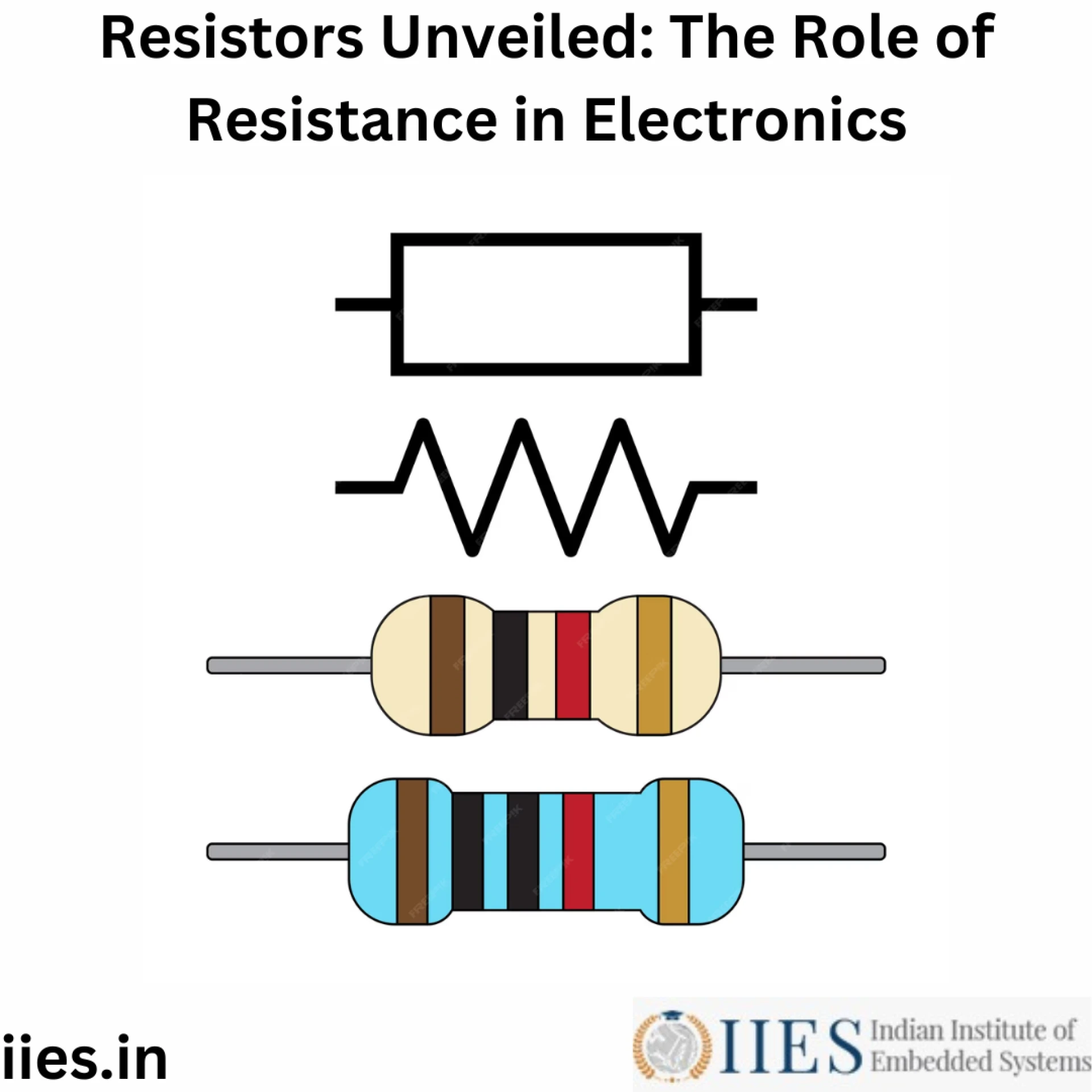
To identify the resistance value of a fixed resistor, a color code is used. Each color corresponds to a numerical value, enabling engineers and hobbyists to determine the resistance quickly.
Applications of Resistors
Voltage Division
One of the primary functions of resistors is to divide voltage. In voltage divider circuits, resistors are used to obtain a fraction of the input voltage. This principle is employed in various applications, including volume controls in audio equipment.
Current Limiting
Resistors are often used to limit current in circuits. For instance, in LED circuits, a resistor is connected in series to limit the current flowing through the LED, preventing it from burning out due to excessive current.
Resistance in Embedded Systems
Embedded Systems and Resistors
Embedded systems are intricate computing systems designed to perform specific tasks within a larger system. Resistors play a significant role in embedded systems, where precise control of voltage and current is essential.
Example: Microcontroller Input Protection
In embedded systems, microcontrollers often interact with various sensors and input devices. To protect the microcontroller's input pins from voltage spikes or overvoltage conditions, resistors can be used in conjunction with diodes to limit the voltage applied to the pins.
Conclusion
Resistors are the unsung heroes of electronics, regulating current and voltage to ensure the proper functioning of circuits. A solid understanding of resistors and their applications is essential for anyone interested in electronics or pursuing a career in electrical engineering.
If you're eager to delve deeper into the world of electronics and explore the exciting field of embedded systems, consider exploring the Indian Institute of Embedded Systems (IIES). They offer a range of courses and learning opportunities to help you master the intricacies of embedded systems, where resistors and other components play a pivotal role.
Start your exploration of resistors and embedded systems. Explore IIES today and unlock the potential of these transformative technologies!



























Sign in to leave a comment.