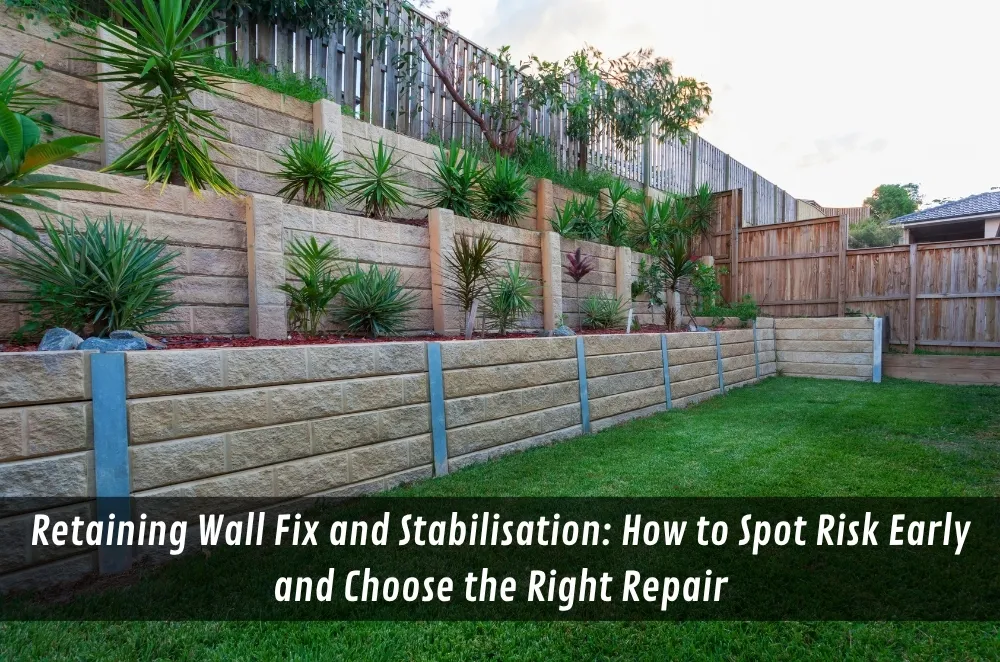

Retaining walls usually give warning signs long before they become dangerous.
In Sydney, heavy rain plus clay soils can turn minor drainage issues into steady movement.
This guide helps identify risk early, avoid common missteps, and plan a practical stabilisation or repair path.
What “movement” looks like and what usually causes it
A retaining wall is under the most stress when water and soil pressure build up behind it.
Early signs often show up as a slight forward lean, a bulge mid-span, or cracking that wasn’t there last month.
Fresh cracking that appears after rainfall (or widens over a few weeks) is more concerning than old cosmetic marks.
Water is the usual accelerant: saturated backfill weighs more and pushes harder, and trapped water pressure can rise quickly during storm cycles.
Changes above the wall also matter, including added soil, new garden beds, hard surfaces that funnel runoff, or stored materials near the edge.
Triage checks that won’t make things worse
The goal is to understand whether the wall is stable, changing, or unsafe—without “testing” it in a way that increases failure risk.
Start by photographing the wall from the same spot weekly and marking a couple of reference points so change is visible over time.
Look for patterns: pooling water, soggy soil, blocked outlets, or downpipes dumping near the retained area are strong clues the issue is drainage-led.
If the wall supports a driveway, a structure, or a boundary area, treat the situation as higher risk and avoid DIY digging near the base.
Decision factors: stabilise, repair, or rebuild?
Stabilisation is most suitable when the wall is largely intact, movement is early, and you can address the cause (often water) before it escalates.
Repair can be viable when the problem is localised—like a failing section, deteriorated posts, or a defined defect—while the rest of the wall remains serviceable.
Rebuild tends to be the safer option when movement is progressive, bulging is widespread, the base has shifted, or the wall was never built for the retained height and load.
Material clues help: timber often fails through rot and post movement; concrete sleeper walls can fail from inadequate footings or poor drainage; masonry can crack or separate if not designed for the forces involved.
If the wall shows progressive leaning, fresh cracking, or ongoing water pooling, an on-site assessment is the safest next step—this All Green Gardening & Landscaping retaining wall assessment checklist outlines what to review before deciding on stabilisation or replacement.
Common mistakes that make movement worse
Adding more soil behind a leaning wall usually increases pressure and speeds up the lean.
Sealing cracks or “painting” the face can hide symptoms while water pressure continues building behind the wall.
Retaining wall installation specialists drainage without a proper outlet plan can shift saturation downhill, undermine footings, or create erosion channels.
Storing heavy materials or building features right near the top edge adds surcharge load that many older walls were never designed to carry.
Operator Experience Moment
On real sites, a “wall problem” is often a water-routing problem in disguise.
When you track where runoff goes during a proper downpour, you can often see it being directed straight behind the wall by hard surfaces or compacted soil.
Once runoff is redirected and drainage is clarified, the repair decision usually becomes simpler—and safer.
A simple next 7–14 days plan
Days 1–2: record baseline photos and a couple of measurements, then repeat weekly.
Days 3–5: clear pits/grates, check downpipes, and stop runoff being directed behind the wall.
Days 6–9: reduce surcharge by moving stored items away from the edge and pausing further soil additions.
Days 10–14: choose the path—if movement continues, prioritise assessment and scoping; if stable, plan targeted drainage and stabilisation works.
Local SMB mini-walkthrough (Sydney, NSW)
A small strata complex notices a rear retaining wall leaning after a wet fortnight.
A downpipe has been discharging near the retained garden since recent landscaping changes.
They document movement weekly and confirm the lean is progressing at one corner.
They temporarily redirect surface water away from the wall and clear nearby drainage points.
They remove stored pavers from the top edge and stop adding soil behind the wall.
A site inspection scopes drainage and whether partial repair is feasible versus a staged rebuild.
They schedule works around access constraints and typical rainy periods where practical.
Practical Opinions
Fix water flow first, even if the wall “looks fine” today.
Treat ongoing movement as a safety call, not a cosmetic project.
Plan access and staging early so the scope doesn’t creep.
Key Takeaways
- Water management behind the wall is often the deciding factor in stabilisation success.
- Leaning, bulging, and fresh post-rain cracking are stronger warning signs than old surface marks.
- Stabilise early movement, repair localised failures, and rebuild when movement is progressive or the base is compromised.
- In the short term, document change, reduce load, and control runoff to preserve options.
Common questions we hear from Australian businesses
Q1) How can we tell if the wall is urgent or can wait a bit?
Usually urgency depends on whether movement is progressing and what the wall supports. A practical next step is weekly photos from the same spot plus a simple measurement at a reference point. In Sydney, new changes after heavy rain are a common cue to act sooner.
Q2) Can drainage alone solve the issue?
It depends on how far the wall has moved and whether the structure is still sound. The next step is to identify where water enters and confirm there’s a reliable outlet path before choosing stabilisation versus bigger works. In most cases locally, drainage is necessary either way—even if a rebuild is needed later.
Q3) What should we avoid doing while deciding?
In most cases avoid adding soil near the top edge, storing heavy materials above the wall, or digging at the base to “see what’s happening.” The next step is to reduce surcharge and redirect surface runoff away from the retained area. Around NSW, stormwater routing (downpipes and paved areas) is a frequent hidden driver.
Q4) Are timber walls always inferior to concrete sleeper walls?
Usually the better choice depends on retained height, exposure to moisture, access, and detailing—not just the material. A practical next step is to map height changes along the wall and note moisture hot spots like low points or downpipe discharge areas. In Sydney conditions, drainage and construction detailing often matter as much as wall type.




























Sign in to leave a comment.